Treasury

Question: how much do we contribute towards the EU budget?

Answer: it depends on how you look at it. I’ve put together the chart below (click for a larger version), which sets how much money we’ve given the the EU since 1973. There are three lines for each year: i) our gross contribution, ii) our total contribution (which is the gross contribution minus the money we get back from the rebate), and iii) the net contribution (gross contribution minus both the rebate and the money that the Treasury gets to pay for various EU projects across the UK). In terms of how much the EU costs the taxpayer, then, I’d say the second line is the best one to follow:

Another fine mess | 28 October 2010

You know that child benefit cut for higher-rate taxpayers? Yeah, well, it may not be quite as straightforward as the government have hitherto indicated. In an important post on his Wall Street Journal blog, Iain Martin sets out a problem that is exercising nerves and minds in the Treasury: simply put, there’s no existing method for establishing whether mothers (who receive child benefit) are living in a household which pays tax at the higher rate. In effect, this means that the policy is “unenforceable” – although there are some possible solutions, as Iain points out: “I hear that ministers are considering (and tell me which part of the rest of

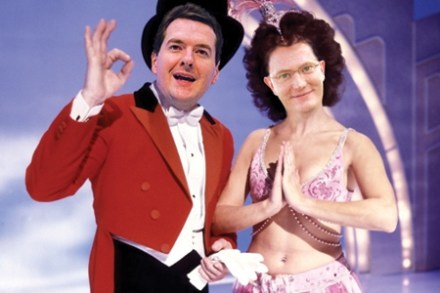
Osborne's Paul Daniels strategy

Is George Osborne the first British Chancellor to hide good news in the small print? I ask this in my News of the World column (£) today, and ask what he’s up to. Listening to Nick Clegg on Marr this morning, even he can’t quite say that the same forecasts that predict 500,000 public sector job losses also envisage three times as many jobs created in the private sector. Why so coy? I suspect because it would spoil the magic. That there is a deliberate gap between what this government is saying and what it believes it is doing.   James Forsyth was the first to write (in his political

Clegg hits back at the IFS

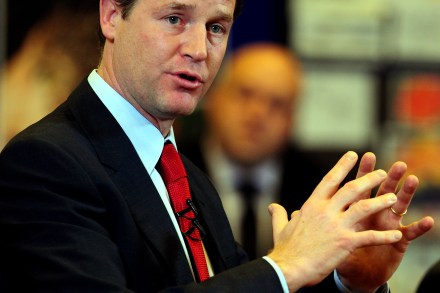
It’s fast becoming a tradition: when the IFS calls the government’s work “regressive,” send for Nick Clegg to take the think tank on. He wrote an article for the FT debunking their analysis back in August. And, today, he does the same via an interview in the Guardian. It’s pretty forceful stuff from the Deputy PM, as this quote testifies: “I think you have to call a spade a spade. We just fundamentally disagree with the IFS. It goes back to a culture of how you measure fairness that took root under Gordon Brown’s time, where fairness was seen through one prism and one prism only which was the tax

The Tory response to Osborne's Spending Review

George Osborne was well received by the 1922 committee of Tory backbenchers when he addressed them on the spending review earlier. There was much thumping of desks, the traditional sign of approval at meetings of the ‘22.   Talking to Tory MPs this afternoon, they are pretty happy with the package. They are glad that the money being taken out of the welfare budget means that the departmental cuts are less than expected. Overall, they think the package is politically sellable and has denied Labour that many targets.   One concern is about how local councils, including Conservative ones, might react to a 28 percent cut in their funding from

The departmental cuts

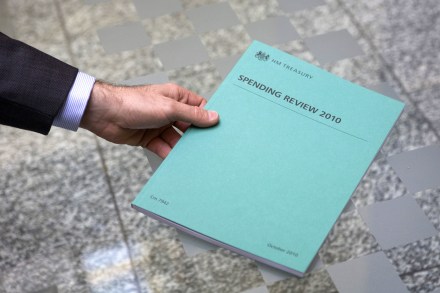
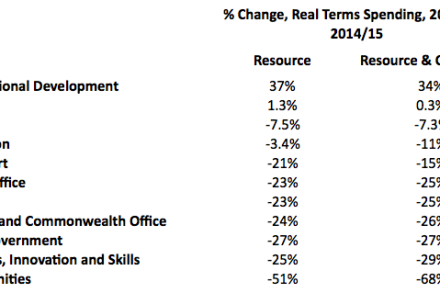
The Spending Review document is available here, but we’ve collected the cuts facing some of the main departments in the table below. This is not the complete picture of Osborne’s announcements today: much of the action takes place in the separate social security budget, but we’ll have more on that shortly.

On the eve of the cuts

In economic terms, the role of the Comprehensive Spending Review is a fairly straightforward one: to set Departmental Expenditure Limits for every government department, and outline some of the policy measures that will be undertaken to keep spending within those limits.   Fraser Nelson has already ably summarised the real impact that the spending review will have on public expenditure, so I won’t go into that here. Suffice it to say that, yes, the cuts are significant but, no, they aren’t nearly as severe as the BBC would have us believe.    But just as interesting as the cold, hard numbers themselves is what they will tell us about the

Putting the cuts into context

Having been accused of being a “pain denier” by Tim Montgomerie yesterday, I’d like to quickly defend myself. In my News of the World column, I sought to put this in some perspective. I put in the fact that has been reported nowhere: that we know what the cuts will be. Total cuts to government spending will be 3.7 percent, spread over four years. It is debt interest which forces departmental cuts down to an average of 13 percent, again spread over four years. There will of course be real pain, for thousands of workers facing redundancy. For commuters facing a huge 30 percent rail fare increase. But when trying

The true scale of the cuts

George Osborne likes to spend his weekends at Dorneywood, the chancellor’s official residence near Slough, but I doubt this one will be  particularly enjoyable. He will be burning the midnight oil as he prepares next Wednesday’s spending review. No doubt he will also be taking calls from ministerial colleagues, muttering dark threats about aircraft carriers, the arts, sport, the roads budget, overseas consulates – you name it. And just when the numbers all add up he will probably have to start all over again after discovering that No10 has  promised to save some wind turbines because Steve Hilton bumped into somebody at a drinks party.   Meanwhile, we can expect

Privatization revisited

The similarities between now and the early years of the Thatcher government can easily be overplayed. Yes, there are parallels: a public sector grown fat on government profligacy, unions leaders stirring up resentment, and a government unsure about quite how radical it wants to be. But there are clear differences too: the political dynamics, the industrial landscape, and, indeed, the magnitude of the fiscal crisis. Nevertheless, there is at least one successful Thatcher-era policy that is desperately due a comeback: privatisation. It won’t have escaped many CoffeeHousers’ notice that, despite the tough talk on the deficit, the government is still borrowing almost £20m per hour. The cost of servicing our

Counting down to the spending review

Only one week to go, folks, until the main event itself: the Comprehensive Spending Review. And judging by this morning’s papers, the Treasury have almost settled on their final acts. Only the welfare, eduction and defence budgets have any significant question marks hanging over them. Those question marks, though, are fading fast. A story in this morning’s Times (£) reports that David Cameron has endorsed the building of two aircraft carriers, but has decided to delay the Trident upgrade until after 2015. No, strictly speaking, he’s not going back on this. Rather, the idea is that the coalition will keep on working towards a replacement for Trident between now and

Jim Murphy for Shadow Chancellor?

Good stuff from Iain Martin: [Ed Miliband will] have to deal with Ed Balls and Yvette Cooper. Balls is an impressively robust “big beast” who wants to be shadow Chancellor, but Ed Miliband may not fancy sub-contracting his economic policy to someone so tricky to control. Subverting Lyndon Johnson’s famous rule, keeping Ed Balls inside the tent makes no difference – he’ll probably still urinate on his colleagues. Indeed. The Balls Problem is a tricky one. Ed Balls is a fine attack dog perhaps the best, certainly the most ferocious, Labour have. But if Miliband gives Balls the Treasury brief there’s every chance that the Shadow Chancellor will eclipse the

Delaying the cuts

Put aside all the post-match analysis of David Cameron’s speech: the most intriguing story in the papers this morning is this one in the FT. It claims that the Treasury is working on plans to “reprofile” the spending cuts, which basically means “delay” them. The idea would be to push the bulk of the cuts back to the end of this Parliament. And the underlying concern is, apparently, that early cuts could trigger various financial penalties, such as those for breaking contracts. The paper even suggests that ministers are worried that, “deep deficit reduction in 2011-12 could undermine the fragile recovery.” The Treasury have firmly denied the story, and I’d

Taxing issues

Today was a reminder of the tax change that would give Tory re-election chances a massive boost, raising the threshold at which the higher rate kicks in. Indeed, electorally dealing with this is far more important than the abolition of the 50p rate and has been made more so by the decision to link the withdrawal of child benefit to the higher rate. During Gordon Brown’s time at the Treasury, the number of people paying the higher rate almost doubled – principally because of fiscal drag, Brown didn’t link the threshold to earnings. This means there are a whole slew of people paying higher rate tax who are comfortably off

Osborne can go even further on middle-class benefits

George Osborne had been expected to subject child benefits to tax. Instead he is to abolish them entirely for higher-rate taxpayers. I’ve spent this morning talking to friends, whose judgment I respect, who are furious about Cameron hitting the squeezed middle. I cannot agree, and here’s why. We are not talking about the “squeezed middle” here – of the 30.5 million income tax payers in Britain, just 3 million pay the top rate of tax (figures here). They’re the best-paid 10 percent – and I have never worked out why the tax of the average worker (who’s on £22k) should be higher to afford the payment to those on twice

OBR Watch

When Sir Alan Budd was head of the Office for Budget Responsibility, there was an insistent argument in opposition circles that the independent body was biased in favour of the coalition. Much of this cented around the OBR’s growth predictions. How on Earth, came the question, can growth hit 2.3 percent next year and 2.8 percent the year after? Isn’t that a bit optimistic in view of all the warnings about a double dip? Won’t the cuts stifle growth? And so on and so on. A few months ago, I produced a graph which showed that, when compared to a range of independent forecasts, the OBR’s growth predictions weren’t really

How Osborne and IDS reached agreement

I have found out a little more about the Universal Credit – and how the arguments over the summer were resolved. First, the backdrop. Money was always going to be a problem. This policy is about saving lives, not money. Right now, we pave the road to welfare dependency, creating a vacuum in the labour market that sucks in workers from overseas. Under Brown, the Treasury accepted this: cheap workers pay tax too, and as do companies who profit from them. Result: tax receipts up, but never fewer than 5 million on out-of-work benefits throught the boom years. The IDS plan was not sprung on Osborne. As I blogged a

IDS the victor?

There are still conflicting reports, but Michael Crick and The Times intimate that a deal has been struck: IDS has beaten the recalcitrant Treasury over his £9bn universal benefit reform, with David Cameron’s express help. As Frank Field put it on Sky News, IDS’ plan is ‘good for the country, good for the taxpayer and good for those dependent on welfare.’ Field gave no clue as to the final outcome of this battle, but victory for IDS would be a crucial moment in public service reform. If Crick and the Times are right then this is obviously fantastic news ahead of the Tory conference, where I feel David Cameron should

Ed Balls saves the pitch till last

Predictable lines from Ed Balls this afternoon. ‘DIY free schools’ are iniquitous; Michael Gove is like the child snatcher in Chitty-Chitty Bang-Bang. Naturally, he made a pitch for the shadow chancellorship. Nick Clegg was his target and his pitch was avowedly left-wing: ‘It was Nick Clegg: the man whose own election leaflets said ’Vote Liberal Democrat or you’ll get a Tory government, who said ‘stop the Tory VAT bombshell, who said spending cuts now would be ‘reckless’ and put jobs and the recovery at risk. It was Nick Clegg who has given us: a Tory Prime Minister, a Tory Chancellor, a massive and unfair hike in VAT and a Budget

Liam Fox Declares War on George Osborne

Liam Fox may well be correct to argue that the Ministry of Defence ought not to be subject to the same level of cuts as other government departments. It is odd to ring-fence NHS and International Development budgets but not the MoD even though there’s supposed to be a war on and all the rest of it. But let’s not pretend that a 10% cut in the MoD budget will necessarily, as the good doctor warns, “destroy” the “reputation and capital” the Tories have accumulated on defence issues for the very good reason that I’m not sure how much that capital has really been earned. Eighteen months ago Fox’s defence