Treasury

Valuing the natural world

Today, the government launched its Natural Environment White Paper. This document is a vision for how we value and use nature, now and in the future. The public was heavily involved in the White Paper’s creation. Thousands of suggestions came from individuals and small local naturalist groups, right up to large national NGOs and bodies like the National Trust. This shows that concern for nature is alive and well in Britain. The paper was launched by Caroline Spelman; but, crucially, it received input from Greg Clark from Communities and Local Government and Norman Baker from Transport. The Treasury have also been close partners. The proposals seek to reconnect people with

The IMF delivers its verdict

While Dominque Strauss-Kahn was in a New York court room, pleading not guilty to charges of sexual assault, his former IMF colleagues were delivering their verdict on the UK economy at the Treasury. The IMF are very polite guests and their report has provided some timely support for the coalition’s fiscal approach by declaring that there is currently no need for a Plan B. The Osborne operation has been quick to point out that even in various alternative scenarios the IMF set out in their report, they don’t call for more spending or smaller cuts. But there are things which the IMF says that won’t be music to Osborne’s ears.

Inflation bites back

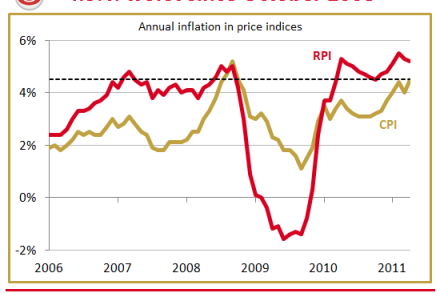
  Good job we didn’t unravel the bunting after last month’s inflation figures. Because today we discover that CPI inflation rose again in April, by 0.5 percentage points, to 4.5 per cent — its highest level since October 2008. That drop in March does look like a blip after all. Even with RPI inflation continuing to fall (by 0.1 percentage points), we seem to have returned to a grim, upwards trajectory. Most forecasters predict that inflation will keep on rising for the rest of this year, outstripping wage growth along the way. The squeeze on living standards continues: We have dwelt on the political problems this creates for Osborne before,

The battle over the 4th carbon budget

At the weekend, it appeared that Chris Huhne had won his battle with Vince Cable and George Osborne over whether or not the government should sign up to the 4th carbon budget. This budget covers 2023 to 2027 and is all part of a plan to cut carbon emissions by 80 percent by 2050 compared to the level in 1990; they have currently been reduced by 26.5 percent from the 1990 level. But it now appears that the greens in government might have been premature in declaring victory. First, the next set of cuts in UK carbon emissions is dependent on the European Union agreeing to embark on an equally

Economy grows by 0.5 per cent in the first quarter of 2011

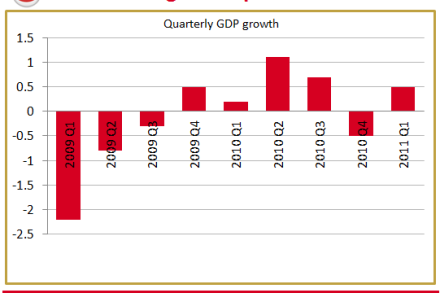
So, we’re not back in recession, and growth of 0.5 per cent in the first quarter of this year is in line with what many forecasters were predicting, but… It is hardly indomitable stuff. As Duncan Weldon explained in a useful post yesterday – in which he rightly picked me up on a loosely worded post of my own (since, cheekily, edited) – 0.5 per cent merely compensates for the shrinkage experienced thanks to the snow last year. Across the last two quarters, economic growth has effectively plateaued. It’s as we were, Q3 2010. The politics of the situation is fissile, even if we are stuck in the murky area

Osborne is on track to rebalance the economy

It may look diminutive in between Easter and the Royal Wedding, but tomorrow is still a big day in the political calendar. It is, after all, the day when we hear the official growth estimate for the first quarter of this year. A negative number, and we shall have experienced two consecutive quarters of shrinkage — which is to say, the country will be back in recession. A positive number, and we shall have avoided that unhappy fate. So what are the forecasters saying? The consensus among bodies such as the NIESR and the CBI is around 0.5 percent, which – as Duncan Weldon explains in a very useful post

The Treasury Select Committee gets prescriptive

Andrew Tyrie promised that the Treasury Select Committee would be an assertive, insistent body under his stewardship — and he hasn’t disappointed so far. The committee’s recent evidence sessions have been fiery affairs, particularly by the usual standards of these things. And today they have released the result: an extensive and prescriptive report into last month’s Budget. Several of the report’s observations are worth noting down — not least that advance briefing of the Budget is “corrosive of good government,” and that “almost all the evidence received [about the government’s Enterprise Zones] is unsure about the extent to which they will contribute to UK growth.” But more significant is the

Osborne needs to make his case for growth

The Guardian have an odd story today. “Business chiefs who backed cuts now doubt UK growth,” runs the headline — suggesting that these sinners are now being confronted with the error of their own ideology. Who are the business chiefs? We have Archie Norman, the retired head of Asda, now part-time chairman of ITV. He “said the government’s growth targets were too optimistic”. Set aside the fact that the government doesn’t make growth targets now, and has subcontracted that the Office for Budget Responsibility. Where is the connection between growth downgrades and cuts? In the imagination of The Guardian, I suspect. Next Andy Bond, another former head of Asda, is

How might the MoD get round its spending settlement?

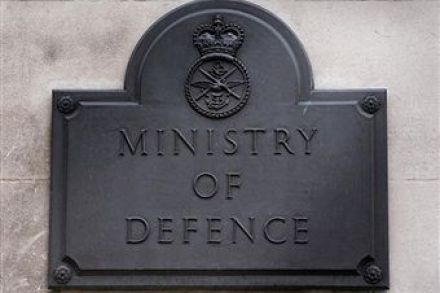
The Ministry of Defence is Whitehall’s last monolith. Charged with the nation’s defence, it is powerful enough to challenge the Treasury. As Pete notes, there are signs that it’s trying to defer (if not avoid) the cuts laid out the punishing strategic defence and security review. It has many ways of doing this. Obviously it can use political pressure because troops are deployed in Afghanistan and Libya. But there’s also a neat accounting step that allows the MoD can transfer costs directly to the Treasury. You may recall that the Budget contained a £700m increase for ‘single use military expenditure’ (SUME) in 2011-2012. SUME does not appear as capital spending

More demands on George Osborne

Is the defence budget the most chaotic in all Whitehall? George Osborne said as much last October — and he’s still dealing with its hellish intricacies now. The main problem, as so often in military matters, is one of overcommitment. Thanks to various accounting ruses on Labour’s part, large parts of the MoD’s costs were hidden in the long grass of the future. It was buy now, pay later — with Brown doing the buying bit, and the coalition doing the paying. The number that William Hague put on it last year was £38 billion. The MoD was spending £38 billion more, over this decade, than had been budgeted. Even

Winners and losers | 6 April 2011

The birds chirruping in the sunlight clearly didn’t get Ed Balls’s memo. Otherwise they’d know that today is “Black Wednesday,” the day when the coalition’s tax and benefit policies swoop in to leave the average household some £200 a year worse off. This is the message that the shadow chancellor is broadcasting this morning, be it on Radio 4 or in a post for Labour Uncut. His claim is that the coalition is — by going “too far, too fast” on the deficit — merely squeezing the “squeezed middle” even more. Only that’s not quite the full picture. The Treasury, for one, is pointing out that today’s measures will actually

Ed Balls ties himself in knots

The Most Annoying Figure in British Politics™ is spread absolutely everywhere today: in the newspapers, on Twitter and, most notably, in interview with the New Statesman’s Mehdi Hasan. The interview really is worth reading, not least because it pulls out and probes some of Ball’s arguments, both for himself and for Labour’s fiscal reasoning. Guido has already dwelt on the former — “I’m a very loyal person,” quoth the shadow chancellor — but what about the latter? Three things struck me: 1) Oh, yeah, there was a structural deficit. The Big News here is probably Balls’s admission that Labour did run up a structural deficit (i.e. a deficit that remains

Osborne's Black Gold Populism

James is right to draw attention to the problems arising from the coalition’s decision to hike taxes on oil companies. Perhps halting the fuel duty escalator was worth it but there are always costs associated with this kind of populism. Oil companies, like the banks, are friendless enterprises and so easy targets for tub-thumping or magpie politicians. Nevertheless, some North Sea oil fields now face marginal rates of 81% while less-maure fields will be taxed at 62%. No wonder Statoil and other companies are reconsidering planned investments in the North Sea. Osborne should understand why. In 2007 he visited Aberdeen and said: “The Treasury don’t seem to understand that the

Laws gives another signal on 50p

Usually, the task of David Laws Watch is to judge just how close the former minister is to a return to government. But, today, his article for the FT is worth highlighting for a different reason altogether. Referencing George Osborne’s signals on the 50p rate in the Budget speech, Laws has this to say (my emphasis): “The chancellor also signalled that excessive marginal rates of income tax – of 50 per cent, even 60 per cent – are on their way out. The Treasury believes that the majority of expected revenue from the current top rate is lost in avoidance. But the government is rightly cautious about the timing of

The big question: has Osborne done enough to deal with inflation?

“We understand how difficult it is for so many people across our country right now.” If you weren’t sure which direction George Osborne’s Budget was going to head in, then he clarified it right from the start of his speech. This was one to tackle the rising cost of living. And much of it — such as the raise in the personal allowance and the fuel duty cut — was welcome. But there is a nagging question hovering above Osborne’s announcement today: has he done enough? The Chancellor will certainly hope so. After all, by scrapping the fuel duty escalator he has effectively encoded a tax cut into all of

Osborne's new, softer cuts

George Osborne has today done some massive juggling. It wasn’t a Budget for jobs after all, but a Budget to help people cope with the soaring cost of living. North Sea oil companies and banks were stung for various income, fuel and corporation tax cuts. The Chancellor spotted — immediately — that cost of living was the No.1 issue and turned on a sixpence. His skills as a politician were again demonstrated. But let’s not fool ourselves. Fiscally, today’s is not a big Budget. What movement there has been is to make the cuts programme even milder than it already was. The “total cuts” figure is, oddly, not printed in

Is 40% the "basic rate" of income tax?

MPs are pretty out of touch, of course, clueless about the way “ordinary people” live. That’s what we’re supposed to think of course. We’re not supposed to remember that MPs probably regularly encounter a much broader range of public opinion and circumstance than highly paid columnists and political editors. Here, for instance, is Ben Brogan committing the sin of assuming (I presume) that everyone is just like the people he meets: If the higher rate threshold stays the same, and yet more thousands of the ’squeezed middle’ are brought into higher rate tax, at what point do we review terms, and rename the 20p rate the lower rate, the 40p rate

Budget morning

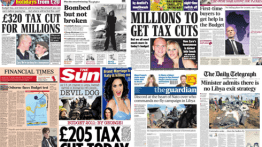
George Osborne couldn’t really have expected a much better set of newspaper covers than the one before him this morning. Despite the dreary background picture – war, confusion, higher inflation, lower growth, the ruinous state of the public finances, etc – a handful of papers are leading on the goodies in his Budget, and specifically the £600 rise in the personal allowance that James mentioned last night. Judging by the movements of the grapevine, this will come into effect in April 2012, and will benefit more people than will the £1,000 rise already announced for this April. While that one was targeted at the least well-off by a reduction in

Your five-point guide to tomorrow's Budget

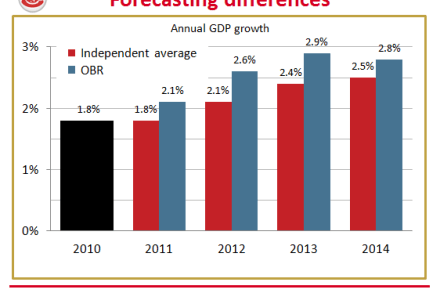
From rescue to recovery — that’s how George Osborne is selling his Budget ahead of its release tomorrow. But what might we see beyond the rhetoric? Here’s a five-point guide for CoffeeHousers:   1) Growth. It almost feels like a tradition now: a new Budget, and a new set of forecasts from the Office for Budget Responsibility. Chief among them will be what the OBR says about growth. Its previous forecast for 2011, made last November, was for 2.1 per cent growth in 2011 — but that will almost certainly be downgraded after the mini-slump in the fourth quarter of last year. As this graph shows, the average of the

Osborne's grand merger?

George Osborne’s Budget — his plan to deliver us from “rescue to recovery,” apparently — is less than a week away, and the wildfire of speculation is taking hold. Perhaps the most intriguing titbit in today’s papers is one that also appeared in the Express last Saturday: that Osborne is considering merging income tax and national insurance. This is a measure that the Office for Tax Simplification recommended in a report last week, suggesting that it would ease the administrative burden on small businesses. Yet that simply echoes a viewpoint that stretches back decades. This IFS report, for instance, quotes an article published by the British Tax Review during the