George Trefgarne

Will Rishi Sunak admit the truth about Net Zero?

From our UK edition

Grant Shapps, the energy secretary, popped up on television at the weekend to explain that the cost of installing a heat pump is only about £3,000, the same as a gas boiler. Hmm. Good luck with that. That number is only true once a £5,000 grant from the government (of which only 90,000 are available) has been considered. It ignores all the costs of insulation and pipework. A friend of mine with a heat pump says about £15,000 is a more accurate number. A lower carbon economy is a good thing, but the Net Zero policy as legally implemented in the UK has been a disaster Inflation, largely a consequence of energy costs, remains the biggest issue not just in Britain but the world right now.
Capital gains from the super-rich

From our UK edition

Suddenly it is starting to look as if the period after 1914 — when London lost its position as the financial capital of the world to New York — was an aberration Suddenly it is starting to look as if the period after 1914 — when London lost its position as the financial capital of the world to New York — was an aberration, a downturn in an otherwise upward trend. Stroll around Chelsea, Belgravia and Holland Park and see the flash cars with blacked-out windows, waiting with chauffeurs inside. Listen to the foreign voices echoing down Bond Street; chat to estate agents, or to bankers or art dealers or even to a good dentist, and the message is clear: London is on the up, and the world’s rich are congregating here like bees around the blossom of spring.

In defence of Liz Truss’s retro economics

From our UK edition

One of the many curious things about Foreign Secretary Liz Truss is that she has the capacity to drive some people around the twist. There are the Trussites, hovering over her Instagram posts in political adoration, and then there are others who consider her a menace who is about to be made Prime Minister in a sinister conspiracy by Brexiteers. At least she is willing to challenge the groupthink of the Bank of England and the Treasury, both of which are full of clever people who have manifestly failed to manage the inflationary shock currently knocking us all off our perches.

How we could be heading for another snap general election

From our UK edition

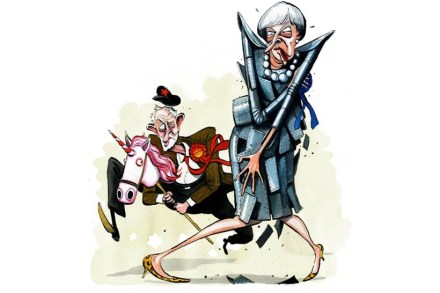
I hate to depress everybody, but the possibility of both a leadership challenge to Theresa May and a general election is suddenly mounting. I don’t believe this is the desired outcome of any of the political factions currently flying under the Conservative party flag, but if things go on like this, it is not hard to see how it might happen. A failure to win Commons votes on numerous aspects of Brexit, notably the Customs Union; a vote of no confidence; Theresa May stepping down or being challenged; a new leader feeling the need for a refreshed mandate; the press and social media howling for this or that; all culminating in a butterflies-in-tummy drive to the Palace.

The rules of the Tory leadership contest make it a wild card to play

From our UK edition

The moment Philip May helped his wife from the stage after her conference speech, it became clear that it is only a matter of when, not if, her leadership of the Conservative Party and occupancy of No.10 comes to an end. What happens next? Who knows, but if you understand the rules, it is just possible a sequence of events has started which will ultimately lead to hundreds of thousands of people participating in a three month election process for a new leader. It might even result in a surprising outcome. In other words, a relatively unknown newer MP, such as Kemi Badenoch (Saffron Walden); or Bim Afolami (Hitchin and Harpenden); or Rishi Sunak (Richmond, Yorks), being chosen. In the short term, such a contest would mean more uncertainty. It would definitely be a risk.

Students are right to vote Labour

From our UK edition

Almost everything which is said officially about student finances is obfuscatory and contradictory, starting with Damian Green’s assertion at the weekend that we need 'a national debate' on tuition fees, only for former education secretary Michael Gove to say the opposite the following day. A week before the General Election was called, the Student Loan Company announced that it was increasing interest rates from 4.9 percent to 6.1 percent, according to its formula of inflation plus 3 percent. Due to the effects of compound interest, that potentially takes the lifetime cost of a typical student’s debts from around £51,000 to £70,000, according to the calculator on the Money Saving Expert website.

The Succession to the Crown Bill is a constitutional can of worms

From our UK edition

Today, the Succession to the Crown Bill will receive its second reading in the House of Commons. If one had to think of one person who would welcome this plan to 'modernise' the Monarchy, it would have to be that arch-Blairite, Baroness Jay of Paddington. But she popped up yesterday in her capacity as chair of the Lords’ Constitution Committee, to warn of the potential 'unintended consequences' of the Bill and to decry the use of the emergency fast track procedure to rush it through. Surely some mistake? Actually, no. Baroness Jay arguably knows more than anybody about tinkering with the constitution, having made it her life’s work.

An election before 2015 could soon be illegal

From our UK edition

Amazingly, the forces of conservatism derided by Tony Blair, are in the ascendant, their enemies scattering and in retreat. Bin Laden is dead, the oil price tumbling, the Royal Wedding was a triumph and now Labour and the Lib Dems beaten at the ballot box. Surely, we tell ourselves, this is an alignment of the stars, a Conservative moment. David Cameron must seize the day, or at least the year, by abandoning the Coalition and calling a general election soon. Landslide, here we go! Hold your horses. Britain’s electoral machinery is off the road, its parts all over the workshop floor. Thanks to the constitutional tinkering of the Coalition, the procedural and practical obstacles to holding a general election in the next four years are substantial and rising.

The true scale of the cuts

From our UK edition

George Osborne likes to spend his weekends at Dorneywood, the chancellor’s official residence near Slough, but I doubt this one will be  particularly enjoyable. He will be burning the midnight oil as he prepares next Wednesday’s spending review. No doubt he will also be taking calls from ministerial colleagues, muttering dark threats about aircraft carriers, the arts, sport, the roads budget, overseas consulates – you name it. And just when the numbers all add up he will probably have to start all over again after discovering that No10 has  promised to save some wind turbines because Steve Hilton bumped into somebody at a drinks party.

The credit crunch with jokes

From our UK edition

Unlike most financial writers, who are too serious for their own good, Michael Lewis has a sense of humour and he deploys it deftly. In Liar’s Poker, his semi-autobiographical account of the Salomon Brothers bond desk published 20 years ago, the traders always explain a market move they do not understand by blaming it on ‘the Arabs’. At once, we realise that the Masters of the Universe do not always know what they were talking about. In The Big Short, Lewis examines the credit crunch through the eyes of a handful of ‘short-sellers’, who not only saw it all coming, but put their money where their mouths were by placing bets that the boom would go bust. Lewis also makes this tale digestible with little vignettes.

Put the lights back on: shale gas has arrived

From our UK edition

Fretting about an impending energy apocalypse has long been a diverting parlour game of the chattering classes. Projections are drawn up showing that the last drop of petrol will be squeezed into the last 4x4 in about 50 years’ time. It is said that Britain, forced by the European Union to retire a third of its coal-power stations, will soon be unable to meet its energy demands; the lights will go out within a decade. It seems almost a shame to spoil the gloom by discussing something that has already turned the American energy debate upside down: shale gas. Held in your hand, a piece of shale looks distinctly unrevolutionary. It is a heavy black sedimentary rock found all over the world.

Even oilmen are human

From our UK edition

Until the credit crunch sent bankers to the naughty step of capitalism, the spot was occupied by oilmen. The consequence is that an exciting tale of human endeavour — how the abundant resources of the earth have been harnessed to power an era of unimagined prosperity — is often obscured by hostile forces and, it has to be said, spectacular blunders by oilmen themselves. However, it is, if you think about it, remarkable that in the 150 years since it all began when one Colonel Drake first struck oil in Pennsylvania, a global market — designed by no one individual or authority — has grown up which keeps the energy flowing even through wars and natural disasters.

How the first multinational was hijacked by greed

From our UK edition

In June 1773 Adam Smith was at home in Kirkaldy, Fife, hard at work on his Wealth of Nations, when an excited letter arrived from his fellow philosopher David Hume. ‘Do these events affect your theory?’ wrote Hume. ‘What say you?’ Smith was caught up in perhaps the third or fourth most serious stock market crash of all time. Shares in the East India Company — which, along with government stock, made up most of the market — had collapsed, bringing about 30 banks down with them. Smith had deposited his savings in the Ayr Bank and one of its customers who had borrowed to speculate on the market had disappeared. It was as if shares in BP, Shell, HSBC, Vodafone and GlaxoSmithKline had all dived at once, leaving Barclays and Lloyds TSB imperilled.

Awash with oil and plenty more to come

From our UK edition

George Trefgarne says there’s no need to worry about recent dramatic swings in oil prices: despite Opec production cuts, there’s ample supply for a new era of cheap energy It must be quite boring to be a crewman on the curiously named Front Queen, an oil tanker reportedly moored off the sweltering coast of Malta. This vessel was chartered a couple of weeks ago by one of the few healthy banks in the world, JPMorgan Chase, in order to sit in the baking sun of the Mediterranean, filled with heating oil, in the hope that the price goes up. The Front Queen is not alone. There is currently about 70 million barrels’ worth of crude, or nearly one day’s global production, bobbing about in ships around the world.

Darling has offered an incentive for chicanery

From our UK edition

Imagine the scene at around 10 p.m. last Thursday night in the private apartments at Buckingham Palace. It could well have been past normal bedtime for the Queen and Prince Philip, but they were sitting up — perhaps aided by a scotch and water or some camomile tea — waiting so that Her Majesty could give gracious assent to the Banking (Special Provisions) Bill, then being rushed through the Commons. The Queen no longer actually signs Acts of Parliament. Instead she puts her ‘sign manual’ on Letters Patent, which serves the same legal purpose of transforming a Bill into law. Even so, one cannot help feeling that this truncated ceremony was still a sort of rebuke to the Prime Minister.

The making of Ronald Reagan

From our UK edition

I have a new hero. He is called Lemuel Boulware, of America’s General Electric Company. According to a fascinating new book by Thomas W. Evans*, Boulware should be credited not only with a role in defeating the intellectual apparatus of communism, but with the creation of one of the most successful US presidents of all time: Ronald Reagan. History has largely glossed over the fact that Reagan spent eight years from 1954 as GE’s ‘ambassador’. He was employed by America’s biggest company to go round its plants giving pep talks, and to present General Electric Theater, a popular television chat show. Reagan was hired by Boulware, who was GE’s head of public relations.

Are these Spanish builders really fit to run Heathrow?

From our UK edition

After the chaotic scenes of the past few weeks, with probably more than a million travellers caught up at Heathrow alone, it is surely time to rebrand BAA. In the fashionable corporate way, those three initials no longer actually stand for anything, but everyone thinks they still signify the British Airports Authority. This unloved operator is, however, no longer either British or an authority. In fact, it is a private company controlled by a secretive family of Spanish builders.

A superjumbo-sized monument to Euro-folly

From our UK edition

Jacques Chirac hit the nail on the head in 2002 when he opened a factory making components for the Airbus A380. The aircraft was, he said, ‘A symbol of what Europe can achieve.’ I could not put it better myself. As the vast 550-seat superjumbo wowed the crowd at Farnborough Air Show this week, there was no mistaking its significance. Conceived by French and German politicians; bureaucratic, expensive and dogged by scandal — the A380 is indeed a wonderful monument to the European Union. In fact, so short is this engineering marvel on market logic that there is a small but distinct risk that it could bring down not only Airbus and its Franco–German parent company EADS, but the struggling premiership of the bouffant-haired Dominique de Villepin.