Theresa may

May says little new in statement as she again attacks MPs for failing to make a decision

Theresa May’s statement tonight wasn’t particularly dramatic. She had no new policies to announce or arguments to make. Rather, she once again attempted to frame the choice before MPs as her deal, no deal or no Brexit. She tried to position herself as the defender of the referendum result and attacked MPs for failing to take a decision. As a political journalist my reaction to the statement was, is that it? But the question is whether the attack on MPs for the endless motions and amendments and for not talking about anything else will resonate with the public, and lead to them putting pressure on their MPs to back the deal. May said, as she had in the House earlier, that she won’t delay Brexit beyond June 30th.

What Theresa May revealed to Boris Johnson

In the House of Commons today, Theresa May indicated that she would quit as Prime Minister if the UK hadn’t left the EU by the 30th of June. She was, in effect, suggesting that if MPs vote down her deal again next week, they’ll be making her departure from Downing Street more likely. But this is the opposite of the promise many Tories want her to give. A growing number of senior figures in the party believe that May should say that she’ll go if her deal passes. In other words, vote for the deal and then you can pick a new Prime Minister. They believe that this carrot might entice some Brexiteer rebels to back the deal.

Theresa May hints she’ll quit if no Brexit by end of June

After a morning of rumours and heightened tension over the terms of the Article 50 extension Theresa May will seek, No. 10 have finally released the letter. The Prime Minister has asked the European Commission for a brief delay to Brexit until the end of June. In the letter, May makes clear that she has plans to ask MPs to vote on her deal for a third time – and hopes this extension will allow time for this to happen and the subsequent legislation to pass in an orderly fashion. Speaking at Prime Minister's Questions, May confirmed that she would put her Brexit deal to a third vote in the Commons but stopped short of saying when. She said that if the deal failed for a third time, Parliament would then need to decide how to proceed.

May should pledge to resign – it’s not too late to save her legacy

Allies of Theresa May have long talked about how she wants her legacy to be about more than Brexit. But the brutal truth is that there is no such legacy available to her. Rather, her choice is between being the Prime Minister who got a withdrawal agreement through or the one who had to ask for a long, humiliating extension. If May wants to increase the chances of the former being her legacy and not the latter, then she is going to have to promise to go at some point before the next meaningful vote. Earlier today, one office holder in the ERG told me that if May said she would leave once the Withdrawal Agreement Bill was through the number of Brexiteer rebels would reduce to 20 or so. But it is not just on the ERG side that the prospect of a new prime minister would help.

May under pressure to set an exit date to get her deal over the line

Is this the week Theresa May sets out an exit date for her departure from No. 10? There is hope in government that this will be the week the Prime Minister passes her Brexit deal. However, the price of her doing so could include a promise to resign before the second stage of negotiations begin later this year. No. 10 are working to try and ensure May passes her deal before this week's EU council meeting where she has to try and seek an Article 50 extension. In a bid to try and do this, ministers have been locked in talks with the DUP all weekend on what could be done to make the deal palatable to them.

Better than 50:50 chance that the government can get the DUP on board for meaningful vote 3

This weekend all eyes are on the DUP. As I say in The Sun this morning, if the government can satisfy them, then Theresa May has a chance of winning the vote on Tuesday because of the domino effect that them coming across will set off. But if the DUP won’t come over, there’s no point holding a third meaningful vote. The DUP spent yesterday in intensive talks with senior government figures. I understand that these talks were broadly positive. One Cabinet Minister close to the process tells me that the chances of the DUP backing the deal are ‘a bit better than 50:50. I’d put it at 60:40.

Brexit, Trump’s wall, and the cynical inertia of the political class

From our US edition

I had lunch yesterday with a friend from London who brought grim tidings from Albion. Like me, he is an advocate of national sovereignty. He thinks the people of the United Kingdom ought to be allowed to govern themselves. So he, again like me, is an advocate for Brexit. He had no idea what was going to happen with Brexit. Yesterday was a busy day. I also chatted with friends about the crisis at our southern border. All honest people acknowledge that there is a crisis, that thousands upon thousands of people, most without English and without skills, are pouring over the border.

cynical inertia

Brexit explained

From our US edition

As Americans will recall, escaping the arbitrary power of an empire can take years. Now imagine doing it with the French being actively obstructive, George Washington committed to paying the taxation and doing without the representation for a period to be determined by George III, and Washington, having lost the support of his closest advisors, now asking Lord North for help. This is pretty much where Theresa May’s government finds itself after this week’s double defeat in the House of Commons. These are only the latest in an apparently endless sequence of humiliations. There are more to come, but no one knows where they will come from, or when. Frankly, it’s humiliating to have to explain how we got here from the 2016 referendum. But here we are.

brexit explained

Row breaks out between the whips and Number 10

As if the government did not have enough troubles right now, a major row has erupted between the Whips’ Office and Number 10. The whips think that a Number 10 aide was telling ministers they were safe to abstain on the no to no deal motion, when there was a three-line whip to vote against it. After the amendment ruling out no deal in any circumstances passed, the government decided to whip against its own motion rather than allowing a free vote on it. This irritated a slew of Remain / soft Brexit ministers who wanted to vote against no deal. Sarah Newton resigned as a Minister of State to do so. A handful of Cabinet Ministers — Amber Rudd, David Gauke, Greg Clark, David Mundell and Claire Perry — abstained.

Meaningful vote 3 in the next seven days

Theresa May’s extension motion makes clear that she intends to bring her deal back for another vote in the next seven days. The motion states that if a meaningful vote has been passed by the 20th of March, then the government will request a short technical extension to pass the necessary Brexit legislation. (This request would be made at the European Council meeting next Thursday). But if no deal has been passed by the 20th, the UK would request a much longer extension — which would require the UK to participate in the EU Parliament elections. So, it is clear that the government are going to try and pass the meaningful vote between now and the 20th. There is optimism in government that it might be third time lucky for the withdrawal agreement.

Third time’s the charm? We could be heading for another vote on Theresa May’s Brexit deal

From our US edition

Late last night, there was a sense of optimism among British government ministers that Theresa May’s revised deal might have a chance of passing. But those hopes were crushed this morning by Attorney General Geoffrey Cox’s blunt legal advice. With Cox declaring that the legal risk was unchanged, the Democratic Unionist Party were never going to back the deal. That in turn meant the bulk of the Brexiteers in the European Research Group wouldn’t either. In the end, the withdrawal agreement went down by 149 votes — at the worst end of expectations. ‘I profoundly regret the decision that this House has taken tonight,’ May said upon defeat.

brexit deal

DUP confirms it won’t support May’s Brexit deal

The DUP has confirmed that it will be voting against Theresa May's Brexit deal this evening. A party spokesman said that 'sufficient progress has not been achieved at this time' and that 'it is clear that the risks remain that the UK would be unable to lawfully exit the backstop were it to be activated'. Along with the European Research Group's recommendation to vote down the deal, this means that the Prime Minister's strategy of trying to win over the DUP and the Brexiteers in her own party has failed. It means that she is facing a landslide defeat tonight. The Commons benches behind the Prime Minister as she is giving her speech at the start of the debate are eerily empty, almost as if a good number of Conservative MPs can't face being there to watch government disintegrating.

Has May got enough?

There was no triumphalism in Theresa May and Jean-Claude Juncker’s press conference. Nor was there much detail. May talked about how the joint interpretative instrument meant that the backstop could be challenged and taken to arbitration if the EU was trying to apply ‘the backstop indefinitely’. What May did not mention was how this arbitration mechanism would work. Multiple Cabinet Ministers think, after discussion tonight, that the arbitration does not refer to the ECJ. If that is the case, it will convince a slug of Tory MPs that this arbitration mechanism has teeth. The second aspect is the aspiration to have alternative arrangements in place by the end of December 2020, in other words at the end of the transition.

Is there any way that May’s deal could pass on Tuesday?

The government’s efforts to get changes to the backstop have run into a brick wall in Brussels. The EU thinks, with justification, that MPs won’t allow no deal and so feels under no pressure to make significant concessions. As I write in The Sun this morning, one minister fully briefed on the negotiations says ‘we’re at what the hell do we do time’ But without a change to the backstop, Theresa May’s deal is going down to another heavy defeat on Tuesday. That won’t be the end of the matter, though. For the next day, parliament will vote against leaving on March 29th with no deal. Parliament will then almost certainly vote to request an extension to Article 50. At this moment, the UK would be in the EU’s hands.

Theresa May’s latest Brexit speech only highlights the government’s problems

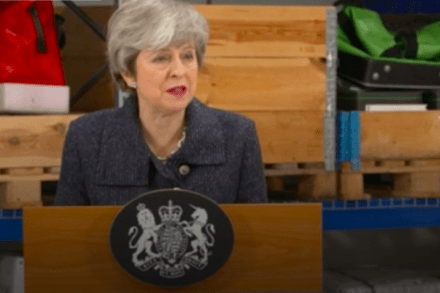
Theresa May is in Grimsby today putting in a last ditch effort to convince MPs to back her deal when it returns to the House of Commons on Tuesday. The view in both Downing Street and the Cabinet is that as things stand it will be rejected for a second time. With no concession on the backstop as of yet from Brussels, there is little chance of Brexiteers rallying around the Prime Minister's deal. May's speech this lunchtime has only served to hammer this point home. The Prime Minister used the set piece to turn her ire on Brussels for the lack of progress. May warned EU leaders that it wasn't just MPs who have a choice to make – the EU must too: 'Just as MPs will face a big choice next week, the EU has to make a choice too. We are both participants in this process.

10 days to save Brexit

MPs have 10 days to pass Theresa May’s Brexit deal or calamity strikes, I say in The Sun this morning. May’s deal is far from perfect. But what will happen if it doesn’t pass is truly appalling. If May’s deal hasn’t won a Commons vote by March 12th, the Commons will vote on whether to proceed with no deal. The parliamentary arithmetic is such that no deal will almost certainly be defeated. The next day, parliament will then vote on whether to request an extension from the EU. This vote will almost certainly pass. At this point, the United Kingdom would be in the weakest position it has ever been in this negotiation. Whether to grant an extension or not would be up to the EU and would require all 27 member states to agree.

May’s breaking point

The only certainty in the Brexit process is that there is no certainty. Brexiteers had long sought solace in the fact that, by law, the United Kingdom will leave the European Union on 29 March with or without a deal. But it’s now clear that this is not necessarily the case  —  or even likely. As we have seen this week, Theresa May is not in control of her party any more than Jeremy Corbyn is in control of his. Corbyn has been forced to move towards the idea of another ‘public vote’ on Brexit, though he has no enthusiasm for one, because he fears that if he doesn’t, MPs would leave his party and join the new Independent Group.

What will the Commons do to Brexit next week?

Brexit is back in the Commons next week. As I write in The Sun this morning, two of the big questions are: what will Eurosceptic Tories accept in terms of changes to the backstop and will the Cooper amendment pass. A document circulating among Tory Eurosceptics sets out what MPs should and shouldn’t regard as a meaningful change to the backstop. It warns that assurances from the EU Council would be ‘worthless’ and that changes to the political declaration would be ‘not legally binding’. It says that an interpretative instrument would have, ‘Some legal value’ but ‘would be a face-saver that would be legally pretty meaningless.

Home truths | 21 February 2019

The creation of a commission to examine beauty in new building created a stir in the media, with the chairman subjected to a hate storm of unusual turbulence even by the standards that he regularly has to endure. Hate storms arise when powerful interests are threatened, and this was no exception. There is hardly a person in this country who is not aware of what Milan Kundera has called the ongoing ‘uglification of our world’ and who does not hope that something might be done about it. No one I talk to denies the need for a large number of new houses. But they all hope that this need can be reconciled with our deep-seated desire for beauty. Kant wrote that in judgments of beauty we are ‘suitors for agreement’.

What can May now get on the backstop?

When Theresa May goes to Brussels next week to bat for changes to the backstop, she’ll do so with a large crack in her bat—I say in The Sun this morning. The symbolic defeat that MPs inflicted on her Brexit plan on Thursday night has significantly weakened her negotiating position. The EU doesn’t want to make significant changes to the backstop. When the Brady amendment passed the House of Commons, saying parliament would accept the deal if the backstop was replaced, the EU responded by saying that they didn’t think this parliament majority was ‘stable’. Thursday night’s vote helps them make that argument.