Theresa may

How business-friendly would Theresa May’s government be?

From our UK edition

When the main opposition party is proposing to jack up corporation tax from 19 per cent to 26 per cent the Conservatives don’t have to do too much to claim the mantle of the pro-business party, but with Theresa May suddenly attracting the nickname ‘Red Theresa’, just how business-friendly would a post 9 June May government be? First, the losers. First Philip Green and other company-owners who leave pension funds under-funded: the Conservatives are promising punitive fines and a possible new criminal offence for those who ‘deliberately or recklessly put at risk the ability of a pension scheme to meet its obligations’.

The Tory ‘dementia tax’ could backfire for Theresa May

From our UK edition

The Prime Minister says there is no such thing as ‘Mayism’, only ‘good, solid Conservatism’. Fine. But let’s examine just how ‘good’ and ‘Conservative’ her party’s new policy on social care is, unveiled earlier today. The Tory manifesto says, in effect, that people who need care in old age will have to pay for every penny of it – no matter how big the costs – if they have more than £100,000 in assets, which will be protected. Payment can be deferred until after death, but there’s no escaping it. If you have a home worth, say, £216,000 (the national average), own it outright, and need to be looked after for a long time, you may have to cough up £116,000.

Theresa May’s preachy government is on a mission to restore our confidence

From our UK edition

Every political moment is informed by, and a reaction against, its predecessor. The Age of May is no exception. David Cameron’s successes were founded, at least in part, on the vague appreciation that he seemed like a nice enough chap. Theresa May’s victories are built on the fact that she isn’t.  Being a 'bloody difficult woman', if also a bloody dull one, has its advantages and not just in terms of paying a measure of homage to the great ghost of the Iron Lady. Theresa will stand for no nonsense, you understand, and things will be done properly and with a sense of order and purpose. What you see is what you get and there’s no need to like it; you are simply asked to respect it.

Earn less than £85,000? You might be better off under Corbyn

From our UK edition

Recent elections have followed the same format: the Conservatives positioning themselves as the party of low taxes while Labour feels obliged to make its own commitments in order to try to neutralise the issue. This year is different. One of the notable omissions from the Conservative manifesto is any firm promise not to jack up the rate of income tax or national insurance. As expected, the Conservative manifesto does not repeat David Cameron’s ‘five year tax lock’ which committed the Conservatives not to raise the rates of income tax, national insurance and VAT during the lifetime of the Parliament just ended. Reducing taxes on businesses and individuals has been reduced to a mere ‘firm intention’.

Theresa May’s new Conservative philosophy

From our UK edition

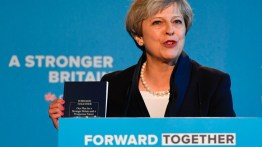
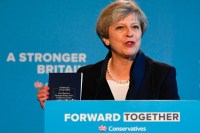
When you go to the polling station, Tory campaign chiefs want you to be thinking about Brexit and who you want as Prime Minister negotiating for Britain. This point was underlined at today’s Tory manifesto launch.  Theresa May was introduced by the Brexit Secretary David Davis and she herself concentrated on why Brexit makes the next few years so ‘defining’ for the UK and concluded by declaring that ‘every vote for me and my team’ will ‘strengthen my hand as I fight for Britain’. On the EU, the manifesto largely repeats the points made in May’s Lancaster House speech. But by making clear that the UK is leaving both the single market and the customs union, it means that the Lords can’t try and block either of these things.

The Tories’ biggest gamble? Over-estimating the strength of the post-Brexit economy

From our UK edition

Unemployment is down. Retail sales are still strong. House prices are stable. Even the Great British Peso, the currency formerly known as the pound, has recovered much of its losses of the past year. After the vote to leave the EU, the UK economy has been remarkably strong. Even triggering Article 50, which some said would be the point when the whole pack of cards collapsed, doesn’t seem to have made any difference. With that wind in behind the UK’s sails, it is easy to understand why the Conservative party is feeling fairly secure about the state of the economy. And that may help explain why there is remarkably little in the manifesto to strengthen the competitiveness of the country. Sure, the commitment to reduce corporation tax to 17percent is maintained, and that is great.

2017 Conservative Manifesto: full text

From our UK edition

The Conservative Manifesto 2017: Our Plan for a Stronger Britain and a Prosperous Future   The next five years are the most challenging that Britain has faced in my lifetime. Brexit will define us: our place in the world, our economic security and our future prosperity. So now more than ever, Britain needs a strong and stable government to get the best Brexit deal for our country and its people. Now more than ever, Britain needs strong and stable leadership to make the most of the opportunities Brexit brings for hardworking families. Now more than ever, Britain needs a clear plan. This manifesto, Forward, Together: Our Plan for a Stronger Britain and a Prosperous Future will meet the great challenges of our time, beyond Brexit.

Red Theresa

From our UK edition

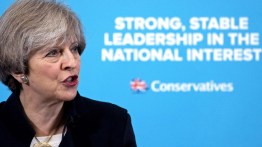
Never has the Conservative party been more confident about winning a general election. Theresa May’s popularity ratings have broken all records; her aim in this campaign is not just to defeat the Labour party but to destroy it. The Tory MPs who talk about ten years in power are the more cautious ones; some talk about staying in government until the 2040s. The party’s name is seldom mentioned in this campaign. We instead hear only about ‘Theresa May’s team’, and voters seem to approve. As to what the Conservatives stand for, they’d rather not say. At times it seems they’re not even quite sure. The Tory messages revolve around Jeremy Corbyn and not much else.

Middle May

From our UK edition

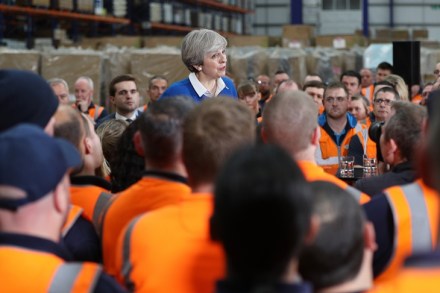
Once, politicians remained in their safe spaces and elections were fought in a handful of swing seats. This time Theresa May is campaigning in Labour heartlands, pitching herself at people who have never considered voting Conservative before. Tories are targeting seats they have not held since the 1930s and social class seems almost irrelevant. Pollsters YouGov recently observed that class now tells us ‘little more about a person’s voting intention that looking at their horoscope or reading their palms’. As Tony Blair might have put it, the political kaleidoscope has been shaken and the pieces are in flux. A picture of a Britain with new fault lines is emerging.

This is an emergency

From our UK edition

The NHS as we know it is dying. It’s no longer a matter of if it will collapse, but when. Those of us who work on the front line have known this for some time, and it’s heartbreaking. Last week’s ransomware cyber-attack served to highlight how frail and vulnerable the health service is. While many tried to blame Health Secretary Jeremy Hunt for failing to prevent such a disaster, the archaic IT system is actually emblematic of how the NHS as a whole has struggled to keep up to date and adapt to the modern world with the necessary speed. I trained as a doctor specifically because I was so proud of the NHS and the ideologies underpinning it. It is one of this country’s greatest achievements: a fair, equitable and cheap way of delivering healthcare.

We owe it to hunt staff to repeal the ban

From our UK edition

Though I don’t think much of Theresa May’s paternalistic soft-left politics, I do like her no-nonsense style. That Q&A she did for the Sunday Times where she was asked ‘Sherlock or Midsomer Murders?’ — ‘I’ve watched both’ she replied — was hilarious in its Olympian imperviousness to the convention, established by Tony Blair, that prime ministers must kowtow at all times to popular culture and sentiment. So too was the extraordinarily unevasive answer she gave when asked recently why she was committed to allowing Conservative MPs a free vote on rescinding Tony Blair’s fox-hunting ban. ‘As it happens, personally, I’ve always been in favour of fox hunting,’ she said. Me too.

The one question Theresa May should ask Labour voters — in order to win them over

From our UK edition

Prime Minister, I have good news and bad news.  The good news is that you have been denounced in the letters page of the Daily Telegraph. One correspondent huffs: 'I wonder if Theresa May and her small group of advisers closeted in Westminster are aware of the fact that each initiative they introduce in an attempt to win over traditional Labour voters risks having the opposite effect on traditional Conservative voters.’ Another damns your energy price cap as ‘wrong-headed’ and even accuses you of ‘play[ing] into the hands of Jeremy Corbyn’s muddle-headed electioneering economics’. Lord Tebbit echoes these fears: 'The further Labour goes Left, that would mean the further we go Left. We need to stick to sensible, Conservative economics.

Team Theresa’s concept of ‘workers’ is seriously outdated

From our UK edition

I can understand why Theresa May should want to toy with the idea of having 'workers’ representatives on board'. As with Tony Blair and his promise to be tough on crime, and David Cameron and gay marriage, it has become a tradition in modern-day elections that a party campaigning from a position of strength makes an audacious raid behind the lines to plant a flag in some prominent place in enemy territory. It creates the impression that you are not merely trying to pitch for votes at the fringes of your opponents’ traditional homeland – you are confident enough to present yourself as a government for everyone. May’s proposals are, however, highly tokenistic.

Northern Ireland isn’t impressed with Theresa May

From our UK edition

Theresa May has been continuing her UK-wide tour to convince voters in all corners of the country to back the Conservatives. This weekend saw the Tory campaign machine make a whistle stop tour in Belfast. The Prime Minister attended a local agricultural show and talked to farmers and families about why they must support the party. So far, so uncontroversial. All Prime Ministerial candidates seeking election or re-election make the customary stop on the far side of the Irish Sea to make a pitch to Northern Irish voters. This time, however, Theresa May's trip has unleashed anger among both voters and politicians in Northern Ireland. Her attempt to charm locals has backfired spectacularly.

Theresa May’s Ronseal politics

From our UK edition

Why do Conservative politicians love Ronseal so much? Theresa May tells today's Sunday Times that the Ronseal slogan - 'it does what it says on the tin' - is her 'political philosophy'. David Cameron spent years talking about Britain's yearning for 'a kind of Ronseal politics', before describing the Coalition government as operating according to the Ronseal principles. May's Ronseal branding seems to suit her better: A.N. Wilson describes her in this week's magazine as 'patently boring'. Ronseal's slogan was developed as an acknowledgement that it was competing against fancier brands in a crowded market, which isn't May's problem. But she has always styled herself as a woman who gets things done. Does the Ronseal brand really fit with May's policies?

To tax the rich, introduce a tax cut

From our UK edition

Jeremy Corbyn wants to put up income tax only for people who earn more than £80,000 a year, he says. Anyone below that figure is safe. This reminds me of John Smith’s ‘shadow Budget’ in the 1992 general election. Smith said that the top rate of income tax would rise to 50 per cent for everyone earning more than £36,375 a year (which would be just under £72,000 today). Most people earned much less than the sum chosen, but voters decided they did not like such a clear intention to damage the higher earnings they hoped they might one day achieve. The shadow Budget was said to have lost Labour the election. Perhaps bearing this in mind, Mr Corbyn has so far avoided a specific percentage and pitched the taxable sum a little higher, but the signal is similar.

Theresa May’s recycled battle bus

From our UK edition

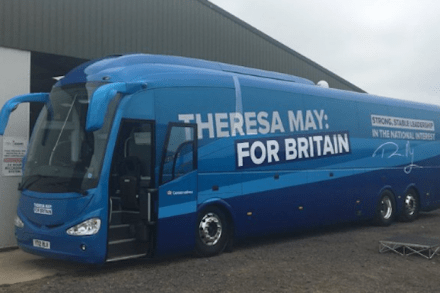
An eagle-eyed Twitter user has spotted something that could be a metaphor for the last 12 months of British politics. Theresa May's 2017 general election battle bus is – wait for it – last year's Remain bus, spray-painted with new 'strong and stable' slogans. It looks like the number plate checks out: https://twitter.com/MySweetLandlord/status/863056304574783490 https://twitter.com/MySweetLandlord/status/863061739616841728 Quite funny, this. May has spent the early part of her premiership desperately trying to prove her Leave credentials.

No left turn

From our UK edition

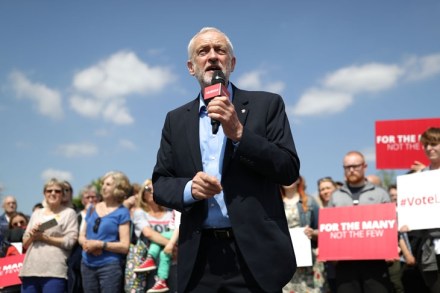
It would be easy to dismiss Jeremy Corbyn’s launch of the Labour party’s election campaign this week on the grounds that hardly anyone believes he has the slightest chance of becoming prime minister. But given that David Cameron was given a 0.5 per cent chance of winning a majority, and Donald Trump a 1 per cent chance of the presidency, it would be foolish not to take the main opposition party seriously. At the very least, Corbyn’s ideas need to be examined in order to understand why Labour finds itself in the position it does, and why no party leader to the left of Tony Blair has won a general election in over 40 years.

Portrait of the week | 11 May 2017

From our UK edition

Home After spectacular local election results, Theresa May, the Prime Minister, said: ‘I’m taking nothing for granted over the next five weeks. I need support from across the United Kingdom to strengthen my hand, and only a vote for me and my team will ensure that Britain has the strong and stable leadership we need.’ The Conservatives increased their number of council seats by 563. Labour lost 382 and Ukip lost all 145 it held, but gained a single one, Padiham and Burnley West, Lancashire, from Labour. In Scotland, the Conservatives became the second party to the Scottish National Party and gained seven seats in Glasgow (where Labour lost control of the city) and Paisley’s Ferguslie Park, Scotland’s poorest community.