Theresa may

Theresa May pulls no punches in her attack on the European Commission

From our UK edition

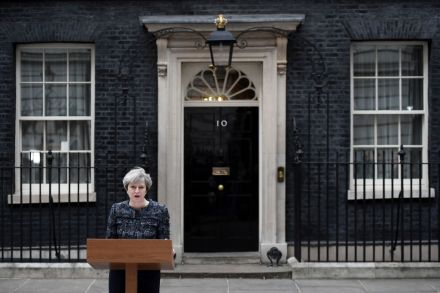
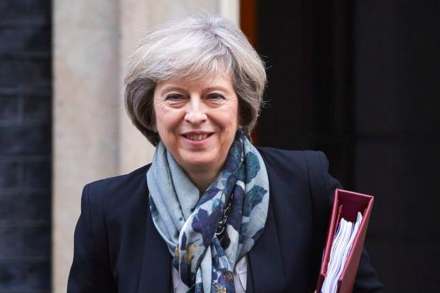
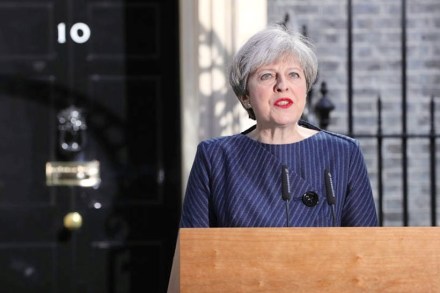
Theresa May has kicked off the Tory general election campaign with a remarkably punchy statement in Downing Street. She accused the European Commission of trying to interfere in the UK general election. She said that the hardening of the Commission’s negotiating stance and the leaks of recent days ‘had been deliberately timed to affect the result of the general election that will take place on 8 June.’ She added that there were those in Brussels who did not want to see the UK prosper. May’s charge takes us into new territory. I can’t recall a British Prime Minister accusing an allied power, let alone a group the UK is still a member of, of trying to interfere in our elections before.

Theresa May hits out at the ‘bureaucrats of Brussels’, full transcript

From our UK edition

I have just been to Buckingham Palace for an audience with Her Majesty The Queen to mark the dissolution of this Parliament. The 2015 Parliament is now at an end, and in 36 days the country will elect a new Government and choose the next Prime Minister. The choice you now face is all about the future. Whoever wins on 8 June will face one overriding task: to get the best possible deal for this United Kingdom from Brexit. And in the last few days, we have seen just how tough these talks are likely to be. Britain’s negotiating position in Europe has been misrepresented in the continental press. The European Commission’s negotiating stance has hardened. Threats against Britain have been issued by European politicians and officials.

The Conservative party is treating the electorate like mugs

From our UK edition

What a curious election this is proving to be. It is hard to think of another general election in which the two largest political parties indulged in so much nonsense, nor did their best to persuade you that what is evidently true cannot possibly be true.  In the first place, the Conservative party asks you to believe the Labour party could yet finagle its way into Downing Street. You can’t afford to take a risk on Jeremy Corbyn, the Tories tell a public that has not the slightest intention of taking a risk, or anything else, on Jeremy Corbyn.

The EU has gifted the Republican cause a blueprint for a united Ireland

From our UK edition

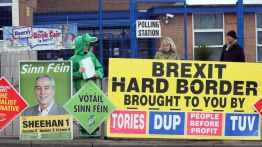
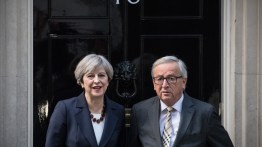
Theresa May's awkward dinner date with Jean-Claude Juncker stole the headlines, but there was another Brexit development that passed with much-less fuss: the European Union's plan for Ireland to reunite after Brexit, which it inserted quietly into its negotiating guidelines. Few in Britain paid much attention to it. Across the Irish Sea, it was a different story. Among Catholic communities, there is growing hope that Brexit could be the issue which finally sees partition end on the island. Yet within Protestant communities, there is a growing fear that the EU is using Brexit as a tool to sneak through Irish reunification. The British government appears to be doing precious little to stop it.

Theresa May’s scrutiny-dodging will only get worse

From our UK edition

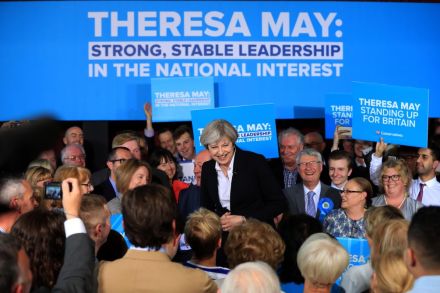
What a very boring election this is. The Tories are trying to keep their Prime Minister away from anyone who isn’t an android programmed to wave a placard about ‘strong and stable leadership’. Journalists from local papers are being kept in rooms to prevent them from - gasp - filming an interview with the Prime Minister for their websites. Other events take place away from the media entirely, with Theresa May cocooned safely among Tory activists: the political equivalent of a tree falling in an empty forest. Over the bank holiday, the Sunday papers carried tales of a row between May and her key aide Fiona Hill in which the Prime Minister apparently complained that she was being kept away from voters.

Diane Abbott, the brain of Labour

From our UK edition

I awoke this morning to hear Diane Abbott’s brains leaking out of her ears and all over the carpet during an interview with LBC’s excellent Nick Ferrari. You will need a mop and a bucket very sharpish, I thought to myself, as she gabbled on, the hole beneath her feet growing ­larger with every syllable she uttered. Diane has had the brain leakage problem before, many times, and my worry is that following the LBC debacle there is almost nothing left inside her skull at all, just a thin ­greyish residue resembling a particular kind of fungi or leaf mould. This would leave Diane on an intellectual par with Emily ­Thornberry, a disaster for Labour. Later Diane explained that she had ‘misspoken’ ­during the interview — but how were we to know?

Who does Jean-Claude Juncker think he is?

From our UK edition

Jean-Claude Juncker: what a nasty piece of work. There aren’t many politicians I’d say that about. Even most of those I disagree with strike me as being pretty decent people. Theresa May might be a petty authoritarian, but she isn’t sinister. Jeremy Corbyn is wrong about everything, and stuck politically and sartorially in 1983, but he seems a nice enough guy. But Juncker — it is still rare that such a noxious character, such a scheming operator, such an arrogant arse, such a jumped-up, poundshop Machiavelli, darkens the corridors of politics. He’s the worst. All of Juncker’s awful traits were on display at the weekend, in the spat over his dinner with May last week.

The snap election is likely to make the Commons a lot more dull

From our UK edition

At midnight, we won’t have any MPs. The dissolution of Parliament means that no-one who has sat on the green benches of the Commons for the past two years has any official status above their fellow candidates in the General Election. Some will return victorious for another five years (or until another advantageously early election). Some have decided that it’s time to go. Others will find that their local electorates have decided it is time for them to go.  Elections are exciting for the political world. They activate a gene in politicians that the rest of us fortunately do not possess, which makes them enjoy six weeks of trying to save their jobs, or fighting again in a seat where they were turfed out only a few years before.

The boring mystery of Theresa May

From our UK edition

Theresa May spent the weekend in Scotland and not even the civilised bit. The Prime Minister was posted to the wilds of Aberdeenshire, which are handsome and underpopulated but not exactly a commuter hub. Journalists grumbled about the remoteness of the location, well aware that inaccessibility was the point. May has not been campaigning in this election so much as touring the nation’s emptiest rooms, occasionally bringing along another borough councillor who will be elected to Parliament in five weeks’ time. The punters have been kept far away from the Prime Minister for reasons of security — political security. Party strategists have long memories. They remember the name Sharon Storer.

In praise of Jeremy Corbyn’s campaign

From our UK edition

Almost two weeks in, and before the short campaign has even started, people are starting to wise up to Theresa May's conjuring trick. Last week, Philip Collins of the Times tweeted 'I am usually a strong defender of politics but this empty, choreographed, stale, boring Tory campaign essentially implies we are all idiots' (which was retweeted four and a half thousand times). This was then followed up by a performance on Marr that Fraser Nelson judged to have 'perfected the art of saying nothing'. At the same time, people are still picking holes in the Labour effort. On Thursday, a video emerged of Jeremy Corbyn heading to address a crowd, before he was spun around by a lackey in order to face the gathered cameras.

Sunday political interviews round-up: Theresa May says Conservatives will not raise VAT

From our UK edition

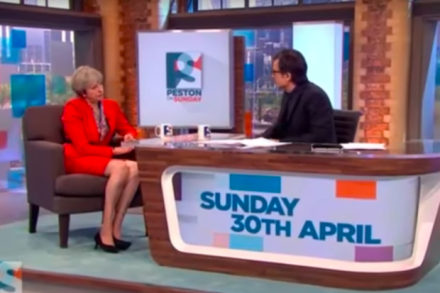
Theresa May - Conservatives will not raise VAT Touring both the BBC and ITV studios today, Theresa May tried her best to avoid giving specific answers about the Conservatives tax policies after the election. However, during an interview with Robert Peston, the Prime Minister appeared to disown David Cameron's 'triple lock' and make a commitment that a Conservative government would not raise the level of VAT above 20% over the next Parliament: Peston: Given what you say your record as a party is on taxes, do you need to repeat David Cameron's triple lock - no rise in VAT, no rise in National Insurance, no rise in income tax - do you need to repeat that? May: Well, I'm clear that we have no plans to raise the level of tax. Peston: What does the level mean? I'm not sure what that means.

Theresa May interpreted: her Sunday morning interviews

From our UK edition

Theresa May has perfected the art of saying nothing in interviews. The most any journalist can hope for is a subtle shift in position, or an absence where a position once stood. She seems to think that, if you refuse to give the press anything, the public won’t care. Worse, she seems to be right – for now, at least. So it would have been with a heavy heart that Andrew Marr set off to see if he could try to draw blood out of the Prime Ministerial granite. Same for Robert Peston afterwards. A Theresa May interview means the recital or verbal formulae: ‘strong and stable’ here, ‘working families’ there, ‘for the many not the few’ there. Then a journalist afterwards tries to explain what message, if any, might have been buried in those words.

Why the Tories are talking up Labour

From our UK edition

Considering that their party is expected to win by a landslide, the Tory spin doctors sound unusually panicked. They are keen to point out that the polls aren’t always right, and the pollsters are still trying to correct what they got wrong at the last general election. They insist that national voting tells you little about what will happen in the key marginal seats. These are normally the pleas of a party that is failing, and trying to persuade voters that it is still in the race. But Labour isn’t doing a good job of spinning its own prospects — so the Tories are doing it for them. This is not as odd as it first sounds. The Tories are worried about complacency, about their vote not turning out.

Why some Tories aren’t thrilled about the prospect of a May landslide

From our UK edition

If the polls are anywhere near right, then Theresa May will be queen of all she surveys on June the 9th. As I say in The Sun today, not since Margaret Thatcher in her pomp will a Prime Minister have been so dominant over her Cabinet. She’ll have her own, sizable majority, her own mandate and the right to implement the policies in her manifesto. This prospect, though, isn’t thrilling everyone in the Tory party. Some ministers worry about the fact that May will have such a free hand, and the direction she might take the government in. Concern has been heightened by the fact that the manifesto is being written without much consultation with ministers.

Capping prices to win votes is no substitute for a serious energy strategy | 29 April 2017

From our UK edition

Is capping domestic energy prices an equitable way to help the ‘just about managing’, or an electoral gimmick with a whiff of anti-free-market ideology? When it was Ed Miliband’s idea, it was certainly the latter. Now it’s likely to be included in Theresa May’s manifesto, offering a potential £100 saving for millions of homes on ‘standard variable tariffs’, it is defended by the ever-plausible Sir Michael Fallon as a matter of ‘intervening to make markets work better’. And that, after all, is what the Prime Minister said she would do, wherever necessary, in the interests of fairness.

Why the Midlands will matter on June 8th

From our UK edition

It is no coincidence that Theresa May chose to hit the campaign trail in Wolverhampton and Dudley last weekend; both are areas where Ukip did especially well in 2015. What is emerging is that the West Midlands – particularly the Labour-held Midlands marginals – will be the key battleground in this coming election. From the creation of the Mercian kingdom by Alfred the Great, to the Battle of Bosworth and Germany’s bombing of Coventry in 1940 – not to mention the 2015 election which led to Brexit – the Midlands has provided the backdrop against which the future of our country has been shaped. The election on 8 June will be no exception.

A progressive alliance? It’s more a coalition of chaos

From our UK edition

My heart soared when I first heard the phrase ‘progressive alliance’ in this election campaign. Not the reaction you’d expect, perhaps, but any attempt to persuade people to vote tactically on the eve of a general election is doomed to failure. A complete waste of time. I should know because I tried to get a similar venture off the ground three years ago. Mine was a conservative version, obviously. In 2014 I was worried that the split on the right would enable Ed Miliband to become our next prime minister. So I launched a Unite the Right campaign and set about trying to persuade supporters of Ukip and the Tories to vote for which-ever candidate in their constituency was best placed to defeat the Labour candidate. Our slogan was ‘Country Before Party’.

The Spectator Podcast: Europe’s new emperor

From our UK edition

On this week’s episode of The Spectator Podcast, we discuss whether France is voting for the lesser of two evils in Emmanuel Macron, consider whether Tim Farron made a mistake by bringing God into politics, and look at how the spread of Mayism across Britain could alter the Conservative party. First, following Emmanuel Macron's stunning victory in the first round of the French elections – taking a seemingly unassailable popularity into the run-off with Marine Le Pen – Jonathan Fenby considers, in this week's magazine cover story, whether Macron is in fact headed for disaster. He joins the podcast along with Anne-Elisabeth Moutet, to discuss whether the 39-year-old sensation is all he seems.

Watch: Jeremy Corbyn forgets to face the camera

From our UK edition

Boris Johnson has stolen the show this morning by calling Jeremy Corbyn a ‘mugwump’. But the Labour leader is making a pretty miserable attempt at trying to recapture the limelight. During a campaign speech in Essex, Corbyn had a golden moment to set out Labour’s pitch to voters. The Sky News camera was rolling, with hundreds of thousands of viewers watching at home to hear what Corbyn had to say. The only problem? Corbyn started his speech with his back to the camera. Thankfully, an aide stepped in to put Jezza right before people got bored of the sight of his back. His blunder might have slightly undermined his introduction to the audience as ‘the future Prime Minister’ though.

Labour is full of mugwumps – but Corbyn is not one of them

From our UK edition

Trust Boris to dominate the headlines by reopening that most famous of books, Johnson’s Dictionary. Writing in the Sun, our effortlessly provocative Foreign Secretary swiped at Jeremy Corbyn with this colourful barb: ‘He may be a mutton-headed old mugwump, but he is probably harmless.’ Couched rather incongruously as the reflections of ‘the people’, this comment has left many laughing, but more still scratching their heads. In fact, there’s more to being a ‘mugwump’ than a throw-away jibe. The word comes from the original New Englanders, the Algonquians, for whom mugquomp meant ‘great chief’. It was a term of respect laden with connotations of nobility. But that presumably wasn't what Boris had in mind.