Television

How to win MasterChef

‘Warmer, sharper and funnier than ever,’ claims one reviewer of ‘the BBC’s disgraced cookery show’ MasterChef. But this is nonsense. First, MasterChef was never ‘disgraced’. It was just the victim of some desperate sub-#MeToo media insinuations about the mildly laddish shenanigans of its two ex-presenters John Torode and Gregg Wallace. These insinuations were likely not unconnected with a) the show’s need for some publicity; and b) an excuse for a revamp after 20 years with those presenters now starting to look about as fresh and inviting as the trays of congealing fried eggs and uncrispy bacon you get in a hotel breakfast buffet. MasterChef was never ‘disgraced’.

Would W.G. Grace recognise the game of cricket today?

There’s a fascinating thought that the authors of Full Circle pursue for just a couple of pages, then leave hanging: ‘Association football offers an alternative history by which to consider the course cricket might have taken.’ In fact, the book demonstrates that cricket has followed football’s course, albeit about a century late. In cricket, too, professionals ousted amateurs, embraced the market, saw economic power shift east and chose a short format that allowed games to be played in an evening. Like it or loathe it, cricket has effectively become football. Reading this serious and competent work, you wonder at times why the journalists Richard Heller and Peter Oborne bothered to write it. There are already countless cricket histories.

Meghan is a woman much misunderstood

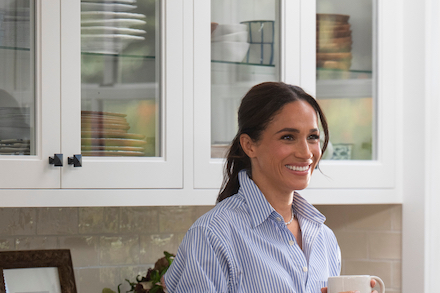
Lying in bed with a swollen face, I decided that the best thing to do was nothing, so I ended up watching the Duchess of Sussex make smoothies. I don’t know why everyone is so mean about her Netflix show because it hit the spot for me. As I took to my bed after surgery to take out the old screws and plates in my long-ago broken jaw, everything put me on edge apart from watching Meghan and her lovely way of smiling and smiling as she expressed wonderment at a bunch of grapes, or the way a liquidiser whirred.

Louis Theroux needs to make a positive case for masculinity

I’ve always had a soft spot for Louis Theroux. I wouldn’t call him a friend, exactly, but I’ve known him for about 40 years. We started our journalistic careers at the same time and would frequently bump into each other at parties. He’s intelligent and funny and, in person, doesn’t answer every question with a question or pretend to be puzzled when he’s evidently long made up his mind. The passive--aggressive ‘just asking questions’ routine is, thankfully, confined to his TV appearances. By this I mean he has no hesitation in telling me I’m being ‘unbelievably stupid’ – which, because we disagree about politics, is quite often. But he’s a QPR fan so I can forgive these outbursts.

In bed together: The writers of HBO’s Industry on bankers and politicians

No TV show better encapsulates the nexus between money and power than Industry. The HBO drama sees investment bankers screwing, snorting and slogging their way to the top of English society. Now, in its fourth series, political intrigue is taking centre stage. Think House of Cards – but with more sex and better-remunerated hotties. Mickey Down and Konrad Kay, the co-writers of the show, explain when we chat that they wanted to ‘expand the canvas’ as Industry progressed. It initially focused on the ‘hermetically sealed’ world of the trading floor but has now expanded beyond. ‘Finance is linked to other spheres of influence,’ says Down. ‘Obviously finance and media have a transactional relationship. Finance and politics also have a transactional relationship.

The streaming model is broken

‘Do you want to stream something?’ my girlfriend asked me. It was 5 p.m. on a Saturday and I’d had a horrendous week. I’d caught one of those mutant viruses that you learn about in nursery rhymes or at the London Dungeon. The cough was the worst part. It was the sort of cough that evacuates a Tube carriage. It was the sort of cough you hear in a western before the protagonist says: ‘Old Billy Boy got consumption. There ain’t a darn thing we can do ’bout it. Doc says he got weeks. Poor bastard. He ain’t never gon’ make it to Montana.’ In short, I was feeling out of sorts. And as such, I was ready for some mind-numbing television. ‘We can watch something,’ I said. ‘What do you fancy?

The real reason I’m leaving Bake Off

I have been dithering for years about when to stop judging The Great British Bake Off. When I joined nine years ago, I thought, since I was in my mid-seventies, that I’d be lucky to manage two years. At that age, my mother was deaf as a post and away with the fairies, believing her son was her father and that her cat was the one she’d had 40 years before. But my marbles stayed more or less in place and there seemed no good reason to give up a job I loved. Finally, though, the desire to work less and play more got to me. Bake Off and its offshoots such as The Great American Baking Show and even the Christmas specials are all filmed in the summer, which has meant I could never have a summer holiday. So, I finally jumped.

The true villains of our TV crime dramas? The creators

Idly watching the first episode of a TV crime drama series recently, I found myself in a slightly troubled frame of mind. We were already 35 minutes in and no probable villain had shown their face. We had seen black people, Chinese people, lesbians, the disabled, the impoverished and powerless, Muslims, the young and idealistic… yikes, I thought to myself, it simply can’t be any of them, can it? Surely not. And then, as if the scriptwriter had heard my private worries, for lo, a very rich, marble-mouthed white woman emerged and was shown being beastly to some young and idealistic people and I thought: bingo! We have our villain. There is no need to watch the remaining five episodes. She did it, the rich cow. The only slight surprise is that it was a woman rather than a bloke.

New York, I love you, but I need to get home

I reached New York for the premiere of the fourth series of Industry in a mild state of delirium. I was travelling from Lamu, and it had taken four flights and 20 hours in the air to reach the US. Lamu is so beautiful that it briefly makes you consider whether to bother with western civilisation at all. On the rickety flight to the island from mainland Kenya, I had sat next to a German count I vaguely knew. ‘You looking to get a little fucked up?’ he asked. I mumbled something about ‘family time’. He nodded and wished me luck. On New Year’s Day I ran into him again, by which point he had abandoned all pretence of dignity. It felt fitting, then, that I should follow this holiday with a work trip to New York to party with abandon.

Another year without an Oscar

With the close of 2025 I crowned a tumultuous year in which I got married, moved house and saw Evelyn, my belligerent character, leave Coronation Street after six years, heading to virtual university at 79 to study law with special emphasis on dogs. The Street may have gone very gay and very murderous lately, but I hope canine-obsessed Evelyn left her mark on its cobbles. I loved my sojourn there, so she’ll be back and she’ll be ugly. My last vainglorious appearance of 2025 was in the Boxing Day episode of ITV’s The Masked Singer, where the panel failed to guess the identity of the seething, exhausted old goose, wobbling and warbling blindly around the stage. I was voted out in favour of Dermot O’Leary dressed as a sprig of mistletoe with Mick Jagger-sized red lips on his hips.

The obvious truth about BBC bias

For quite a few members of the House of Commons culture, media and sport committee, the answer to the claims of left-wing bias against the BBC could be annulled by the simple expediency of firing the only supposedly right-of-centre person within the corporation, Robbie Gibb. It is a curious logic that the left employs. This is especially true in the case of Labour’s Rupa Huq, the MP for Ealing Central and Acton (which, I am told, is in London), who believes that people can only be ‘black’ if they subscribe to the same idiotic world view as herself.

My teenage brush with a micropenis

Like Adolf Hitler, I have been involved in a Channel 4 documentary about penises. I also share a love for watercolours and a partiality for Wagner but that, I promise, is where the similarities end. But back to penises. The Führer’s genitalia – or lack thereof – is a feature of a new documentary, Hitler’s DNA: Blueprint of a Dictator. The documentary makers have examined a scrap of the bloodied fabric from the bunker sofa upon which Hitler blew his brains out and the long – but mostly the short – of the findings are that history’s most evil man likely had underdeveloped sexual organs, including a micropenis and an undescended testicle.

Nobody Wants This could learn a few things from Seinfeld

Nobody Wants This, the Netflix romcom that brought us the ‘hot rabbi’, recently returned for its second season. For the uninitiated, the first series introduced us to sex and relationships podcaster Joanne, played by Kristen Bell, who meets Noah, played by Adam Brody (of The O.C. millennial crush fame), a reform rabbi who has just broken up with his long-term girlfriend. The premise felt fresh and original: a romcom that dared talk about religion and even made it the key part of the plot. It’s undoubtedly a hit, with season two racking up more than eight million views in its first four days of streaming, taking it to the number one spot on Netflix’s chart.

Meghan Markle’s TV show is a balm for desperate housewives

The Duchess of Sussex has achieved something quite remarkable. After the brickbats hurled at the first season of her Netflix show With Love, Meghan – the furious pro-monarchy outrage, the eye-rolling from critics, the memes that lampooned her syrupy anecdotes – many TV personalities would have flinched. They would have called consultants, tweaked the format, apologised by going in a ‘new direction’. Meghan Markle (or should I say Sussex) has done the opposite. Season two arrived last month: unchanged, unrepentant and every bit as twee as the first.  Like her homemade ‘jam’, that’s not to say it’s gone down well. ‘Painfully contrived’, ‘irrelevant meets intolerable’ and ‘tone-deaf’ were just some of the newspaper reviews.

The Office is the TV show that will never die

A thought hit me when bingeing the first series of The Paper on Sky’s Now streaming service this week: how on earth did it take this long for someone to make a sequel to The Office? Don’t get me wrong, this wasn’t a glowing verdict on the comic merit of The Paper – an Office-style mockumentary set in a struggling regional newspaper in Toledo, Ohio. Rather it was a reflection on the usually mercenary economics of big television. During the pandemic, the American version of The Office racked up an astonishing 57 billion streaming minutes, despite its final episode having aired in 2013. The show premiered in 2005, inspired by the British sitcom created by Ricky Gervais and Stephen Merchant that ran from 2001 to 2003 (and which is itself still a big hit on iPlayer).

The brilliance of BBC Alba

During lockdown, a friend and I moved into a flat that had a difficult relationship with the TV aerial. Ineptitude and laziness combined to ensure that the only channels we were able to watch were BBC ones via the iPlayer app. So most nights – if there was no live sport – we found that our entertainment was at the behest of the state broadcaster. And what a drag it was. Every time, we’d reject the populist crap on BBC1, the parochial crap on BBC2, the braindead crap on BBC3, the boring crap on BBC4, the insane crap on BBC News, the wrist-slashing crap on BBC Parliament. And then we’d get to the end of the nav bar, to see one option left, and my flatmate would put on a Scottish accent and say: ‘Alreet, what’s on Alba?

Let’s scrap football’s post-match interviews

‘The view was stunning.’ ‘The hotel room was well appointed.’ ‘It’s a city of contrasts.’ Such numbing clichés in travel commentary are considered, by anyone remotely au fait with Eric Newby or Patrick Leigh Fermor, to be unacceptable. But if you watch Match of the Day, you’ll know the footballing equivalents of these kinds of asinine blandishments have long been deemed worthy of the kind of critical scrutiny usually reserved for Jonathan Franzen novels. After following the game for 40 years, I’ve finally reached breaking point with the abysmal drivel that comes out of the mouths of players, pundits and managers alike. Of course, they aren’t being paid to be articulate and witty to the cameras – they’re paid to win games of football.

Britain has lost the plot over Peppa Pig

We’ve been through a lot as a nation over the past few years. Watching politicians debate scotch eggs, finding out (without wanting to) how Prince Harry lost his virginity, Just Stop Oil’s tomato soup tantrums… so sometimes an event arises that makes you ask yourself: has this all taken a larger toll than we realised on our collective psyche? Are we, in fact, having some kind of national nervous breakdown?  The answer would appear to be a big, fat, pig-shaped yes, given the ‘breaking news’ announcement on ITV’s Good Morning Britain this week that Peppa Pig matriarch Mummy Pig had given birth to her third piglet, Evie. https://twitter.

The BBC’s problems go far beyond Gary Lineker

As one might expect from a 103-year-old organisation, the BBC has a very high opinion of itself. Outside Broadcasting House stands a statue of George Orwell. Inscribed next to it is a quotation by him: ‘If liberty means anything at all, it means the right to tell people what they do not want to hear.’ A noble sentiment, and a more flattering testament to the corporation than Orwell’s description of it after working there during the second world war: ‘Something halfway between a girl’s school and a lunatic asylum.’ In his growing outspokenness, the football pundit Gary Lineker might have thought that he was channelling Orwell.

The truth about my relationship with Phil Spencer

I never thought I would read a headline like ‘Kirstie Allsopp’s husband enables upskirting’. Regrettably, this type of nonsense has become a regular part of our life since Ben and his business partner Will decided to rescue an old pub on Latimer Road. There used to be a dozen pubs on this street, but they have nearly all gone. Ben and Will are romantics and are hugely attached to this part of west London, where they have worked together for 25 years. They thought that reviving the pub would be a fun project, but some locals are working night and day to ensure it never comes back to life, lodging dramatic objections to everything and anything.