Students

The Lib Dems are spared by idiotic students

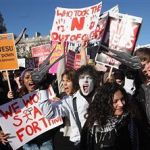
The violence at today’s student protest is, politically, a boon to the coalition. The story now is not the Lib Dems breaking their word but the storming of Millbank. The violence will also have cost the no-fees cause much public sympathy, we don’t like attempts at aggressive direct action in this country. There are questions that need to be answered after today, why were the cops so unprepared for the protest turning violent? I crossed through the protest at lunchtime and then it was quite clear that there was potential for trouble. I’m also bemused as to why it is taking so long to put a stop to the violence and deal with those involved. Given the political environment, this might well not be the last protest to turn nasty.

Cheating on the students

Writhe, squirm, cringe and cower. The Commons wanted to inflict ritual punishments on Nick Clegg today for his broken pledges on student fees. The plan nearly succeeded. With Cameron in China, (finding out what happened to our manufacturing base), Clegg took his place at the dispatch box opposite Harriet Harman.    Long practice has given Harman some skill, and even self-possession, at the dispatch box. She had an exceptionally easy target today. As she stood up to give Slick Nick a roasting, the streets around parliament were swelling with angry university-goers waving photos of Clegg signing his fateful election pledge on fees. The LibDem manifesto was being burned in public. Yellow election placards were being trampelled and spat on.

The politics of the student protests

The student protests really are throwing up some extraordinary images. Who'd have thought that they'd end up smashing their way in to the lobby of Tory HQ, setting fire to placards, hurling bricks and other objects – and all as news helicopters buzz insistently overhead? It's not Paris '68, but it's certainly not traditional British reserve either. I'd be tempted to say that this is the fury of a generation which, as I've written before, has generally been excluded from the political conversation – if, like Iain Dale, I didn't suspect that this demonstration had been overtaken by a bunch of dubious fringe groups. So, instead, I'll refer CoffeeHousers to this argument made by the Guardian's Julian Glover a few months ago, and which I've highlighted before.

Gaining work experience

Twenty years ago, students typically took low skill "summer jobs" simply to earn money.  Now, most offices and organizations feature youngsters putting in unpaid time for work experience.  It might be a week or two, or even half a year. The practice has its critics.  Union leaders are decidedly edgy about free labour competing for jobs with their members.  There are charges of exploitation and bad treatment.  The caricature has unpaid interns working photocopiers or being sent to collect sandwiches or laundry for management, without gaining any useful hands-on experience.

Reporting protest

Anyone who has ever been on a protest march or felt the heady frission of student rebelliousness should check out Hugo Rifkind's piece in the Times today. A really subtle piece of reporting, with no hint of the usual establishment sneer. What's fascinating about his observations the history of student revolt is how similar the present wave of sit-ins is to the protests of the past. The latest generation of student revolutionaries use the Israeli action in Gaza as their starting point but their real gripe is with global capitalism. They know as little about the realities of life in Isreal's occupied territories as their precursors in the 1968 "events" knew about Vietnam. Their unwitting alliance with the Islamic extreme right is unfortunate.