Stalin

Life in a gulag

From our UK edition

I was invited to Moscow earlier this year to give a talk about my latest book. But while I was there, I wanted to see if I could track down a few survivors of the gulags — the prison work camps where millions died during the communist years. I wanted to film interviews with them to be used as exhibits in a museum of communist terror which I hope to help create. I asked Anne Applebaum, who wrote Gulag: A History of the Soviet Camps, if she could offer any advice on finding survivors. She gave me tips but added: ‘You’re a bit late.’ The people who were incarcerated in Stalin’s work camps are mostly dead. It was going to be difficult — perhaps impossible.

A brave new world – at gunpoint

From our UK edition

Of the many books published this year to mark the centenary of the Russian revolution, this is perhaps the most curious. China Miéville is best known as an imaginative and entertaining writer of ‘weird’ (his word) science fiction and magic realism. October is a narrative history of the two 1917 revolutions in Russia, written from an ultra-left perspective — with a novelist’s eye for a good story and colourful characters. So it’s an examination of why the communist experiment failed miserably — at the cost of much blood — that is also wonderfully well written: smart, witty and full of fresh insight. But it can also read like an A-level essay, regurgitated from textbooks. Weird indeed.

The good, the bad and the ugly

From our UK edition

Vladimir Putin notoriously declared the collapse of the Soviet Union in 1989 to be one of the greatest disasters of the 20th century. However, as Revolution: Russian Art 1917–32 — an ambitious exhibition at the Royal Academy — helps to make clear, the true catastrophe had occurred 82 years earlier, in 1917. Like many of the tragedies of human history, the Russian revolution was accompanied, at least in the early stages, by energy, hope and creativity as well as by murderous cruelty and messianic delusion.

Only obeying orders | 12 January 2017

From our UK edition

Spare a thought for the poor Gulag guard: the rifleman standing in the freezing wind on the outside of the wire, almost as much a captive of the Stalinist prison machine as the inmates he’s guarding. Alexander Solzhenitsyn, Evgeniya Ginzburg and Varlaam Shalamov have left the world a rich, searing portrait of the Gulag from the point of view of the prisoner. But the diary of Ivan Chistyakov is unique — a narrative of the brutal conditions in Stalin’s Gulag, told from the point of view of one of the captors. Chistyakov was a senior guard at the Baikal-Amur Corrective Labour Camp or BAMLag, and he wrote his personal diary in 1935–6, just as Stalin’s henchman Naftaliy Frenkel was putting his scheme for mobilising convict labour into high gear.

Whisper who dares

From our UK edition

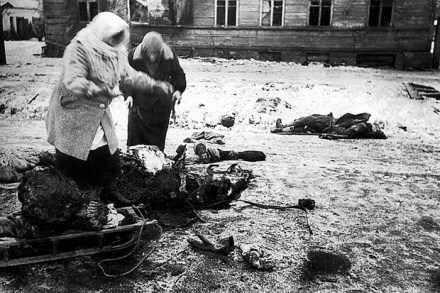
Stand aside, Homer. I doubt whether even the author of the Iliad could have matched Alexis Peri’s account of the 872-day siege which Leningrad endured after Hitler’s army encircled the city in September 1941. I never knew, for example, that if an adult starved for months on a few ounces of bread daily, a sip of soup and very little water — if they were lucky enough to get their daily rations — you couldn’t tell when they were naked whether they were male or female. I wouldn’t have believed that starving parents might eat their dead children, or vice versa; yet 1,500 Leningraders were arrested for cannibalism.

Stalin’s five year plans? A success, says BBC

From our UK edition

Following Fidel Castro's death, the BBC were accused of giving too much airtime to tributes to the Cuban dictator. When it came to print, BBC News described him as ‘one of the world’s longest-serving and most iconic leaders’ only mentioning in the fourth paragraph that ‘critics saw him as a dictator’. So, Mr S was curious to learn that the corporation, too, is able to see the positives when it comes to other left-wing dictators of Christmas past. Step forward Stalin: https://twitter.com/JGBartholomew/status/810609896521629696 On the BBC's Bitesize study site, there is a revision guide on Stalin's Five Year plans.

A marvel and a mystery

From our UK edition

In 2013, Pavel Dmitrichenko, disgruntled principal dancer of the Bolshoi, exacted a now infamous revenge on the company’s artistic director, Sergey Filin, for overlooking his girlfriend in casting the starring role in that most Russian of ballet classics, Swan Lake. The circumstances surrounding the acid attack, which seemed to combine ballet’s glamour with a murky underworld of intrigue, conspiracy, villains and victims, quickly became a contemporary metaphor for the Bolshoi itself. It’s irresistible as a lens through which to consider this intriguing institution at the heart of Russian politics, culture and life.

Red with the people’s blood

From our UK edition

Few 20th-century historians doubted that the 1917 Russian revolution was one of the most influential events of their time, indeed of all time. As the centenary commemoration approaches, however, it seems remarkable how far and how fast the ideology that inspired Lenin and millions of his worldwide followers has receded in significance. Many are the imperfections of capitalism, but almost nobody outside Jeremy Corbyn’s office any longer supposes that communism, least of all the old Soviet brand, offers a credible alternative. This would amaze our grandparents’ generation on both sides of the struggle. The novels of C.P. Snow are indifferent fiction but intriguing middle-class social history.

You’ve lost that loving feeling

From our UK edition

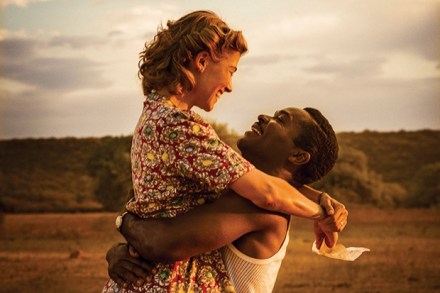
A United Kingdom is based on the greatest love story you probably didn’t have a clue about. I know I didn’t. It’s based on the true story of Seretse Khama, heir to the African kingdom of Bechuanaland (now Botswana), and Ruth Williams, a typist, who fell in love in 1940s London and married despite everyone and everything trying to separate them, including a vicious colonial British government. But this, sadly, is not the greatest film about the greatest love story you didn’t have a clue about. It’s OK. It does the job. It’s serviceable. It won’t be the biggest disappointment in your life. The story’s too good for it to get away completely.

The great Soviet gameshow

From our UK edition

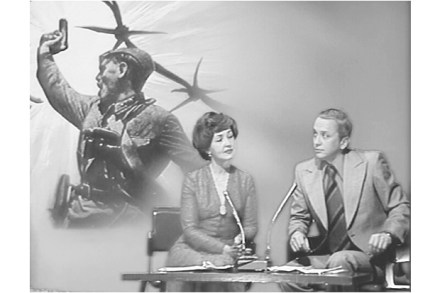
In the opening chapter of her history of Soviet Central Television, Christine E. Evans observes two Russian televisual displays of 2014. February saw the opening ceremony of the Sochi Winter Olympics — which sought to depict a millennium of national history using glitter and gameshow grandiosity. April brought the stern, but no less theatrical, Direct Line with Vladimir Putin — an annual phone-in — during which the president celebrated Crimea’s annexation with an orgy of televisual patriotism. Although more glitzy than their Soviet-era equivalents, both can be seen as displays of continuity in Russian broadcasting, rather than incidences of invention.

No happy endings

From our UK edition

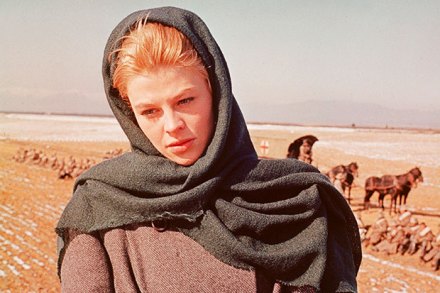
Between agreeing to review this book and receiving it, I got worried. Like many, I adore Doctor Zhivago with its tragic love story between the eponymous doctor-poet and the beautiful Lara, set in post-revolutionary Russia. When in Moscow, I followed the trail of literary pilgrims to Boris Pasternak’s dacha in the writers’ village of Peredelkino. I also had fond memories of Julie Christie and Omar Sharif in David Lean’s epic 1965 film; never underestimate the enhancing effect on romance of fur hats, sparkling snow and long-distance trains. Anna Pasternak, the writer’s great niece, is a journalist and Daily Mail columnist who made her name with Princess in Love.

Young at heart

From our UK edition

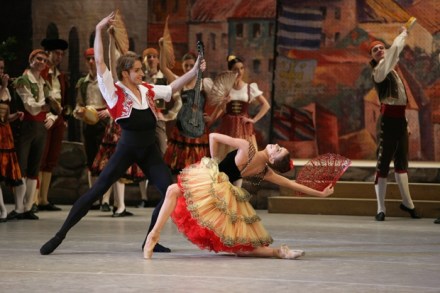
The second half of the Bolshoi tour brought much fresher fare than the first: following the ubiquitous warhorses Don Quixote and Swan Lake, we got three jolly nights of Moscow speciality: an iffy Shakespeare comedy nailed by superb performing, a giddy rewrite of Stalin’s favourite ballet and a breathtakingly fruity restoration of a 19th-century ballet entertainment, with pirate ships, dancing gardens and a vision of the hedonistic life of abducted women somewhat at odds with Boko Haram’s. The sexual politics of Shakespeare’s The Taming of the Shrew are potentially tricky for ballet since the woman is physically dependent on the man.

Enemies of history

From our UK edition

At the start of the 21st century, no one felt the need to reach for studies of ‘third-period’ communism to understand British and American politics. By 2016, I would say that they have become essential. Admittedly, connoisseurs of the communist movement’s crimes have always thought that 1928 was a vintage year. The Soviet Union had decided that the first period after the glorious Russian revolution of 1917 had been succeeded by a second period, when the West fought back. But now, comrades, yes, now in the historic year of 1928, Stalin had ruled that we were entering a ‘third period’ when capitalism would die in its final crisis. As the Wall Street crash was only months away, this was not as fanciful as it seemed.

Russia’s dumping ground

From our UK edition

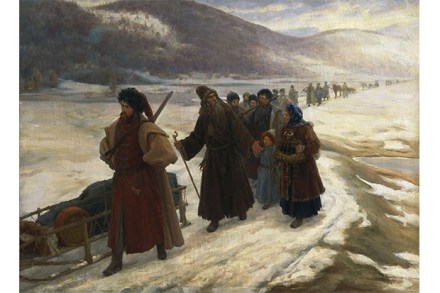
Almost as soon as Siberia was first colonised by Cossack conquistadors in the 17th century, it became a place of banishment and punishment. As early as the 1690s the Russian state began to use Siberia as a dumping ground for its criminals, as though its vastness could quarantine evil. Katorga — from the Greek word for galley — was the judicial term for a penal sentence where inmates performed hard labour in the service of the state. The sentence was commonly imposed in place of death from the reign of Peter the Great onwards. And in many ways Siberia truly was a House of the Dead — as Daniel Beer, who borrows the title of Fyodor Dostoevsky’s prison novel for his masterful new study, recounts in horrific and gripping detail.

Nostalgia and nihilism

From our UK edition

‘Gilded doorknobs,’ spits a Party diehard as she contemplates the blessings of the Soviet Union’s collapse. ‘Is this freedom?’ Dozens of witnesses from the ‘lost generation’ in Russia who had ‘a communist upbringing and a capitalist life’ share Elena S’s disgust and bewilderment as they contribute to this epic fresco of an empire’s bitter aftermath. Some adjust smartly to the post-Soviet disorder, although a 35-year-old advertising manager reflects that ‘I never dreamed of being fucked in stairwells or saunas in exchange for expensive dinners.’ The few winners and many losers agree: ‘You can’t buy democracy with oil and gas… You need free people, and we didn’t have them.

The bane of Albania

From our UK edition

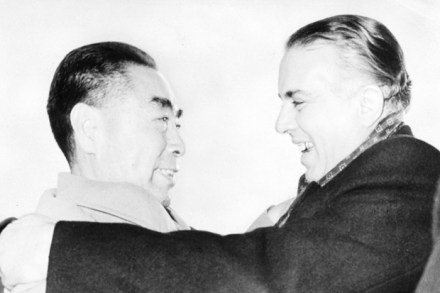
In his final public appearance, the Albanian dictator Enver Hoxha addressed a Tirana crowd to commemorate the capital’s liberation from German invaders on the 28 November 1944. The Hoxha who had entered the city as a communist partisan was now a weak old man. He was often confined to a wheelchair, had to be hoisted on to his podium using a custom-built lift and was only prevented from falling by camouflaged safety rails. The dictator was deeply vulnerable but still formidably powerful.

Communism kills

From our UK edition

I went to Budapest last year and did the usual touristy things. I climbed up the hill to the fantasy castle walls in Buda. I took a boat ride. I went to the Turkish baths — edging cautiously into scalding hot water and then summoning up the courage to tip a bucket of cold water over myself. Finally, I reached the grim end of the tourist trail: the so-called House of Terror. On the outside, it looked like every other Hungarian house on the boulevard. Inside, it was a museum set up in the actual place where first Nazis, then communists, inflicted imprisonment, terror and murder. Visiting it was a powerful emotional experience. You see the actual basement cells where prisoners were tortured or hanged.

Sixty years on

From our UK edition

The book of the year has long been a favoured genre in popular history, and is a commonplace today. While a book of hours endlessly recycles, the point of the book of the year is change, the more the better. There is an implied contest between years — you say 1917 is the most important; I trump you with 1940, or 1968 or 1979…. It is at once a rather silly genre, potentially nothing more than a dreary compendium of novelties, and one with distinct possibilities, as illustrated by both these books taking on 1956, one globally, one for Britain. Simon Hall’s approach is to write the story of a year in global history, by moving through the Americas, Africa and Europe, taking up the story of particular events as they happen at the rate of over one a month.

A pitiful wreck

From our UK edition

When I look at the black-and-white photograph of Julian Barnes on the flap of his latest book, the voice of Kenneth Clark floats up from memories of the black-and-white television of my childhood: ‘He is smiling — the smile of reason.’ Supremely ‘civilised’, thin-lipped, faintly superior, temperamentally given to aphorism, it is no surprise to discover that Julian Barnes is a Chevalier de l’Ordre des Arts et des Lettres. Yet Barnes in his fiction is unlike the simplified Voltaire of Clark’s Civilisation. His novels never proclaim the triumph of reason: instead, they explore the dark and disruptive, uncivilised emotions on the edge of words — love, certainly, but also jealousy, paranoia, inconsolable grief and the fear of dying.

Of hearts and heads

From our UK edition

Like most trade unionists in the 1970s and 80s I worked with a fair few communists. Men like Dickie Lawlor, Jock Cowan and Maurice Styles, postal workers for whom all events were viewed through the prism of ‘scientific socialism’. Communism gave them a philosophy by which to live their lives, and they were respected as men of principle even by those who abhorred their politics. Marx may have disparaged religion as the opiate of the people (and, in an even more memorable phrase, the sigh of the oppressed), but it was difficult to avoid the term ‘religious zeal’ when describing the way men like Dickie, Jock and Maurice approached their union work. By the time I knew them they’d long passed the stage of seeking converts.