Snp

Alex Salmond’s Inevitability Strategy

Apparently it is all but compulsory for London-based observers to note that Alex Salmond is "wily". Those possessing an Anglo-Scots dictionary may add that he's "sleekit". By this they really mean he's not a numpty and this, given the pressures of the times and all of that, is as much of a compliment as any minister can hope to receive. Alex Salmond is an intelligent politician who is often on manoevres. Shockerooni! Be that as it may, it is evident that the First Minister appreciates the importance of image-projection and, accordingly, is doing his utmost to present Scottish independence as a destination that's as logical as it is inevitable. It is about building momentum which in time becomes self-sustaining.
Salmond: Scotland Free By 2016?

So, the game is afoot. The Scottish government today published its consultation document on an independence referendum to be held in the autumn of 2014. You can read it all here though I should warn you that most of it is entirely unobjectionable. If Mr Salmond is the salesman he hopes he is, the next Scottish parliament - due to be elected in May 2016 - will be the first to govern an independent nation since that auld sang ended in 1707. I notice, however, that the favoured question proffered by the SNP has changed. As recently as last year it proposed asking for a mandate to open negotiations. This has become a simpler, more direct question: Do you agree that Scotland should be an independent country?  No "maybe" box is provided for responses.

Salmond’s dangerous strategy

Cartoonists like to portray Alex Salmond as a modern-day Braveheart preparing to charge the English enemy. But, in truth, Salmond’s strategy is far more subtle — and dangerous — than that.   The SNP leader’s piece in The Guardian today — a preview of the Hugo Young lecture he’s delivering tonight — downplays what a dramatic step independence would be. At times the article reads like an argument for ‘devo max’, not independence. He bemoans that devolution ‘left Scotland with fewer powers than the German Länder, most American states, parts of Spain or, within these islands, the Isle of Man’.   Salmond also wants to suggest that not that much would change after independence.

The John Wilkes Society is Reborn

John Wilkes was radical and wrong; his latter-day equivalents are merely stupid and wrong. To buttress this notion, I submit the cases* of Simon Heffer and Melanie Phillips. We are talking, as you know, about the Scottish Question upon which these Daily Mail columnists have recently seen fit to pontificate. As we shall see, if these are the people teaching Scotland to Middle England then the plain yeomen of England should demand better from their newspaper. It is one thing to peddle nonsense - everyone must do what they can to earn a living - quite another to sell an argument that contradicts itself. Yet hark at this from Mr Heffer: As in some marriages, divorces happen when one side walks out.

Scottish independence by numbers

It's far from the first poll on Scottish independence in recent years, or even in recent days, but YouGov's effort for Channel4 this evening contains some noteworthy findings nonetheless. What is does is replicate the conditions that — for the reasons that Peter Kellner explains in a very useful blog post here — Alex Salmond would like in 2014. Which means two questions, one after the other. First, status quo or ‘devo-max’? Second, status quo or full independence? And the results? By YouGov's count, 58 per cent of people are in favour of ‘devo-max’ for the first question, with 42 per cent against. And, for the second question, 39 per cent back full independence, with 61 per cent against.

A joke too far?

Tom Harris lost his job as Labour's ‘Twitter tsar’ today after uploading this Salmond-themed Downfall video onto YouTube.

From the archives: Saving the Union

With Scottish independence very much the issue of the week, we thought you might enjoy this Spectator leader from 1979, arguing for a 'No' vote in that year's referendum on Scottish devolution: To preserve the Union, 24 February 1979 ‘So, Sir, you laugh at schemes of political improvement?’ ‘Why, Sir, most schemes of political improvement are very laughable things.’ The Scotland Act, which comes before the judgement of the Scottish people on Thursday, is certainly laughable. Would that it were no more than that.

The Pound, the Euro and Other Scottish Pink Herrings

The crisis in euroland continues unstaunched and, perhaps, irrevocably. Naturally, being self-obsessed sorts and this being the week it is, one is drawn to consider the impact this must have on Alex Salmond and the prospects for Scottish independence. Plainly, the currency question is a difficult one for the First Minister. While the euro seemed solid it was at least straightforward, even though one wondered if swapping monetary policy set by the Bank of England for monetary policy set by the European Central Bank would necessarily be a great bargain. But the euro is no longer solid and uncertainty reigns.

Transcript: Gove on sacking teachers

This morning, the Education Secretary went on the Today programme to explain his plans to make it easier to sack teachers. Here’s the full transcript: James Naughtie: From the start of the next school year in England, head teachers will find it easier to remove teachers that are considered to be under-performers.  The Education Secretary, Michael Gove, thinks the process is too cumbersome so it is being streamlined. The National Union of Teachers, as we heard earlier, says it could become a bullies’ charter.  Well Mr Gove is with us. Good morning. Michael Gove: Good morning. JN: Bullies? MG: I don’t believe so.

Osborne sparks the unionists’ fightback

Edinburgh It became clear last night why George Osborne was put in charge of the Coalition Government’s fightback against Alex Salmond and separatism: he is the only one who has the ability to really score points off the Nats. The Chancellor’s intervention on currency and bank notes – suggesting that an independent Scotland might not be able to keep the pound and that, if it did, it might be banned from producing Scottish bank notes – hit the SNP hard. Osborne’s remarks shook one of those comfortable certainties which the SNP has been peddling for so long – that Scotland would simply keep sterling after independence and everything would progress as normal.

Would Spain stop Scotland from joining the EU?

Alex Salmond’s case for independence relies on Scotland joining the European Union. If an independent Scotland was a member of the EU, then Scotland would be part of the single market and free movement of labour across the border could continue (an independent Scotland would also have to join the euro, but that’s something Salmond is less keen to talk about). But, as one Whitehall source points out to me, it is far from certain that Scotland would be able to join the EU.   The Spanish are currently blocking Kosovo’s accession to the EU. Why? Because the Spanish, who don’t even recognise Kosovo as a state, fear the implications of a region becoming independent and then joining the EU. They worry that it would encourage Basque separatism.

Peter Oborne Returns to Form

After last week's mishap, Peter Oborne returns to form with a column best considered as a mash-note to the Radio Four theme. Because Peter is, essentially, a romantic he allows himself to be carried away by the fond vigour of his desire to see Great Britain preserved for future generations to enjoy. That should not detract from the central thrust of his column: Alex Salmond, that most brilliant and attractive of modern British politicians, is capable of superbly articulating the sense of nobility, romance, mission and fierce patriotism felt by many SNP supporters. Nationalism and the cry for liberty can be an intoxicating cocktail, even at the start of the 21st century. So far his opponents have produced nothing to rival it.

Salmond’s dangerous corporatism exposed

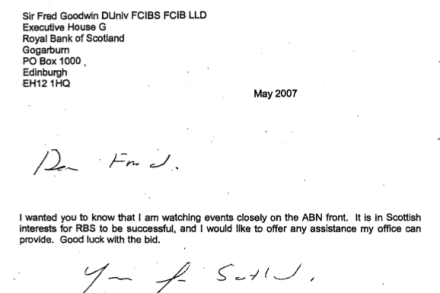
How would an independent Scotland have fared during the crash? Given that the liabilities for RBS alone represent 2,500 per cent of Scotland's economic output, it's a difficult question for Alex Salmond. He replies that the banks in Scotland would have been better-regulated by wise, old him, so the problems would not have arisen. But Faisal Islam at Channel Four has unearthed a letter that rather explodes this theory, written from the First Minister to Fred the Shred egging him on with the calamitous acquisition of ABN Amro. This, as CoffeeHousers will know, is the acquisition which was so hubristic that it went on to sink the whole banking group.

A fairly bland PMQs

Today's PMQs was rather a bland affair. Ed Miliband started with three questions on train fares that David Cameron batted away, but there is a little row brewing over whether Cameron's claim that he is simply continuing the policy of the last government is correct. Later, Miliband moved onto the safe territory of the Union and consensus broke out with only the half dozen SNP MPs dissenting from it. Angus Robertson, the SNP's Westminster leader, then asked the PM a question that, in a preview of the SNP's campaign tactics, was designed purely to get the words Cameron, Thatcher and Scotland into the same sentence. There were two other things worth noting from the session.

Will Miliband use his lifeline in PMQs?

At the weekend, Tories were anticipating giving Ed Miliband an almighty kicking at PMQs. Lord Glasman’s description of Labour’s economic record as ‘all crap’ had given them a killer line. As one member of the Cameron circle joked to me, ‘we’ve never had more material to work with.’    But Ed Miliband now has a get out of jail free card. If he asks six questions about the Union and the referendum, it will be impossible for Cameron to have a pop at him without looking distinctly unstatesmanlike. On Scotland, the two leaders need each other. The Unionist side cannot win without the Labour party and the Labour party will find it very hard to win general elections without Scotland.

The battle lines that are being drawn over Scotland

In the wrangling between Westminster and Holyrood over the referendum there are two big issues at stake, the date of the vote and —more importantly — the number of options on the ballot paper. Salmond, as he made clear on the Today Programme this morning, wants to have the referendum in autumn 2014 and have three options — the status quo, independence and ‘devo-max’ — on offer.   The reason Salmond wants ‘devo-max’ to be there is that he’s not confident he can get independence through this time round.

Salmond’s running rings around Cameron

Edinburgh If anyone had any doubts why Alex Salmond picked up almost every UK political award going last year, then they should study how he has dealt with the referendum issue this week. At every turn he has out-manoeuvred his UK counterparts — and this was perfectly demonstrated tonight. Earlier today, in the Commons, Michael Moore, the Scottish Secretary, had delivered the UK government’s riposte to the SNP’s referendum plans. Mr Moore was considered, clever and smart. In fact, it was a first cogent and effective strike back by the UK government on this issue for more than a year. But what will lead tomorrow’s papers in Scotland? It won’t be Mr Moore’s statement.

The coalition finds its balance over Scotland

As much as I dislike the phrase ‘the third way’, it sums up what the coalition has done today. Given the choice between hobbling or accommodating Alex Salmond and his referendum on Scottish independence, it has decided to do neither and both. In the words of the Scottish Secretary Michael Moore, speaking in the House just now, the referendum will be ‘made in Scotland, by the people of Scotland’ — just so long as Westminster okays it first. Maybe that'll make more sense if we look at what, specifically, was announced today. Moore's main point was that any referendum held by the Scottish government, without the approval of the UK government, would be ‘unconstitutional’.

The battle for Britain | 10 January 2012

So, Alex Salmond has named his date for the independence referendum: August 2014, a few weeks after the 700th anniversary of the Battle of Bannockburn. David Cameron wanted it earlier, and may yet refuse to grant Salmond this date — No10 hasn't yet responded. Cameron was forcing the issue on the grounds that he wanted to end uncertainty — Salmond is now offering certainty, at least in terms of timing. But he hasn't said whether he wants a two- or three-question referendum. This is crucial, because Salmond is likely to lose an independence referendum and he knows it. So his game plan will be to have a third option, a consolation prize, so he doesn't walk away from this empty handed.