Snp

Music to the SNP’s ears: Vote Labour, get more austerity

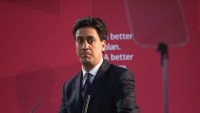
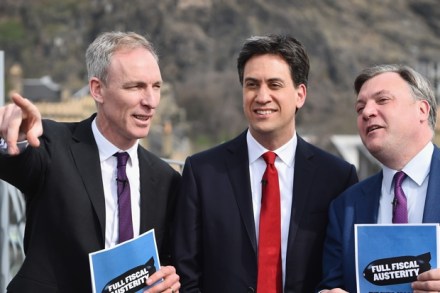
As Jim Murphy tries to turn back the SNP surge, he has been arguing that a Labour government wouldn’t result in endless austerity. He has repeatedly cited the Institute for Fiscal Studies’ finding that Labour couldn’t meet its deficit reduction target with no cuts at all after 2015-16. Now, Ed Balls and Ed Miliband have today been clear that Labour will bring in cuts post 2016. But they have avoided contradicting Murphy by name. Chuka Umunna, however, showed no such restraint earlier today. Under questioning from Andrew Neil, he declared: ‘The leader of the Scottish Labour party will not be in charge of the UK Budget.
What’s going on in Scotland

If the election in England is the political equivalent of trench warfare with Labour and the Tories inching forwards and then back, what’s going on in Scotland is a rout with the SNP driving all before it. What is remarkable is how the Nationalists are even in with a chance of winning seats such as Edinburgh South West that voted No by a more than twenty point margin. At the moment, everything their opponents throw at it seems to bounce off the SNP. The so-called Sturgeon memo, which claimed that she had told the French Ambassador that—contrary to all her public protestations—she would prefer Cameron to Miliband as Prime Minister, was the big story this time last week. But now, it is an irrelevance.

Campaign kick-off: 27 days to go

It's the Conservatives’ turn to try and bounce back today. After the ‘dead cat’ thrown onto Ed Miliband’s kitchen table, it looks as if Tories parties will be hoping to return to policy — not slashing non-doms — and move away from personal attacks. To help guide you through the melée of stories and spin, here is a summary of today’s main election stories. 1. Polls everywhere, but not a lead in sight No fewer than five opinion polls were released yesterday, three of which showed Labour leads while two had the Conservatives ahead. The Guardian went as far to deem Thursday as ‘The day the polls turned’, but there is still no clear frontrunner at this stage.

Barometer | 9 April 2015

The Scottish way of death Nicola Sturgeon said the SNP would block a rise in the state pension age on the grounds that it would be unfair to Scots, who don’t live as long as the English. — The idea that the Scots die early was fuelled by a study by the Glasgow Centre for Population Health in 2006, which found male life expectancy in the Calton area of Glasgow to be 54: less than in many developing countries. — The figure, derived from statistics collected between 1998 and 2002, was exaggerated by the presence of a large number of hostels in the Calton taking in drug addicts from other areas. Life expectancy in Glasgow as whole last year was 73 for men and 78.5 for women, the lowest for any council area in Britain but not by much. In Blackpool it is 74.3 for males.

Miliband vs Millwall

I’ve been trying to think of a good football analogy to describe the battle between the two main parties as the general election approaches. One suggestion is the second leg of a Champions League game, with the Conservatives having won the first leg by one goal to nil. If we assume that the Tories are playing at home, that means Labour have to score two goals to win, whereas all the Tories have to do is not concede. Last week’s debate certainly felt like that, with Cameron playing a tight, defensive game and Miliband trying to score at every opportunity. The Conservative leader ended up winning on aggregate because the Labour leader failed to find the back of the net. But a Champions League match suggests two teams of real quality, which is where the analogy breaks down.

Swing time

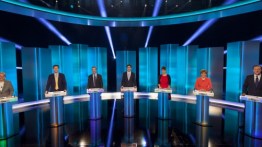
The age of two-party politics is over: we know that because everyone keeps saying so. We are entering an era of coalitions, apparently, where compromise is king and a wider variety of views will be represented in parliament. These barely comprehensible seven-way television debates are the future, we are assured, and decisive general election results a thing of the past. Look deeper and this analysis falls apart. Even now, Labour and the Conservatives between them have about two thirds of the vote, just as they did at the last general election. What we are witnessing is the collapse of the Liberal Democrats, who have been reduced — on a bad day — to being the UK’s sixth most popular party.

Sturgeon vs Murphy vs Davidson is the best show in British politics

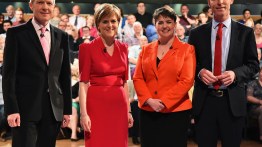
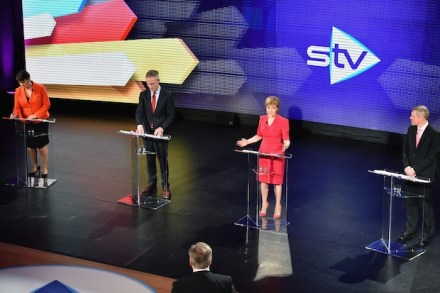
Right now, you know, Nicola Sturgeon vs Jim Murphy vs Ruth Davidson is the best show in British politics. It really is. Better, for sure, than David Cameron vs Ed Miliband vs Nick Clegg. The three Scottish leaders are each substantial - and likeable - figures in their own right but it also helps that the question of Scotland is a large and important issue upon which there is mighty disagreement. That makes for a heftier, more passionate, kind of politics. The future matters and is, depending upon our choices, very different. It is more than just a managerial process. This week's two Scottish debates confirmed all this. They were, as Fraser says, proper politics. There is a thirst for argument up here and a welcome for the rough-and-tumble too.

Campaign kick-off: 28 days to go

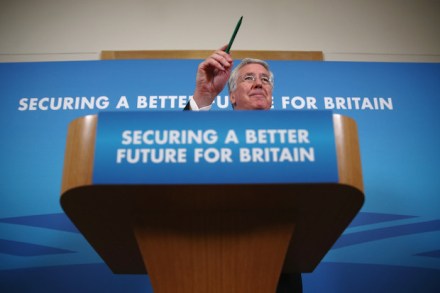
Trident is set to be the big issue today — but the fight isn't just about policy. Several newspapers have splashed on the news that the Tories are attempting to embarrass Labour over whether they would allow the SNP to box them into scrapping our nuclear deterrent. To help guide you through the melée of stories and spin, here is a summary of today’s main stories. 1. Fallon vs. Miliband The Defence Secretary Michael Fallon has launched an attack on Ed ‘backstabber’ Miliband in the Times today — claiming that he would trade renewing Trident for SNP support to prop up his government. ‘Ed Miliband stabbed his own brother in the back to become Labour leader.

Podcast: what if Ed wins, the madness of Scottish politics and Catholic wars

Ed Miliband could still win the general election, but what would happen next? On the latest View from 22 podcast, The Telegraph’s Dan Hodges discusses this week's Spectator cover feature on what to expect from a Miliband premiership with George Eaton of the New Statesman. Would Miliband manage to take his lofty ideas about reshaping capitalism into No.10? Or would he be more pragmatic in power? Like his mentor Gordon Brown, could Miliband's indecisiveness turn out to be a fatal flaw? James Forsyth and Alex Massie also discuss the current madness of Scottish politics.

A Scottish revolution is coming, and everyone’s losing their heads

[audioplayer src="http://rss.acast.com/viewfrom22/edcouldstillwin/media.mp3" title="James Forsyth and James Forsyth discuss the current state of Scottish politics" startat=866] Listen [/audioplayer]Normally, if a candidate whose party came fourth in a constituency last time tells you they’re going to win, you put it down to election derangement syndrome. But in post-referendum Scotland the normal political rules don’t apply. When Joanna Cherry, the SNP candidate for Edinburgh South West, says she’s headed for Westminster — despite the SNP picking up just 12 per cent of the vote here in 2010 — she is probably right.

Switch over to the Greek debt drama: the final episode must be coming shortly

Bored with the election? Switch over to the Greek debt drama. In this week’s cliffhanger, silver-tongued finance minister Yanis Varoufakis visited IMF chief Christine Lagarde on Sunday, promised to meet his country’s obligations ‘ad infinitum’, and was expected to meet a €450 million repayment to the IMF on Thursday. But more troublesome members of the ruling Syriza party denounced the IMF and Brussels for treating Greece as ‘a colony’, threatening a snap election ‘if creditors insist on an inflexible line’, and warning that public-sector salaries and social security payments must rank ahead of debt as cash runs out. Which it will before August.

The referendum is still defining Scottish politics

One of the most striking things about Scotland is how the referendum still dominates politics here. I’ve seen more Yes posters and stickers than I’ve seen posters for any political party. The referendum also goes a long way to explaining the SNP surge. In Edinburgh East, for instance, 17 thousand people voted Labour in 2010, giving the party a nine thousand majority. Considering that the seat has been Labour since 1935, you’d expect that to be enough for the party to hold on easily. But as the SNP candidate for the seat Tommy Sheppard pointed out to me, 27 thousand people in this seat voted Yes last autumn. If he can get two thirds of them to turn out and vote SNP, then he’ll win.

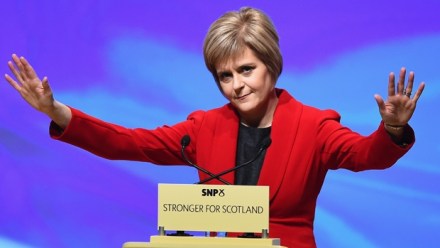
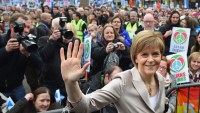
Nicola Sturgeon and the SNP continue to defy the usual laws of politics

It's nice to be noticed. I cannot recall the Scottish portion of a UK general election ever exciting this much interest from folk unfortunate enough to live south of the Tweed. I don't blame southrons for wondering just what in god's name is happening up here, however. These are uncharted waters for all of us. And yet, despite that, it is a little less revolutionary than it seems at first. Consider these numbers: 39, 33, 29, 32. That's the share of the constituency vote won by Labour in the four elections to the Scottish parliament. And then there are these numbers: 29, 27, 33 and 45. That's the share won by the SNP.

Three ways the Scottish leaders’ debate will affect the UK general election campaign ​

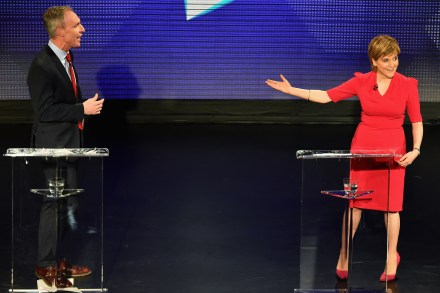
Tonight’s Scottish debate isn’t going to fundamentally alter the dynamics of this general election campaign in Scotland. But it will reverberate through the UK-wide general election campaign. Both Ed Miliband and David Cameron have been left with questions to answer by their Scottish leaders while Nicola Sturgeon has made clear the price she intends to try and extract for supporting a Labour government. In heated exchanges with Sturgeon about the economy, Jim Murphy pointed out that the Institute for Fiscal Studies says that Labour would not need to cut further after 2016. Now, the Labour leadership in London has studiously avoided endorsing this idea. But Miliband and Ed Balls can now expect to be put on the spot about it after Murphy’s comments.

My night with Nicola Sturgeon

When I watch Nicola Sturgeon exercising her newfound charm and confidence, I experience a pang of intimate regret. Some 15 years ago — when she was a new MSP and the SNP’s shadow education minister — we both appeared on a late-night Scottish television show in Aberdeen, in which guests were invited to defend controversial propositions in front of a live audience of students. My task was to argue that poorer countries should not have their debts forgiven (then the theme of the Millennium ‘Jubilee’ movement, now a key argument about Greece) as a result of misplaced rich-world guilt; needless to say I took a pasting. The future first minister made a worthy but jokeless case for teaching Gaelic in primary schools, and provoked a lot less shouting.

The Scottish TV debates offer Labour one final chance to hold back the SNP advance

Tonight’s Scottish leaders’ debate in Edinburgh is as important to the general election campaign as last week’s debate featuring Cameron, Miliband et al in Manchester. Both this debate and the second Scottish one tomorrow offer Labour a final opportunity to reverse the SNP advance. The polls indicate that the SNP are on course to take 28 Scottish seats off Labour in May. This would make it the largest Scottish party at Westminster. It would also make it impossible for Ed Miliband to win a majority. At the moment, nothing seems capable of halting the Nationalists’ momentum. The dramatic fall in the oil price, which has upset many of the calculations in the independence white paper, hasn’t dented their support.

Why all this talk of a hung parliament could be a self-fulfilling prophecy

In a close campaign, you would normally expect the smaller parties to get squeezed as voters decided that is really a choice between Labour and the Tories. But this time, thing might be different. Why, because the general expectation is that there will be another hung parliament and the coverage of the campaign is being reflected through that prism. This emphasis on the likelihood of a hung parliament could change how people actually vote. As I write in the current issue of the magazine, the British Election Study shows that among voters who expect another hung parliament support for both Labour and the Tories is radically lower with the minor parties doing that much better. Among those who expect one party to win outright, Labour and the Tories poll at 39 and 38 percent respectively.

Tories convinced ‘moment of maximum danger’ has passed

On Thursday night, David Cameron didn’t eviscerate the competition. But nor did he suffer any damage and that, to Tory high command, meant that it was job done. The Tory leadership didn’t want any debates at all, they’d rather not have taken the risk. So, to get through this one debate with the dynamics of the campaign unchanged was, to their mind, a result. As Cameron enjoyed a late night drink with Samantha Cameron, George Osborne and his key aides on Thursday, he reflected on how much better he felt than he did after the first debate five years ago when he knew that he had not only underperformed but that he had two more to get through. This time round he’d done fine and was done with debates.

Why the leaked Nicola Stugeon memo rings true 

After 15 hours of fascinating and - let’s face it - fairly exciting developments in l’affaire Sturgeon, here’s where I think we are, and I’ll try to stick as much as possible to incontrovertible facts, not political bluster: If this was all a grand misunderstanding, I think the various parties would have come together by now to explain what they think has happened, e.g. perhaps Nicola Sturgeon used the word ‘expect’, that got turned into ‘espoir’ back in the French embassy, and then relayed to the FCO as ‘hope’. That’s pretty plausible, but we’ve heard no such explanation yet.