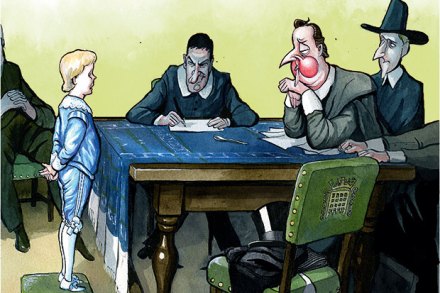
Safe space

The mental health election spiral

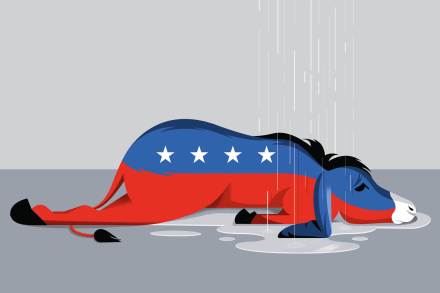
My first semester of college coincided with the 2012 presidential contest between Barack Obama and Mitt Romney. I was a conservative from a small rural town at an elite liberal university, and this was not great for my social life. My freshman floormates at Georgetown defaced my political signs, made nasty comments to me in the hallways and on election night my RA dropped by my room to rub it in my face when the race was called for Obama. The following morning, we all went back to class and started preparing for midterms. Four years later, universities across the country all but shut down when Donald Trump won the 2016 election. Suddenly the mental health of the losers was priority number one. Classes were canceled to allow students space to grieve.
mental

Are we losing the American dad?

Over the past weeks, a cadre of young men has spent their days marching across the quad, demanding an end to a justifiable, nay honorable, Israeli war on amoral terrorists. An overlapping segment has donned their rainbow buttons and profile-art propaganda to honor the sexual proclivities of their fellow man. They scream borrowed sentiments in all caps, tapped self-righteously into the iPhones their parents have surely furnished. They take over streets and public spaces, inconveniencing the world around them. Their posters, wearing whatever slogan trends on social media, may as well say, “Look at me, world… but let me put the right filter on first.” These are the men of their generation. These are the next generation of American fathers.

father dad

Republicans are embracing the left’s victim culture over antisemitism

For years, Republicans have claimed that theirs is the party of free speech. They have correctly amplified instances of the intolerant left cracking down on conservative speech, particularly on campuses, often under the bogus guise of combating "hate speech," racism, sexism, homophobia, transphobia and other scourges they grossly exaggerate. Many of us on the right have mocked safe-space-craving Gen Z and millennial students and their expansive needs to feel “safe” by insulating them from speech that hurts their feelings. But now Republicans are conflating legitimate criticisms of Israel with antisemitism and essentially embracing the left’s victim culture in calling for safe spaces — if not by name — for pro-Israel Jews on college campuses.

israel

Can the University of Austin spark a new Enlightenment?

The University of Austin, America’s newest university, was launched this month. I am one of five founders, because I am convinced that higher education is at considerable risk. A new ideology — sometimes called social justice, and revealed in numerous ways, but most succinctly called “woke” — is taking a huge toll on the free exchange of ideas. Safe spaces and trigger warnings are demanded by students, and many faculty as well, rather than recognizing that challenge, risk, and discomfort create strength of will, and wisdom. Instead of being the adults in the room, scared and hapless administrators capitulate to their demands.

austin

Why trigger warnings don’t work

The science is in, but don’t expect that to change anything. According to at least 17 recent studies, trigger warnings — those advisories posted ahead of content some readers may find distressing — not only fail to alleviate suffering in the emotionally disturbed but may actually induce greater trauma in those individuals. There are, to date, no studies that indicate trigger warnings work to their intended purpose. They were dreamed up in the 1970s after psychologists began to diagnose a new condition, post-traumatic stress disorder, in Vietnam War vets. But trigger warnings only reached popular consciousness in the 2010s, when feminist blogs used them ahead of content about sexual violence.

trigger

Free speech and expensive schools in South Dakota

In nearly every state, the legislature is nervous about the public universities it finances. And fair enough. Apart from sports, the state colleges in America tend to make the national news only when protests break out, and protests tend to be driven by a radicalism that reveals the school protesters are far to the left of the legislatures of even the more liberal states. Such national news embarrasses the legislators, who send querulous letters to the school officials, with distant threats of cutting state funding. Which tempts those officials to surrender preemptively to activists, in the hope of avoiding protests. Conservatives in America typically blame the radicalism of college administrators for, say, the academic banning of conservative speakers on campus.

university of south dakota

Rewriting Kipling for the modern age

From our UK edition

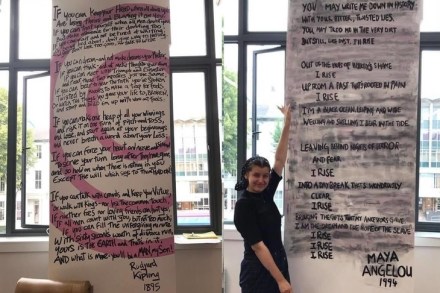
It is often said that we should worry about the world we are leaving to the younger generation. I am a bit more worried about the poor world, given the state of the younger generation who will soon have custody of it. Last week, for example, the students of Manchester University have decided that Rudyard Kipling’s poem “If” is not suitable for their college because he was raaaaacisst. Of course. They have replaced his poem with some vapid drivel from the serially overrated Maya Angelou. It might have been better if they’d simply rewritten Kipling’s verse, adapted it for modern times.

Blame the grown-ups for the safe-space tribe

From our UK edition

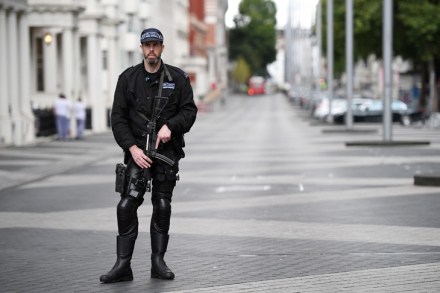
A car driver ploughs into a bunch of people outside the Natural History Museum in London and lefties are furious mostly because the right-wing columnist Katie Hopkins thought it was another jihadi attack. For thinking this she is a racist bigot and consummately evil — despite the fact that I suspect most Londoners thought precisely the same as Hopkins when they heard the news. We are in the bizarre situation where horrible incidents not perpetrated by Muslims are gleefully welcomed by the lefties because they believe it adds grist to their idiotic mill: other people are capable of driving cars into pedestrians, you see, so it is racist to suggest that radical Muslims have a particular predilection for doing so.

How ‘safe spaces’ make life harder for people with mental illness

From our UK edition

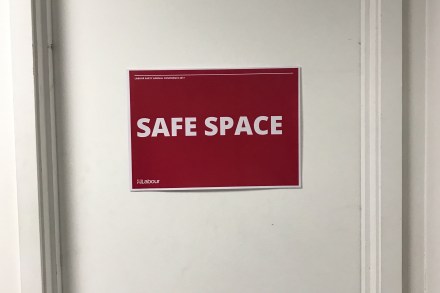
Oh, how wonderfully hilarious: Labour conference has a safe space. It's exactly what you'd expect from a Party now led by eccentric former rebel backbenchers who'd probably still rather be making jam in peace in Islington, isn't it? I ventured into the room marked 'safe space' in the Brighton Centre this week, half expecting to find a group of Blairites huddled in one corner and a group of members who just couldn't cope with the idea of a debate on continuing single market membership in the other. Disappointingly, it was just a bare room with a few chairs and an odd hatstand which seemed to be brandishing a bin.

Latin texts are full of violence, racism and class – that doesn’t mean they need a trigger warning

From our UK edition

Last week, Brendan O’Neill described in this magazine how students regulate ‘unacceptable’ political views with ‘no platform’ policies, safe spaces and trigger warnings. Two weeks ago a student Latin course (Reading Latin, P. Jones and K. Sidwell) was ‘outed’ by an American PhD student, because the text featured three goddesses, each confidently stripping off, determined to win the golden apple from Paris, and two rapes. Such ‘offensive’ choices, she said, did not help the cause of Latin, ‘or make the historically racist and classist discipline of classics any more accessible’. Both rapes featured in a foundation myth of early Roman history.

The Spectator Podcast: Campus tyranny

From our UK edition

On this week's episode of The Spectator Podcast we look at the issue of 'safe spaces' on campuses and beyond. We also discuss Donald Trump's military strategy, and look at Indian independence, 70 years on. First up: In this week's Spectator cover piece, Brendan O'Neill slams British universities for what he sees as a burgeoning liberal conformism within their walls. Is he right to despair? Or is this just a grumpy older generation railing against change? He joins the podcast along with Justine Canady, Women's Officer for UCLSU, and Madeleine Kearns, who writes about her experiences at NYU in the magazine. As Brendan says: "In the three years since The Spectator named these Stepford Students, the situation has become far worse.

Unsafe spaces

From our UK edition

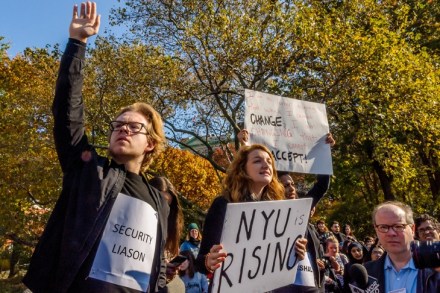
As a child in Glasgow, I learned that sticks and stones might break my bones but words didn’t really hurt. I’m now at New York University studying journalism, where a different mantra seems to apply. Words, it turns out, might cause life-ruining emotional trauma. During my ‘Welcome Week’, for example, I was presented with a choice of badges indicating my preferred gender pronouns: ‘he’, ‘she’, ‘they’ or ‘ze’? The student in front of me, an Australian, found this hilarious: ‘Last time I checked, I was a girl.’ Her joke was met with stony silence. Later I realised why: expressing bewilderment at the obsession with pronouns might count as a ‘micro-aggression’.

Censorious universities are a bigger problem than Stepford students

From our UK edition

Have you heard the one about the students who said clapping could cause anxiety? Or the students who banned sombreros? Of course you have. You can’t move these days for tales of Britain’s blue-haired belligerents and their campus war on free speech, ‘fascist’ tabloids and fancy dress. Student leaders have become a national embarrassment – and with good reason. They’ve turned everything that was good about being a student – broadening your mind, having fun, being free – upside down. But it’s become a little too easy to bash students, to pretend that a new generation of so-called 'snowflakes' are single-handedly destroying Enlightenment values. Student union politicos are, after all, entirely unrepresentative.

The Spectator podcast: Syrian nightmare

From our UK edition

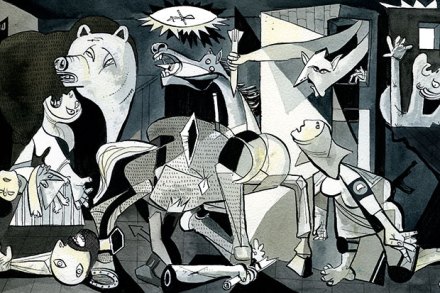
The Syrian initiative to retake the last remaining rebel stronghold of Aleppo, following a two week ceasefire, has proved controversial in the international community. Images of children bloodied, bruised and painted with masonry dust have decorated the front pages of British newspapers, but is there anything that can help ease the pain of ‘Syria’s Guernica’? These are the issues raised in Paul Wood’s cover piece this week. Speaking to the podcast from Washington, he said: "This has been going on for five years now and there have been surges from both sides. We happen to be in the middle of a surge by the regime attempting to take the last bit of rebel held Aleppo.

The students fight back

From our UK edition

Last week, students at York University staged a walkout from the sexual consent classes organised by their student union women’s officers. A quarter of the freshers decided they didn’t want to be lectured to by union worthies about when it’s OK to have sex. So they got up and left. ‘These talks are inherently patronising of both genders,’ said Ben Froughi, a third year accounting student at York, who had stirred up sex class dissent by handing out leaflets telling students the classes were optional and they didn’t have to attend. But sex consent classes are mandatory at some universities, including Cambridge and Oxford. Young people are being chaperoned through the minefield of sexuality, often against their will.

The only way to make a ‘safe space’ for conservatives at universities

From our UK edition

To Edinburgh for the book festival, where I am to explain Fools, Frauds and Firebrands to respectable middle-class Scots, who have an endearing way of suggesting to me that I, like them, am a thing of the past. They queue to buy the book, which is nice of them; however, the publisher has failed to deliver any copies, so the need to part with a few quid for politeness’ sake slips painlessly over the horizon. Only the students in the queue awaken me from my complacency. Where do we turn for comfort, they ask, when our reading lists are gibberish about which we can understand only that it is all left-wing? Is there no network, no secret society, no alternative reading list to get us through the next three years?

The Spectator podcast: David Cameron’s purge of the posh | 4 June 2016

From our UK edition

To subscribe to The Spectator’s weekly podcast, for free, visit the iTunes store or click here for our RSS feed. Alternatively, you can follow us on SoundCloud. Naming the best columnist in Britain is like naming you’re the best Beatles song: it varies, depending on what kind of mood you’re in. But who would deny that Matthew Parris is in the top three? The quality of his writing is, itself, enough to put him into the premier league but that’s just part of the art. What sets Matthew apart is his sheer range, and his originality. You never know what he’ll be writing about, whether you’ll agree with him, or virulently disagree. Most columnists join arguments; Matthew Parris starts arguments.

The Spectator podcast: David Cameron’s purge of the posh

From our UK edition

To subscribe to The Spectator’s weekly podcast, for free, visit the iTunes store or click here for our RSS feed. Alternatively, you can follow us on SoundCloud. Naming the best columnist in Britain is like naming you’re the best Beatles song: it varies, depending on what kind of mood you’re in. But who would deny that Matthew Parris is in the top three? The quality of his writing is, itself, enough to put him into the premier league but that’s just part of the art. What sets Matthew apart is his sheer range, and his originality. You never know what he’ll be writing about, whether you’ll agree with him, or virulently disagree. Most columnists join arguments; Matthew Parris starts arguments.

Bored of the dance

From our UK edition

[audioplayer src="http://rss.acast.com/viewfrom22/thespectatorpodcast-politicalcorrectness-budget2016andraves/media.mp3" title="The Spectator Podcast: The end of raving" startat=1080] Listen [/audioplayer]At 19, I dropped out of university to pursue a career as a rave promoter. I went into business with a schoolfriend. We rose through the ranks of party promotion, founded a record label, and started an annual dance music festival. After more than ten years, though, we’ve regretfully decided to close down. And here’s why: young people these days just don’t know how to rave. They are too safe and boring. Rave, like all youth movements, was meant to be about freedom, rebellion and pissing off your parents.

Safe space in ancient Athens

From our UK edition

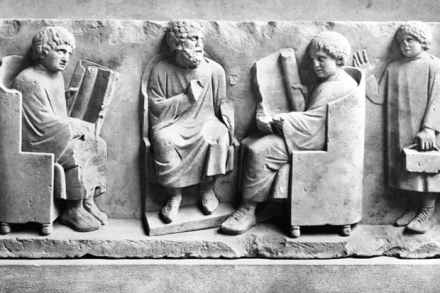
Brilliant Oxford undergraduates argue that it is right to prevent us saying things they object to, because speech they do not like is the equivalent of actions they do not like. They had better not read classics, then. There is no safe space there. Greeks made a clear distinction between logos (‘account, reckoning, explanation, story, reason, debate, speech’, cf. ‘logic’ and all those ‘-ologies’) and ergon (‘work, deed, action’). For a Greek, to reject logos was to reject the expression of thought; and so to close down any possibility of people giving an account or reason for why they were thinking and acting as they did; and therefore to prevent any way of combating them — except, of course, by force.