Saddam hussein

Accelerating the ‘kill chain’ – a terrifying glimpse of future warfare

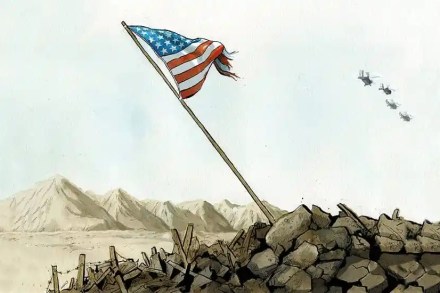
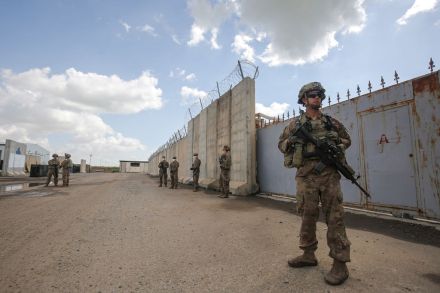
America possesses the most powerful military in history, but since 1945 it has not won a war against anyone other than Saddam Hussein. It appears not to understand why. In fact the only thing the US seems worse at than winning wars is learning lessons from its defeats. People such as the secretary of war Pete Hegseth think it’s all about woke. Lily-livered longhairs stateside stabbed the army in the back over Vietnam; then ‘stupid rules of engagement’ tied the military’s hands in Iraq and Afghanistan and caused the disasters there. The solution is to fight harder, if necessary even at the expense of ethics and the law. Another answer might be to get US forces fighting smarter.
Trump’s goals in Iran have always been clear

The bombing of the Revolutionary government in Iran is drawing comparisons with the war in Iraq. But the comparisons are with the wrong war. In 1981 there was an attack on Iraq which much more closely resembles what Donald Trump is trying to achieve in Iran. The story goes back to 1976, when the government of Jacques Chirac in France sold a nuclear reactor to the Iraqis – a deal for which the French have always managed to avoid much criticism. The French charged the Iraqi government twice the going rate. But as one of the Iraqi nuclear team later recalled: ‘We were happy to pay. After all, who else was going to sell us a nuclear reactor?’ Who indeed.

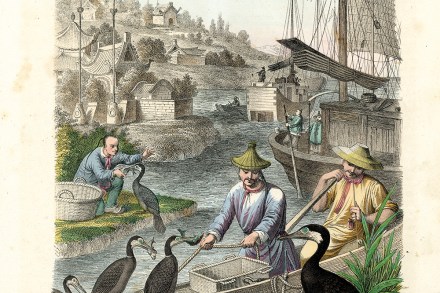
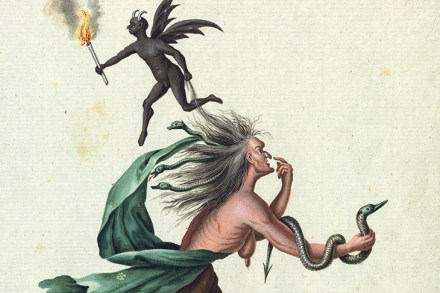
The cormorant – symbol of gluttony and the Devil

Greed, death, hate and clouds of destruction – this is the cormorant season all right. I was hungry to read Gordon McMullan’s book because I love the birds and looked forward to learning their secrets. But I gathered only a little about the green-glossy, serpentine jewel of a fowl I saw in Hebden Beck recently, hunting in the middle of town where I’d never seen it before. Look elsewhere for the creaturely particulars, such as the spur of bone at the back of the skull from which thick muscles link to the lower mandible, giving the corvus marinus a mighty bitey beak. This book is not concerned with what we know about cormorants but with the cormorants that we ourselves are.

Can you tell a good guy from a bad guy in the Middle East?

Please excuse the tone of jubilation, but I have been dancing around my kitchen for the past couple of days, in a state well beyond elation, at the removal from power of Bashar al-Assad’s murderous regime in Syria and its successors who, I am convinced, are a little like our own Liberal Democrats, except with powerful rifles. No matter how deranged the dictator, whoever is trying to oust him will be about ten times worse An expert from a Washington D.C. thinktank told the BBC that some of the chaps who had marched through from Homs to Damascus were ‘moderates’. This was the line taken up, so far as I am aware, by the corporation itself and indeed most other broadcasters – hence my delight.

Ambitious, bold and confusing: BBC4’s Corridors of Power – Should America Police the World? reviewed

Narrated by Meryl Streep, Corridors of Power: Should America Police the World? announced the scale of its ambition straight away. Before the opening titles, we’d already heard from Hillary Clinton, Colin Powell, Madeleine Albright and the late Henry Kissinger. We’d also seen the lines drawn up as to how its bold subtitle might be answered. It is an authentically confusing programme, where any firm moral position doesn’t stay firm for long As Clinton put it, in 1945 a question emerged whose implications would dominate post-war US foreign policy: ‘Why didn’t we do more to try to prevent the transport of the Jews?’ The immediate response was the heartfelt yet potentially glib declaration: ‘Never again.’ But what would that actually mean in practice?

Was I right about Iraq?

Back in March there was a glut of pieces about the 2003 Iraq war. The 20th anniversary seemed to much of the political and pundit class to be the perfect time to return to this scorched landscape. A number of people asked me to throw in my views and I failed, for two reasons. Firstly because, as some readers will know, I hate anniversaries and the lazy hook they provide to the news cycle. Secondly, because each time I sat down to try to write about those days I found myself unusually conflicted. Those of us who defended the war have spent 20 years filled with ‘if onlys’ The reason partly relates to the wonderful, heroic former Labour MP Ann Clwyd, who died last week at the age of 86. After the war’s height, as the insurgency had begun, I went to Iraq with Ann.

Written in blood or bound in human skin: the world’s weirdest books

In 1791, Isaac D’Israeli — father of prime minister Benjamin — published his most famous work, the Curiosities of Literature, a collection of freewheeling mini-essays on whatever literary topics happened to tickle their author’s fancy: ‘Titles of Books’, ‘Noblemen Turned Critics’, ‘On the Custom of Saluting after Sneezing’, ‘Cicero’s Puns’. One of its joys is its capaciousness — completely unsystematic, yet seeming somehow to touch a little on everything. The book is long, but the essays are rarely more than a couple of pages, sometimes less.