Russian history

Chinese puzzle or matryoshka doll – the complexity of Sino-Russia relations

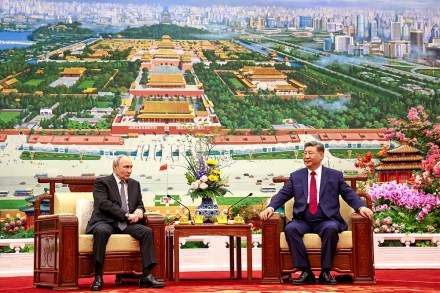
China and Russia are twins. Both are great Asian land empires; both are continental, multi-ethnic powers that expanded by pushing forward their borders rather than by crossing oceans; both have a deep tradition of autocracy that survives to this day; and both (more plausibly in China’s case) believe that their social contract, ideology and system of government is a universal one superior to all others. In Entangled Empires, the German historians Sören Urbansky and Martin Wagner explore the convoluted story of Russo-Chinese relations from the moment in the mid-17th century that roving Cossack bands bumped up against Siberian tribes who owed fealty to Beijing up to the latest performative amity between Vladimir Putin and Xi Jinping.
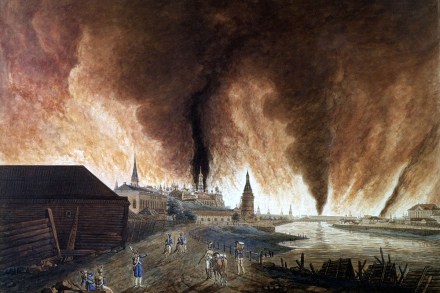
The history of Moscow was one of extreme violence from the start

‘Moscow is hard to love,’ Simon Morrison writes at the beginning of this engaging book, ‘but I love it.’ He deliberately sets out unconstrained by academic pieties, despite holding the post of Professor of Music and Slavic Languages and Literatures at Princeton University. He says he wrote A Kingdom and a Village ‘out of nostalgia for pre-oligarch decrepitude, when the world looked at Moscow with pity’. The Orthodox Church and the security services have been conjoined from the 16th century to the present The book is tripartite. The first part begins in 1147, when a prince named Yuri built a fort on a hill above a river. (When the authorities unveiled a monument to Yuri in 1954, Morrison reveals, a Muscovite yelled: ‘Doesn’t look like him.

How an illiterate peasant changed the course of modern history

There lived a certain man in Russia long ago. He was big and strong, in his eyes a flaming glow. You know the rest. Antony Beevor’s telling of the story of Grigory Rasputin will surely be the greatest literary chart hit of the year. That the life and death of one of history’s most extraordinary charlatans is a well-known and often-told morality tale doesn’t matter. Beevor makes no claim to have uncovered any great revelations. Rather, he carefully sifts Okhrana surveillance logs, court diaries, memoirs, the Empress’s correspondence and contemporary press accounts and, with his characteristically sharp eye for telling detail, extracts enough gems to decorate a whole Romanov party dress. For instance, the Empress’s letters to Rasputin make for startling reading.

A brief history of parties

From our US edition

As Enoch Powell pointed out, “all political careers end in failure.” More often than not, those failures are self-inflicted. Without Partygate, for example, Boris Johnson might still be Britain’s prime minister. Although the debacle may not have been the final nail in his professional coffin, it certainly arranged the wake. His fans and critics alike were infuriated by the idea of public servants living it up while the rest of the nation was locked down during Covid in May 2020. That sort of scandal, however, is nothing new — anger at Partygate is nothing to some earlier episodes in history. Alexander the Great was an Olympian boozer who habitually went on weeklong binges after subjugating his enemies.

history

Distrust and resentment have plagued Anglo-Russian relations for centuries

Has a book ever been more bizarrely mis-titled than this one? The First Cold War: Anglo-Russian Relations in the 19th Century has nothing whatever to do with the actual Cold War, nor is it for the most part concerned with the 19th century. Rather, Barbara Emerson has written a thorough and often diverting diplomatic history of Anglo-Russian relations from the 16th to the early 20th century. This period encompasses at least 14 wars in which British and Russian troops found themselves embroiled, sometimes on the same side, sometimes on opposite sides. None of these wars was remotely ‘cold’. Nor does Emerson attempt to make any argument that the shifting great power politics of the 19th century resembled those of the post-second-world-war nuclear age.

Russia’s complex relationship with the ruble

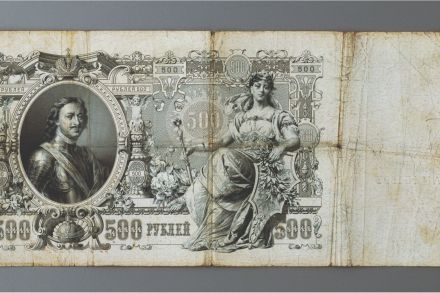
The most impressive banknote I have ever seen is the 500 ruble note produced by the Imperial Bank of Russia between 1905 and 1912. About four times the size of a modern £50 note, it is magnificently emblazoned with a portrait of Peter the Great and a profusion of cupids and classical pillars. It looks as high-denomination money should look – luxuriant, confidence-inspiring and valuable. The ruble (from ‘rubit’, to chop) was originally a chopped-off piece of Viking silver ingot Appearances can, of course, be deceptive. My Russian wife’s great-great-grand-father, the owner of the Volga Bread Bank of Saratov, unwisely chose to keep his considerable savings in the form of trunkloads of such 500 ruble notes.

How does the Russian public view the invasion of Ukraine?

‘It’s too soon,’ said an anti-war Russian friend about the crop of books which have been emerging since late last year on Putin’s invasion of Ukraine. Perhaps he is right. Yet, mindful of Lenin’s maxim that ‘there are weeks when decades happen’, many may feel the period since February last year to have been one of the longest of their lives. Amid the fog of war – an endless news cycle in which events pile up, too enigmatic or episodic for the big picture to emerge – one is grateful to any writer who sets out to give the wider narrative. ‘To look at Russia now, as someone who loves the country, is to despair’ One such is Serhii Plokhy, the Zaporizhzhia-born historian and Ukrainian specialist, in The Russo-Ukrainian War.

Nothing is certain in Russia, where the past is constantly rewritten

Enforced brevity focuses the mind wonderfully. And when the minds in question are two of the West’s most interesting historians of Russia, the result is a distillation of insight that’s vitally timely. Sir Rodric Braithwaite was Britain’s ambassador to Moscow from 1988-92 during the collapse of the USSR (where he was the boss of Christopher Steele, of Trump dossier fame), then chaired the UK’s Joint Intelligence Committee. He went on to write the brilliant Afgantsy, a history of the USSR’s disastrous Afghan war and its impact on the Soviet Union’s collapse, and Moscow 1941, a people’s history of the heroic Soviet fight against Nazism.

Stalin the intellectual: the dictator cast in a new light

The link between mass-murdering dictators and the gentle occupation of reading and writing books is a curious one, but it definitely exists. Mao was a much- praised practitioner of traditional Chinese poetry; Hitler was widely if haphazardly read, dictated Mein Kampf and was a fan of Karl May’s Wild West stories; and Stalin, as Geoffrey Roberts shows, took books at least as seriously as the purging of foes, real and imagined.

Aleksandr Solzhenitsyn’s masterpiece is finally appearing

From our US edition

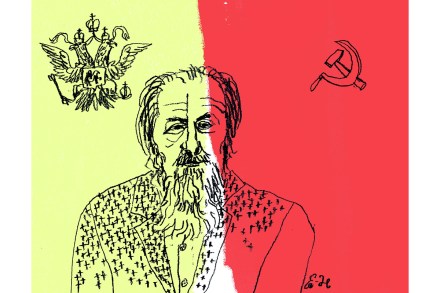
In the mid-1970s, exiled from the Soviet Union for exposing its vast crimes against humanity, and having won the Nobel Prize in Literature for that endeavor, Aleksandr Solzhenitsyn turned his back on the lionization that awaited him in New York and other cultural capitals of the West and instead settled with his family in the woods of Vermont. Avoiding visitors for the better part of the next two decades, he churned out half a dozen or so books, averaging roughly 750 pages each, that together tell the story of the Russian Revolution and its antecedents. This act of sheer energy, self-discipline and renunciation of the conventional worldly pleasures bestowed by the literary elite was in the spirit of Russia’s own eastern monasticism.

Solzhenitsyn

Why autocracy in Russia always fails in the end

Churchill was wrong: Russia is neither a riddle nor an enigma. Russians themselves concoct endless stories to glorify their country’s achievements and minimise its disasters and crimes. But the rest of us do much the same, as we try to explain Britain’s imperial history or the impact slavery still has on America’s revolutionary ideals. Russia is little harder to understand than anywhere else. But you need to separate the facts from the myths, as Mark Galeotti does in A Short History of Russia, an informative, perceptive and exhilarating canter through 1,000 tumultuous years. He starts with two founding events, each a mixture of fact and myth.

‘Mother Volga’ has always been Russia’s lifeblood

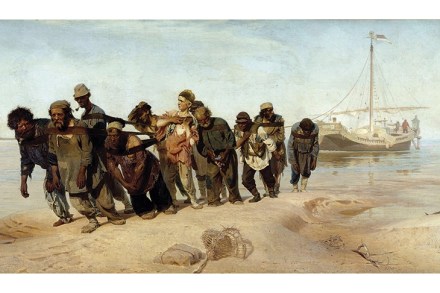
‘Without this river the Russians could not live,’ remarked Robert Bremner in his work, Excursions in the Interior of Russia. The year is 1840. The river in question, the Volga, the 2,000 mile-long meandering waterway stretching from the forests of north-west Russia to the steppes by the Caspian. At the time of Bremner’s survey, half of the Russian empire’s fish was caught in the single stretch of river by Astrakhan, the Volga’s final pit stop before flowing out to sea. Since the earliest days of medieval Rus through to the Soviet and post-Soviet eras, the Volga has not simply fed the mouths of its population but has been crucial to Russia’s commercial, cultural and imperial development.