Russia

What’s the difference between Yemen and Ukraine?

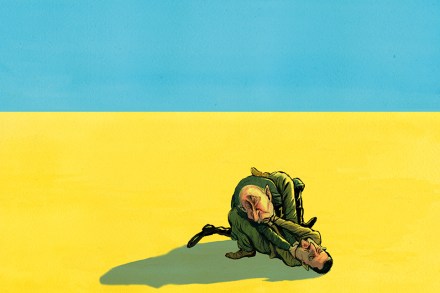
Millions of innocent civilians uprooted from their homes. Residential areas turned into dust, rubble and wire. Thousands of people killed in errant airstrikes. Store shelves emptied of basic staples. A humanitarian crisis dominating the everyday lives of a large swath of the population, who just want to escape the shelling and the fighting. This is the scene the world now equates with Ukraine, which has been subjected to a barbaric war of choice courtesy of Russian president Vladimir Putin. Yet for one poverty-stricken nation more than 2,400 miles to the south, this has been the grim reality for years.

yemen

Where Europe ends and the war begins

On a nondescript bridge in the northeastern Hungarian town of Záhony, the European Union ends and the war begins. Even amid the turmoil in Ukraine, the local border crossing is strangely quiescent. The flood of cars from the early days of the war has slowed to a trickle, and big eighteen-wheelers continue to cross over from Hungary into Ukraine. There are only two signs that something is amiss: a small notice on the door of the nearby Penny Market asking customers to help Ukrainian refugees, and a massive billboard of Hungarian prime minister Viktor Orbán’s stern face, promising voters that he will keep Hungary safe and peaceful.

viktor orban eu hungary

Andrew Sullivan searches for spirituality

It was daunting preparing to meet Andrew Sullivan, considered one of the cleverest, most fearless journalists of his generation. There is the academic pedigree: the scholarship at Oxford — where he was also president of the union and a celebrated actor — followed by the PhD in political theory at Harvard, where he produced an iconic treatise on the work of British mid-century philosopher Michael Oakeshott, performed the entirety of Hamlet all by himself — "a whacked-out mid-1980s" version — and modeled for Gap. And there is the journalistic firepower. At twenty-eight, in 1991, Sullivan became the youngest ever editor of the New Republic, America's most august political magazine.

Time for Turkey to align with the West

To deter Russia from invading Ukraine, the US and its Western allies vociferously vowed unified and decisive action against Russia. Countries like Hungary and Turkey, which enjoy favorable relations with Russia, were a concern, as it was not clear whether they would join US-led sanctions against Russia. Turkey’s refusal to enforce these sanctions would be a significant lifeline for Russia and show division in the Western camp. Turkey’s uncertain loyalties don’t come as a surprise. For one thing, Turkey is heavily dependent on energy imports from Russia. For another, Turkey has had a turbulent history with the Kremlin. When Putin annexed Crimea back in 2014, Turkey only expressed meek disapproval, a stark departure from its historical strategic stance regarding Ukraine.

west

The Hunter Biden disinformation campaign

Democrats are obsessed with the idea that when they lose elections it must be because of outside forces, usually some sort of Russian. But what we know now is that if anyone has been manipulating our once precious democracy, it has been the Democrats. The latest findings by the Durham investigation make clear that the 2016 Clinton campaign paid for and implemented a massive disinformation strategy to falsely link Donald Trump to Russia, and then worked the intelligence services of the United States and the mainstream media to drive that narrative deep into the American psyche. When Trump won, Democrats used that same strategy to try and drive him from office.

walter duranty

The reporter who covered up the Ukrainian famine

Now would seem to be an excellent time for the Pulitzer Committee to withdraw the award it bestowed on Walter Duranty in 1932 for his reporting on events in the Soviet Union. I know I am far from the first to call on the Pulitzer Committee to withdraw the award. I know as well that the Pulitzer Committee responded to one such call in 2003 by declaring that it could find no “clear and convincing evidence of deliberate deception” in Duranty’s 1931 reports from the Soviet Union published in the New York Times in 1931. Those thirteen reports on which the original award was based, admits the Pulitzer statement, amount to work that “measured by today's standards for foreign reporting, falls seriously short.” And time has moved on, etc., etc.

Why the Ukraine war might not end

One thing anyone who studies foreign policy for a living knows is that fairytale endings never happen in war. I suspect Ukraine will follow this sad trend. Why should we expect anything different? War never conforms to humanity’s desire for the good guys to defeat the bad guys. Indeed, great power politics grounded in realpolitik but shaped by mankind’s sense of morality is a mixture that yields tragic results. The demand for closure, clean endings to conflicts where the antagonists get punished, is rarely fulfilled. Wars only have happy endings in the movies. In fact, some wars never seem to end, as the combatants are left unfulfilled — or just haven't been weakened enough.

ukraine

Don’t cancel Russian culture

In the three weeks since Vladimir Putin launched his shocking invasion of Ukraine, the West has surprised the world with the severity of the economic sanctions it's imposed. No one has been more surprised than Putin himself, who believed the West too soft and his own nation’s oil too crucial to the global economy. How the West can further support Ukraine — while also avoiding the not-insignificant risk of a nuclear war — is a complex question. It will not be answered, however, by indulging in ugly prejudices or shunning Russian culture writ large. Since the war began, vandals have targeted businesses that are Russian-themed or owned by Russian expatriates.

The problem with that ‘stalled’ Russian convoy

The amount of disinformation coming out of Ukraine is unsurpassed in modern history. Unlike the glory days when outlets like CNN sent knowledgeable reporters into combat zones looking for actual information, today most mainstream media coverage is based on borrowed social media video, or just made up. The problem with the former, social media video, is that it lacks context. Here's eight seconds of a tank blowing up. Where was it shot? When? Was the explosion caused by a mine, a missile, or something internal to the tank? Is it Russian or Ukrainian (the tank and the missile)? In most cases, the media outlet has no idea of the answers. Even if they stumble onto the basic who-what-where, the exploding tank video is devoid of context.

Angela Merkel’s legacy crumbles

Angela Merkel is one of the most recognizable names in modern politics and probably the only German chancellor since post-war leader Konrad Adenauer that Americans will remember. Merkel was the leader of the center-right CDU party and head of the German government for a full 16 years, making her one of the longest-serving chancellors in German history as well as the first woman to hold the post. Now the full scale of her disastrous reign is becoming clear. Following the nuclear power plant incident at Fukushima in 2011, Merkel began Germany's "Energiewende" (energy shift), intending to phase out of all of Germany's nuclear plants in favor of renewables.

merkel retirement

Tucker torments a Republican for eighteen minutes over Ukraine

Last night, as is his custom, Cockburn was ingesting his daily dose of news in the most palatable way possible — by washing it down with a stiff drink. The television behind the bar was tuned to Fox News, and Cockburn was happy to cease sipping for a moment as the attractive visage of Florida representative Maria Salazar appeared on Tucker Carlson Tonight. The respite was short-lived, as the interview dragged on for a full eighteen minutes, and when Tucker derailed the debate toward the end of the segment with an outlandish analogy, Cockburn nearly spat out his gimlet. (Remembering his manners and the ever-inflating cost of Beefeater these days, he restrained himself.

tucker

Did the realists underestimate Putin?

Liberal internationalists, neoconservatives and NeverTrumpers are having the time of their lives these days, ridiculing anyone on the political right who has ever said a good thing about Vladimir Putin. Those “Putin groupies” as a Wall Street Journal columnist described them, include former Italian prime minister Silvio Berlusconi, far-right French presidential candidate Marine Le Pen, Hungarian prime minister Viktor Orbán and, of course, Trump himself. Trump described Putin as a “genius” and said he was a better president than Barack Obama — and he isn’t the only American president to compliment the Russian leader. President George W. Bush said about Putin, “I looked the man in the eye. I found him to be very straightforward and trustworthy.

putin
zelensky

Zelensky basks in the world’s spotlight

Ukrainian president Volodymyr Zelensky is flying high. The contrast between Zelensky, who virtually addressed Congress this morning, and Russian president Vladimir Putin, who rarely appears publicly, becomes starker almost by the day. Putin believed that he could launch a Blitzkrieg attack that would topple Zelensky but the very opposite has occurred. It is Putin who is cornered while Zelensky basks in the world’s spotlight. In his address, it was shrewd of Zelensky to fold Ukraine’s struggle for independence into the American saga. Essentially, he appealed to the New World to redress the balance of the Old World.

The strange ideology that could be driving Putin

Vladimir Putin’s motives in attacking Ukraine have become the subject of many deep and searching speculations. Is he seeking a personal legacy by attempting to reassemble the parts of the Soviet Union that fell asunder? Is he pursuing Russian national security by making sure Ukraine never becomes the frontline of NATO? Is he gleefully taking advantage of a weak and incompetent US president? Is he vindicating the glorious history of the KGB? These theories are not mutually exclusive, and there are many more possibilities. I want to enter the discussion from my nearly pristine ignorance of Russian geopolitical designs.

eurasianism

When the establishment cries treason

Last week, former Hawaii congresswoman Tulsi Gabbard released a video calling for a ceasefire in areas around American-funded biolabs in Ukraine. She also called for the United States to reconsider its support for these facilities, which experiment with pathogens that could be accidentally released in a time of war. For the crime of preferring that Europeans not die en masse from biological poisons, Gabbard was accused by Senator Mitt Romney of "parroting false Russian propaganda" and spreading "treasonous lies." Gabbard quickly responded with tweets of her own, citing plenty of evidence that, yes, Washington is funding these biolabs, and no, this isn't just a Kremlin talking point. And really, it was all a bit much, this accusation of treason from a sitting senator.

tulsi gabbard virginia treason

Yes, Putin could use biochemical weapons in Ukraine

The Russian Defense Ministry held a briefing last week claiming that they have discovered US-led biological laboratories in Ukraine. Moscow stated that a rapid halt was brought to the facilities’ activities, adding that Kyiv and Washington had violated the Convention on the Prohibition of Biological and Toxin Weapons. The Kremlin did not feel the need to provide evidence of its claims, par for the course in Putin’s Russia.

biochemical weapons

Is Putin nuts?

As Russian forces level Ukrainian cities with artillery, missiles and airstrikes, there's a concerted effort to get inside the mind of Vladimir Putin: from pundits, former US national security officials and current heads of government. What could possibly get the man to stop the bombardment and support a ceasefire? Is Putin intent on conquering all of Ukraine? Or is there some combination of concessions the Ukrainian government and the West could offer that would end the war and bring about a full Russian troop withdrawal? The fact is none of us know what Putin’s endgame is. Putin’s own advisors, especially those kept out of the inner circle, may not even understand what the Russian leader is planning.

crazy nuts

Russia is the West’s great tragedy

The books written about the tragedy of the Russo-Ukrainian War will be legion. In the meantime, there's another book that ought to have been written 20 years ago about a previous tragedy concerning Russia: how, following the collapse of the Soviet Union in 1991 and with it the demise of the communist regime, Russia and the West failed to “converge” in some way. Why did the two did not come to embrace each other politically, economically, and culturally? The rivalry between East and West has since 1917 been fundamentally an ideological and not a nationalist one. Historically, before the Bolshevik Revolution, Washington had been on cordial terms with Moscow, from which it had purchased the Russian territory of Alaska in 1867.

us-russia

Biden must decide the environment’s price tag

Boris Johnson is considering doing something that should be a duty for every leader. In the wake of sanctions poised to disrupt the 8 percent of domestic oil and 18 percent of diesel the UK imports from Russia, Johnson is reportedly toying with the idea of putting his country first and on the road to self-sufficiency by lifting the UK’s moratorium on fracking. The British government banned hydraulic fracturing, or “fracking,” in 2019. Fracking is a method of extracting oil and natural gas by drilling deep underground and fracturing shale rock with a fluid mixture (99 percent water and sand) that allows fossil fuels to flow out, be captured, processed and used to myriad ends (including gasoline).

Russia’s war is a global cancer

One thing I have always found fascinating about Russia is that when they tell us they are going to do something, they usually do it. So when Moscow struck a military base near the Poland-Ukraine border that was a staging ground for arms shipments, we shouldn't have been surprised. They told us that was their next plan of action just twenty-four hours before they did it. But that’s just the beginning of what Russia likely has in store for the West, NATO, and the entire world if we aren’t careful. Russian president Vladimir Putin’s plan seems simple: chaos on a scale that will extend far beyond Ukraine. You see, Putin is starting to come to grips with the fact that he can’t win the war in Ukraine — at least on paper — unless he destroys Ukraine.

cancer