Rome

The key to Giorgia Meloni’s resounding success

From our UK edition

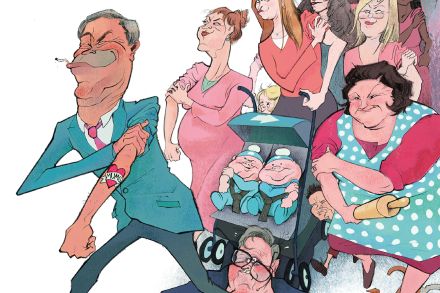
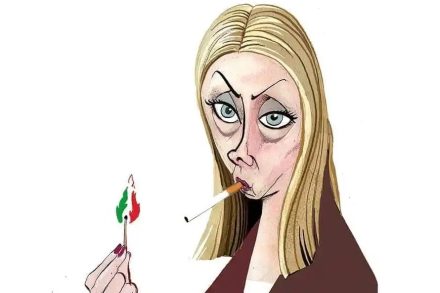
Giorgia Meloni has emerged as one of the most significant politicians in Europe since she became Italy’s first female prime minister in October 2022. I Am Giorgia, already a bestseller in Italy, is her account of how a short, fat, sullen, bullied girl – as she describes her young self – from a poor, single-parent family in Rome managed to do it. Her explanation is that she refused to play the victim, and found iron in her soul – even if, as she admits, she has never found happiness. It is an amazing story: how she transformed from an ugly duckling into the swan who is now a familiar figure on the largely male-dominated world stage, and whose humour, charm, friendliness and no-nonsense talk make her such a refreshing change.

Why I’m ditching ‘authentic’ travel

I’ve always heard Americans describe the food in Rome as “authentic,” though maybe that’s only relative to our three square meals of Little Debbies, reconstituted meat and freeze-dried astronaut food. The things we eat are not authentic food. But abroad, authenticity means anything sourced locally and served by a very small old woman with limited English. If a nonna told me she’d fished anchovies out of the Trevi Fountain and plucked chicory from cracks in the sidewalk, I’d swoon and think: they really know how to do it right in Europe. Authenticity, to me, also means a little discomfort. Bones in your rabbit stew. Lugging a suitcase up a dirt road. Getting pickpocketed.

authentic

Owen Matthews, Matthew Parris, Marcus Nevitt, Angus Colwell and Sean Thomas

From our UK edition

31 min listen

On this week’s Spectator Out Loud: Owen Matthews reads his letter from Rome (1:21); Matthew Parris travels the Channel Islands (7:53); Reviewing Minoo Dinshaw, Marcus Nevitt looks at Bulstrode Whitelocke and Edward Hyde, once close colleagues who fell out during the English civil war (15:19); Angus Colwell discusses his Marco Pierre White obsession, aided by the chef himself (21:26); and, Sean Thomas provides his notes on boredom (26:28).  Produced and presented by Patrick Gibbons.

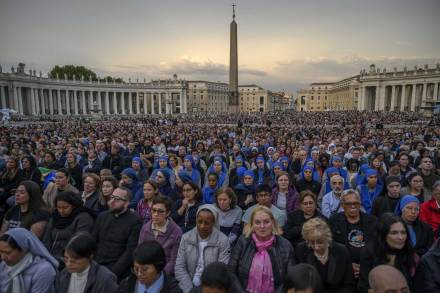
How Rome copes with the Conclave

From our UK edition

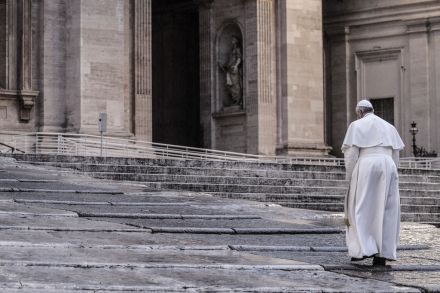
Ordinary Romans, famous for their cheerful working-class familiarity, loved Pope Francis for his common touch. For the first time in living memory, they will have the opportunity of turning out on the streets to say their final farewells to a Pope, as Francis willed that he be buried in the papal basilica of Santa Maria Maggiore on the Esquiline hill rather than in the vaults of St Peter’s. His will be the first papal burial procession to the Basilica since Clement IX’s in 1669. Unlike his predecessors, though, Francis insisted on plainness, economy and simplicity. His first arrival in the Vatican as Pope was by public bus. His departure, in a plain wooden coffin, is likely to be equally low-key and dignified. The mortal Pope dies, but the Eternal City lives. And, indeed, is reborn.

How Pope Francis kept the faith

From our UK edition

As timing goes, a pope simply can’t do better than to die just after Easter Sunday. The moral of the thing hardly needs saying. Francis died in Christ and will share His Resurrection. In fact, that’s exactly what several bishops have been observing today. But Francis also had his Good Friday. He was desperately ill in the Gemelli hospital in February, being very close to death in particular on 28 February. But he pulled through with all the drugs and therapies possible, and went triumphantly on. For that’s what he did. That popemobile trip round St Peter’s Square yesterday, the meeting with J.D.

The Francis effect

From our UK edition

Pope Francis was a man of remarkable complexity who cultivated an image of utmost simplicity. He began the moment he first stepped out on the balcony overlooking St. Peter’s Square in plain white papal attire, without the traditional red mozzetta covering his shoulders, and greeting onlookers with a homely ‘buona sera’. The following day, he was photographed settling his hotel bill. Instead of moving into the Apostolic Palace, he opted to live in a Vatican guesthouse, the Casa Santa Marta. This was also seen as a sign of the new Pope’s humble style. But the decision was more complicated than it seemed: the Casa Santa Marta’s rooms aren’t drafty monastic cells; the Apostolic Palace isn’t exactly the Hotel de Russie.

World leaders pay tribute to Pope Francis

From our UK edition

Pope Francis has died aged 88. At 7.35 a.m., the Vatican announced that Pope Francis had ‘returned to the house of the Father’ at his residence in the Vatican’s Casa Santa Marta. Cardinal Farrell, who announced the death, added that Francis ‘taught us to live the values of the Gospel with fidelity, courage and universal love, especially in favour of the poorest and most marginalised’. Tributes are already pouring in from political and religious leaders around the world. These are the messages that have been sent so far: J.D. Vance, the US Vice-president Vance, the last statesman to meet Francis, having been granted a brief audience with the pontiff yesterday morning, wrote: I just learned of the passing of Pope Francis.

Pope Francis and the Vatican reckoning

From our UK edition

Modern popes, for better or for worse, tend to be defined in soundbites. John Paul II’s clarion call of ‘Be not afraid’ became emblematic of his invitation to young Catholics to embrace their faith and his rallying of the West against the spectre of international Communism. Benedict XVI’s great theological career, and his term as a pope in the model of priest and professor, remains summed up in his simple declaration that Deus caritas est. For Francis, who has died at the age of 88, the world will likely remember, in the immediate weeks after his death anyway, his often quoted, though often misrepresented, motto of ‘who am I to judge?

What Ovid in exile was missing

From our UK edition

A notable recent trend in popular history is the revival of interest in the ancient world. Mary Beard, Tom Holland, Bettany Hughes and Peter Stothard are just some of the historians whose books and television series have cashed in on our thirst for knowledge of distant forebears and their civilisations. Now Owen Rees joins the merry band with a strikingly original take on the subject. He argues that our interest in classical history focuses almost entirely on the Graeco-Roman world, specifically on the capital centres of those cultures. We therefore miss much of what was going on at the periphery of empires, with their vibrant cities and peoples.

Rome is ready for its close-up

Rome Like a Parioli matron shedding her curlers, pins and hairnet in anticipation of a major family celebration, Rome’s monuments are emerging from shrouds of cladding and scaffolding ready for their close-up. The angels and river gods of the Ponte Sant’ Angelo and the Piazza Navona shine as blinding white as the day they emerged from Bernini’s workshop. The ancient granite basins of the Piazza Farnese fountains shimmer with an ethereal bluish light. The big occasion is the Papal Jubilee year of 2025, expected to draw a whopping 32 million visitors. That’s more than ten times Rome’s population, and half as many visitors again as in a normal year. If you’re planning a visit, do it soon before the city is entirely swallowed by crowds.

Rome

Truly inspirational: the hospital diary of Hanif Kureishi

From our UK edition

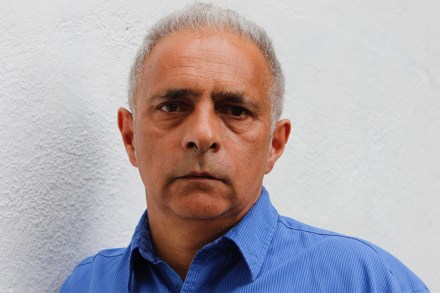
You’d think a book about a paralysed man lying in hospital for a year would be bound to be depressing. It never is. Hanif Kureishi is such an exhilarating writer that you read agog even when he’s describing having his nappies changed or fingers stuck up his bottom. It all started on Boxing Day 2022 when he was sitting watching television in his girlfriend Isabella’s flat in Rome. He wasn’t drunk, he wasn’t stoned, but suddenly he felt a bit dizzy, put his head between his knees and fell off the sofa. In doing so, he somehow broke his neck and became tetraplegic. As a result, he cannot move his arms or legs, he cannot feed himself or scratch his nose or hold a pen. If he cries, he cannot wipe away his tears.

A brief history of parties

As Enoch Powell pointed out, “all political careers end in failure.” More often than not, those failures are self-inflicted. Without Partygate, for example, Boris Johnson might still be Britain’s prime minister. Although the debacle may not have been the final nail in his professional coffin, it certainly arranged the wake. His fans and critics alike were infuriated by the idea of public servants living it up while the rest of the nation was locked down during Covid in May 2020. That sort of scandal, however, is nothing new — anger at Partygate is nothing to some earlier episodes in history. Alexander the Great was an Olympian boozer who habitually went on weeklong binges after subjugating his enemies.

history
Rome

Hotel hopping in Rome

Summer in Rome. Expectation: breathe the soul of the classics, soak up the history, feel the romance. Reality: breathe in the AC, soak in a pool of sweat, feel ever so slightly unhinged. My plans to indulge in Italy’s time-honored tradition of la passeggiata — strolling around looking stylish, gelato in hand — were quickly nixed by the Cerberus heatwave. Dreams of meandering around perhaps the world’s most famous open-air museum gave way to lying recumbent with a handheld fan. Jumping from the relative cool of a sleeper-train carriage onto the platform at Termini station felt akin to opening an oven door and climbing in. Red alert warnings were issued as the mercury soared toward 119°F.

Meloni and her lieutenants plan their takeover of Europe

Cosenza, Italy On a dreary afternoon in May, hundreds of well-dressed Italians crowded into a regal government building in Cosenza, aptly named The Provincial Palace of the Hall of Mirrors. It was a campaign event for Fratelli D’Italia, Italy’s ruling political party. The supporters listened attentively for more than two hours. The mood was triumphant and the politicians spoke as if victory was inevitable. They spoke about a plan for when, not if, the right assumed greater power in Europe.  “This confidence is due to the fact that we, as Italy, have acquired centrality in a very important way,” said Giovanni Donzelli, the party’s national organization manager.  “This centrality is all thanks to the great work done by our leader Giorgia Meloni.

Meloni

Conrad Black adheres firmly to the ‘great man’ view of history

From our UK edition

George Orwell has a story that when Sir Walter Raleigh published the first volume of his projected history of the world while in prison, he witnessed a brawl outside his rooms in the Bloody Tower which resulted in the death of a workman. Despite diligent enquiries, Raleigh was unable to discover the cause of the quarrel. Reasoning that if he could not even ascertain the facts behind what he had observed he could hardly accurately report what had happened in distant lands centuries earlier, he burned his notes for the second volume and abandoned the entire project. No such doubts assail the 79-year-old Conrad Black, sometime proprietor of The Spectator, who, like Raleigh, has written the first of a projected three-volume global history.

Opening a bottle with… chef Heros de Agostinis

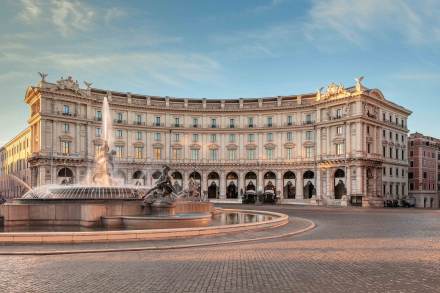
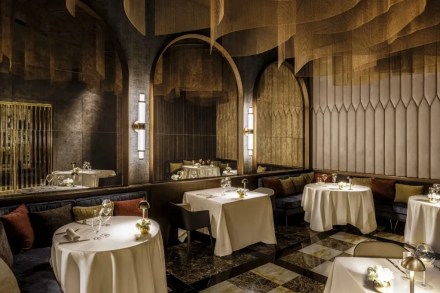
“Stealth wealth” became A Thing in 2023. TikTok was awash with “get the look!” fashion videos; magazines full of think pieces on crisp white shirts and camel cashmere. The idea is to ooze money — or at least look like you do — in classic, understated cuts and colors. What the Streeps and Paltrows have been doing for decades is now the standard for the aspirational and chronically online.  The trend came to mind as I tumbled into Rome’s five-star Anantara Palazzo Naiadi during the Cerberus heatwave. Slick with sweat, a suitcase half my size and missing one wheel, toenails unpainted and there to interview chef Heros de Agostinis, I wished I’d paid more attention. There are fancy hotels, then there are stratospherically fancy hotels like this one.

heros de agostinis

The Roman Empire’s years of glory

The Roman emperor Domitian began life as a spare. At the end of the first century CE, while his brother Titus was the heir to their father Vespasian, the younger boy’s “sense of resentment and frustration had festered,” writes Tom Holland. “Rather than stay in Rome, where his lack of meaningful responsibility was inevitably felt as something raw,” Domitian moved away with a wife whom his family disliked, “doomed forever to be a supernumerary,” paranoid, attracting gossip, avoiding any company in which “innocent mention of baldness” might be viewed as “mockery of his own receding hairline.” In most judgments by posterity this Prince Harry of the early empire fulfilled all this lack of early promise. Big brother Titus became emperor only briefly.

Roman

Everyday life in the Eternal City: Roman Stories, by Jhumpa Lahiri, reviewed

From our UK edition

The middle story in this compassionate collection follows disparate folk loosely linked by a set of steps. Among them, there’s the mother who climbs them first thing in the morning, the girl who descends them at two in the afternoon and the screenwriter who lives at the foot of them, and who stays home nearly all day. Together, these men, women and children represent a cross section of society. One comes from ‘a faraway tropical city’; another compares the grubby sight of graffiti to hearing ‘foreigners talking on the street’. Yet, here they are, existing side by side in a Roman neighbourhood, going about their ordinary daily routines. Which is what the Pulitzer Prize-winning Jhumpa Lahiri does so well: pays attention to the everyday.

Fighting every inch of the way: the Italian Campaign of 1943

From our UK edition

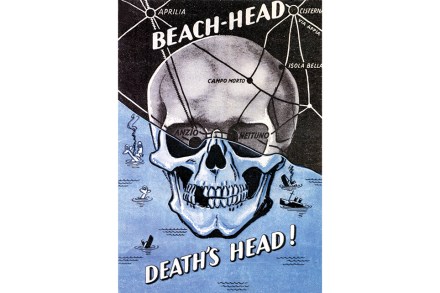
In Whitehall, visible to even the most short-sighted from the gates of Downing Street, stands an outsize statue of Lord Alanbrooke, the strategic adviser to Winston Churchill during the second world war. His job was to help the prime minister see the big picture and concentrate on the decisions that really mattered. This was no easy task. Churchill was both a tricky master and ‘tinkerman’, but Alanbrooke had Ulster blood and knew how to say no. One little village, San Pietro Infine, took more than a week and 1,500 American casualties to capture He also had a remarkable facility for explaining complex strategic problems in simple terms. There is good evidence of this in the BBC archive (and on YouTube) in a television interview he gave in 1957.

Why all Roman roads really did lead to Rome

From our UK edition

Whatever the problems involved in building, let alone finishing, HS2, it is hoped that it will replicate what was ultimately achieved – prosperity, intentionally or not – by the 53,000 miles of roads with which Rome covered its empire (and so successfully that prosperity is now found wherever networks of Roman roads were established across Europe, including Cornwall). The first Roman road was the Via Appia (named after its proposer Appius Claudius), built in 312 bc. It connected Rome with the port of Brindisi 300 miles south; it also offered easy crossing to the wealthy Greek East. This became of great importance: travel by ship, far faster than by road, became vital for economic expansion.