One of the advantages of not having been born yesterday is the ability to recognize certain trends of the news cycle when they come around again.
Am I alone in thinking that every major American political manifesto since about 1848 has made a promise of reducing the taxation burden on its hardworking citizens, for example? Or that for Brits, like me, of a certain age (sixty-eight), our whole lives have been spent in the shadow of a stale and still unresolved debate about the nation’s place in Europe?
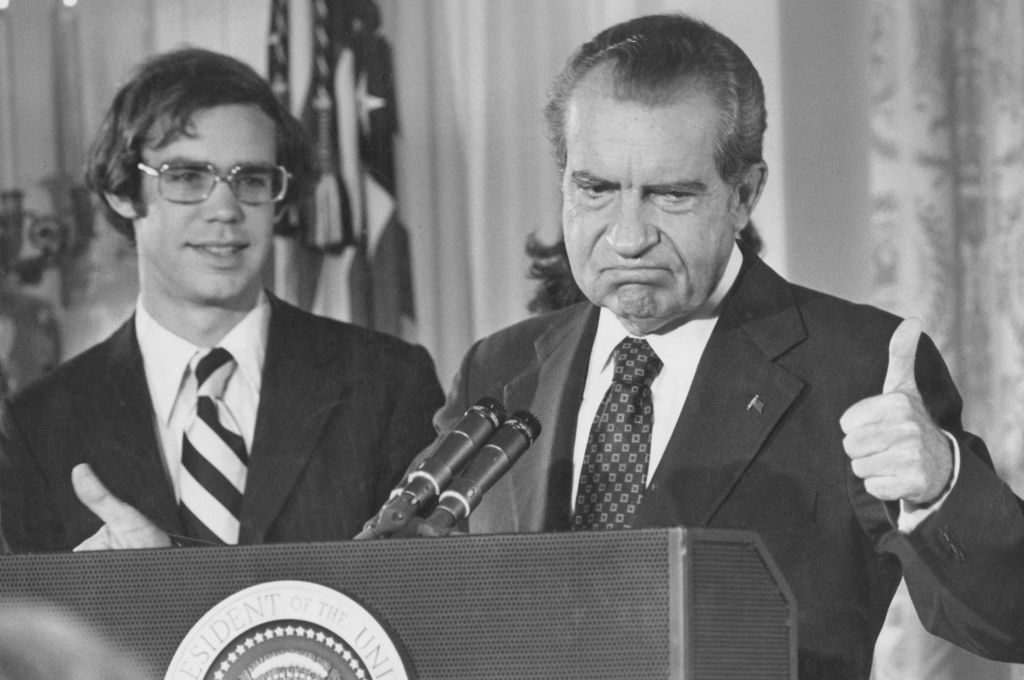
More recently, I was struck by a sense of déjà vu all over again when comparing the final meltdown in Joe Biden’s White House to the events preceding Richard Nixon’s departure from office fifty years ago.
The case for presidential history repeating itself isn’t hard to make. Think of an increasingly embattled and ultimately doomed commander-in-chief with an approval rating mired in the low-to-mid thirties. Throw in a mutinous atmosphere swirling around the Oval Office that brings to mind the old adage, “If you strike at the king, you have to kill him.” And, finally, add a White House press secretary who’s portrayed by admirers as a brave truth-teller and staunch defender of the president (even if those things are mutually contradictory) — and by others as a half-bright hack barely able to put together a coherent sentence without referring to a notebook.
July 1974 or July 2024? The answer, of course, is both.
You may say — but Richard Nixon was the calculated architect of his own doom. Joe Biden, by contrast, can’t help himself. He’s a befuddled old guy, now on his third bout of Covid, who typically starts work around 10 a.m., takes a nap each afternoon before his early-bird dinner and at least up until last Sunday appeared to genuinely believe he was the one person on the planet who can do whatever it is he does in his job.
Maybe. But, by the same logic, at least Nixon’s wonderfully twisted mind was still working flat out until the end. He was barnstorming the Middle East just five weeks before his eventual resignation in the wake of the Watergate scandal, publicly toasting his Israeli hosts as “America’s greatest friends” while privately advising Yitzhak Rabin that the United States would no longer give Israel a blank check. Following that, Nixon set off on a state visit to the Soviet Union, where he swiftly concluded a ten-year trade deal and made significant progress on arms control. Henry Kissinger once told me that Nixon had been personally conducting foreign policy virtually up to the moment he resigned. “The president focused on the conceptual, at which he was brilliant, and left others to fill in the fine detail.”
It would appear that the bar may be set lower for Biden, whose gaffe-ridden but at least halfway lucid press conference following the recent NATO summit — in which he referred to Kamala Harris as “Vice President Trump” — was hailed by some in the media as a display of Ciceronian eloquence. But even that failed to completely silence Biden’s critics from within his own ranks, particularly after the real Trump’s survival of a would-be assassin’s bullet. The floodgates of Democratic dissent were well and truly open, with the oleaginous Illinois congressman Brad Schneider speaking for many in his party. “I love President Biden,” he assured us. “I’m forever grateful to his leadership and service. The time has come, however, for him to heroically pass the torch to a new generation.” Biden’s eventual announcement to that same effect was greeted with a veritable deluge of wailing and gnashing of teeth from within his own party, along with fulsome tributes to his decades of unstinting service to the cause.
Compare that to what Barry Goldwater, the GOP’s former presidential nominee, and a respected conservative leader in Congress, had to say to his Senate colleagues after the release of a compromising Oval Office phone transcript on August 6, 1974. “There are only so many goddamn lies you can take, and now there’s been one too many. Nixon should get his ass out of the White House — today!”
Ah, the 1970s. They did things differently back then, before people started worrying about missing trigger warnings or contaminating safe spaces.
Pre-Watergate, journalists were still much like old-fashioned messenger boys: Here was a piece of news, there was the public, and the hack’s job was to deliver one to the other in as efficient and courteous a way as possible. The idea of personally imposing yourself on the transaction was unthinkable. All that changed in the wake of Woodward and Bernstein, and their crew of swivel-eyed successors in the fourth estate. Of course, there was no excuse for some of the lunatic criminal excesses that went under the name of Watergate, but equally, no understanding of Richard Nixon is possible if one overlooks the spitefulness, self-righteousness, and blatant distortions of his critics.
When the history of the White House briefing room comes to be written, the summer of 1974 will be seen as the turning point. Until then, it had been a relatively sedate operation, where the questions were typically of the “Excuse me, but I wonder if I might ask you about the president’s recent visit to Ohio?” variety, but was already rapidly acquiring some of its modern romper-room characteristics. A thirty-five-year-old former Disneyland barker named Ron Ziegler then had the thankless job of dealing with a press pack he compared to a school of sharks in a feeding frenzy, although, as Ziegler would later privately reflect after watching UPI’s Helen Thomas in action, a shark might conceivably have had the edge in manners.
Ziegler held on to his job throughout the sixty-six months of Nixon’s presidency, even after his boss had publicly shoved him at a veterans’ conference in New Orleans, saying, “I don’t want any press with me, and you take care of it!” Inevitably, he became a figure of scorn and ridicule as the Watergate scandal unfolded. First came his dismissal of the break-in itself as a “third-rate burglary,” and then later his acknowledgement, as the crisis deepened, that his previous statements on the subject were “inoperative.” But through it all Ziegler remained loyal, eventually going into Californian exile with his boss in August 1974, and staying with him for several months even after the former president’s payroll checks reportedly started to bounce.
Flawed as he was, at least Ziegler more or less successfully captained the White House lectern amidst the wreckage of Watergate. Clearly, it would be quite wrong to suggest that his present-day successor Karine Jean-Pierre owes her position to being black, gay and female, as opposed to her solid journalistic credentials, exquisite scholarship and matchless presentational skills — particularly the last, in consistently reading canned answers from a binder to reporters as though she was saying something original. Born in the same week Nixon resigned, she’s the ultimate post-Watergate media artifact — opinionated, vain and so soulless she might as well be one of those automated voices endlessly assuring you how much they value your time, before putting you on hold for forty minutes, not to mention a match for her boss in their mutual inability to fashion a fully coherent sentence.
Say what you like about Richard Nixon, he had standards. Somewhere in the final week of July 1974, he informed his family and staff that he had decided to resign rather than to put the country (and himself) through an impeachment trial in the Senate. Even then, most Americans who wanted Nixon thrown out of office had no idea what actual technical offence he was supposed to have committed. It was more about simply wanting to rid themselves of an administration that by then seemed to exist under a permanent cloud of sleaze. When that sort of vague but unshakable mood sets in, it’s just no good carrying on. Flagrant political mistakes can be patched up, individual foibles and even crimes forgiven over time, and mere sexual incontinence excused. But never the point at which an elected leader comes to be regarded as an irredeemable old phony. There’s simply no coming back from there.
“Enough is enough,” Richard Nixon informed his chief of staff on July 31, 1974, before formally announcing his resignation a week later. Whatever the differences between their two beleaguered presidencies, Joe Biden appears to have had a similar moment of clarity on Sunday.






Comments