Religion

Death of an anti-feminist

Phyllis Schlafly could have been America’s number one feminist. She graduated from good universities, wrote important books on serious topics, was an outspoken orator and political organiser, didn’t let her life be defined by her husband’s career, and stood up to bitter abuse from her opponents. In reality, however, she was America’s leading anti-feminist. Her death this week, at the age of 92, marks the passing of an organisational and publicity genius who did all she could to fight against the spirit of the age. When passage of the Equal Rights Amendment to the US constitution seemed imminent and inevitable in the mid-1970s, she created a democratic grassroots pressure group,

Islamic State’s ‘Jizya tax’ for Christians is pure propaganda

Christians continue to be slaughtered in the Middle East. But as reports of genocidal atrocities mount up, our governments have found a new reason to sit on their hands. Christians, the theory goes, don’t have it as bad as the Yazidis. As ‘people of the book’, Christians enjoy privileged status. Rather than suffering the full extent of Islamic State’s depravities, they can pay a tax (Jizya) in return for protection. It sounds credible and contains just enough theology to bamboozle the secular population of the international community. Here’s the Office of the UN’s High Commissioner for Human Rights: ‘While Christian communities still living in Daesh controlled territories live difficult and often

The Islamist war against Sikhs is arriving in Europe

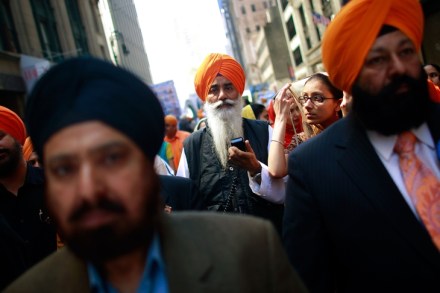
Terror attacks in Germany are becoming remarkably unremarkable. So when a bomb went off in the German city of Essen, near Düsseldorf – and killed nobody – it barely registered. The three teenagers who detonated the device were all members of a Whatsapp group called ‘Supporters of the Islamic Caliphate’, so their intentions seemed pretty clear: they wanted to wage war against the infidels of the West. But their target – a Sikh temple – was striking. While initial reports suggested there was ‘no indication’ of a terrorist incident, any Sikh reading the news would have understood the motive, just as any Jew or Christian would have understood precisely why

Tomorrow’s world | 1 September 2016

It may be difficult to believe when you think of Donald Trump, but the age of super-humans is almost upon us. Some people are confident that over the next century genetic engineering, electronic implants, new drugs and the medical defeat of ageing will give rise to a race of beings with capabilities far beyond our own. And what will they do with them? What will clichéd fears about ‘playing God’ mean to our descendants who, by comparison with us, will effectively be gods? Such questions exercise the historian authors of these two books. Michael Bess’s detailed and humane book adeptly surveys some eye-opening developments in current technology (bionic vision, thought-controlled

France’s burkini ban was an own goal for secularism

I’ve always hated the beach. The water? Great. The sunshine? Terrible. It starts with the hot trek across the sands to find a square of free ground – loaded up with factor 60, several books, a comedy floppy hat, two towels, three bottles of water and the rusty family parasol. Then there’s the bodily anxiety. Find me a woman who doesn’t fret about her body on the beach, and I’ll find you a liar. Just over a year ago, I wrote a post for The Spectator about my own fraught history with my body on the beach. I still don’t understand how it ever became acceptable to wear an itsy bitsy bikini around

France is right to ban the burkini

May I interrupt, for a moment, the howls of anguish from those liberals in uproar at the news that authorities in France are banning burkinis on their beaches? I’d like to relate an incident that occurred earlier this month in France. It involved my girlfriend, who was on her way from Paris to visit her grandmother in eastern France. An hour into her journey she pulled into a service station to fill up with petrol. On returning to her car she made a small sign of the cross as she slid into her seat. Navigating one’s way on a French motorway during the height of summer can be a fraught experience,

Freedom is our best weapon against Isis

Of all the guff churned out about Isis, the refrain that we are engaged in a ‘clash of civilisations’ and ‘battle of ideas’ is uniquely moronic. Isis doesn’t want civilisation. As for a battle of ideas – what ideas? Isis doesn’t have any, unless you count an apocalyptic fight to the death in Dabiq or Rome. We are reliably informed that Isis includes some very intelligent people who spend years planning terror attacks. Yet it took the, ahem, ‘conflicted’ Mohamed Bouhlel – that brave warrior who defecated on his own daughter’s bed – months to plan his terror attack, which consisted solely of getting in a lorry and putting his foot

What performing stand-up in Ukip country taught me about racism

Most people would say UKIP lends itself to comedy better than Denis Healey’s eyebrows lent themselves to tweezers – but not the people of Walton-on-the-Naze, as they live in the party’s only constituency. I’m a stand-up comic, and I was booked to play the town’s first comedy night this month. I don’t know if the lovely promoter realised I was Asian when he booked me; for my part, I didn’t realise Douglas Carswell was Walton’s MP, and only discovered while Googling the town on the way to the gig, when it was too late to turn back. When I arrived in Walton-on-the-Naze’s large ballroom with its cornicing and chandeliers (‘It

Is there something that the BBC isn’t telling us about these Norwegians?

A man has set fire to a train in Switzerland and stabbed lots of people. On the BBC News last night the perpetrator was described as ‘a Swiss national’. Similarly on the BBC News online today: ‘The suspect, described as a Swiss man aged 27, was also taken to hospital after the incident near Salez in St Gallen canton, close to Liechtenstein.’ Do you know, I think there is something the BBC – and the Swiss authorities – are not telling us. This attack was quite similar in some respects to one carried out in London recently, in which an elderly American woman was murdered. Then, at least, the BBC

The Spectator’s Notes | 11 August 2016

Those who want to revive grammar schools are accused of ‘bring backery’ — the unthinking idea that the past was better. But many of their accusers suffer from the rigid mindset of which they complain. They say that grammar schools ‘condemned most children to failure at the age of 11’, and that, even at their peak, grammars catered for less than 20 per cent of the school population. Why assume that the return of grammars must re-create either of these things? Grammar schools grew up, historically, in different ways and at different times. Then, in the mid‑20th-century mania for uniformity, they were standardised and, in the later 20th-century mania for comprehensives, almost

Secularism’s view on violence is less humane than Christianity’s

Let’s say that a man kills a few people at random in your neighbourhood – on the street in broad daylight. Is it better or worse if he justifies his killing spree as part of a holy crusade? In other words, which is worse – terrorism or meaningless psychotic violence? I am aware that this is something I perhaps should not admit, but when reports emerge of such attacks, I sometimes catch myself hoping that it is terrorism, not just meaningless madness. Maybe the journalist in me wants a chunkier story, linked up to world events. But the main motive is wider, I think: we can view the evil of

The Bible is too important to be left to believers

May I write a review of a review? I have to get this out of my system, having been unable to sleep last night, for anger at Christopher Howse’s beastly, scoffing and unjust treatment of a new book: Simon Loveday’s The Bible for Grown-Ups, reviewed in our 30 July issue. Somebody needs to call a halt to the tedious practice of using review to show off at somebody else’s expense. It happens that I feel a special protectiveness towards this book, having seen the manuscript last year and encouraged its author to seek a publisher. Icon books have now published him, and done his study proud. The book deserves it.

To beat Islamist terror, France must close the gulf between church and state

At the beginning of his war memoirs, Charles de Gaulle famously wrote, ‘All my life I have had a certain idea of France’ and its ‘eminent and exceptional destiny’. It was not only an abstract concept: the picture in his mind was of ‘the Madonna in mural frescoes’. Douglas Murray and Haras Rafiq discuss Europe’s summer of terror: What is President Hollande’s certain idea of France? Presumably it cannot be the Madonna, since Hollande is the child of French laïcité, which creates an unbridgeable gulf between religion and the republic. But what happens when, in the name of one religion, men in France enter the temple of another and slit

Terror in France: priest murdered in Normandy church ‘in name of’ Isis

Following a hostage situation at a church in northern France, two armed men and one hostage have been killed. The slain hostage was Rev. Jacques Hamel, an elderly priest, and Le Figaro reports that the hostage takers ‘slit’ his throat while he was giving mass.  The other hostages included two nuns and two worshippers. The French president, François Hollande, and the interior minister, Bernard Cazeneuve, visited Saint-Étienne-du-Rouvray, where the attack happened. Speaking at the site, Hollande said the attack was a ‘cowardly assassination’ carried out by ‘by two terrorists in the name of Daesh’. It also appears that one of the attackers tried to get to Syria, but was deported back to France, where he served

Losing their religion | 21 July 2016

Scriabin once suggested that the audiences for his music should be segregated according to their degree of personal enlightenment, with the ‘least spiritually advanced’ in the worst seats. Unsurprisingly it didn’t happen. But perhaps the Southbank Centre should take up the challenge. For its 2016–17 season, the centre has devised a series of concerts and talks entitled Belief and Beyond Belief. This ‘festival’, as it grandly styles itself, could have been an exploration of the enormous and neglected influence of faith on the great composers. Could have been — but, predictably, won’t be. Instead, the Southbank has chosen to subsume religious faith into ‘belief’, whatever that is, and then tacked

Labour needs to rediscover its religious vision

One of our main political parties is at an immense disadvantage. Labour is tied to a form of idealism. Socialism is a strong form of idealism. It can only gain and hold power by diluting this idealism, mixing it with realism. This is psychologically difficult, existentially unstable. When it finds a way of gaining power, it is not calmly at ease with itself, but divided. And this intensifies after a period of power: purists seek revenge on those behind the ‘successful’ compromise. Blair’s Iraq war adventure is incidental to why he is so hated by the left. He is really hated for winning all those elections. How has such a party survived

Pilgrimage’s progress

If Christian Britain is fading away, what will survive of it? One answer seems to be pilgrimage. In the past decade, 30 pilgrimage routes have been created or rediscovered; holy places have seen a 14 per cent growth in visitor numbers since 2013. These figures are recorded by a new organisation, the British Pilgrimage Trust, which wants to ‘revive the British pilgrimage tradition of making journeys on foot to holy places’. The BPT stresses that not all pilgrims are religious: ‘Bring your own beliefs’ is the slogan. Guy Hayward, who co-founded the BPT with Will Parsons, observes: ‘We have to tread very carefully around the language of spirituality and religion.’

Pride in procreation is dull, pagan stuff. Christians should steer clear of it

Andrea Leadsom presumably considers her aggressive pride in her maternity to be something to do with her Christian faith. To quote her heroine (who now seems wonderfully subtle): No, no, no. Pride in procreation is dull, banal, pagan stuff, not completely unrelated to fascism. Christians ought to steer clear of it. Did Jesus or St Paul lack a stake in the future by virtue of failing to breed? Christianity broke with the Jewish and pagan assumption that having a big family is essential to a fully meaningful and fulfilling life. It said that the community of the church was more important, and in this community the childless, including dedicated virgins, were

Brexit was reckless but not immoral

I voted Remain. I felt that the arguments for and against Brexit were pretty evenly balanced, except in terms of economic risk – and maybe geopolitical risk. So why risk it? But we did risk it. A reckless move, but not a morally indefensible one, as most Remainers are now saying. Let me explain why I’m on the fence about the morality of the decision. Let me come at it in a rather eccentric way – by talking about ideas in a rather general way. I think we have to start by considering what our most basic common creed is, what unites us (in as far as anything does) as

Friel good factor

Does anyone believe Brian Friel’s libellous blarney? He portrays Ireland in the 20th century as an economic basket case where the starving, the retarded, the crippled and the widowed offer up prayers to a heartless God who responds by heaping their burden ever higher. Friel is popular with British mainlanders who are tickled by the news that their Atlantic coastlines are peopled by picturesque barbarians and suicidal drunkards mired in exquisitely revolting dereliction. You’ll notice that aid agencies use the same technique, and for the same audience, when they portray Africa as a rough and ready paradise where life is organised around the latest borehole dug by a team of