Plato

The rebirth of Greek wine

One of the great stories in the world of wine over the last half century is the rebirth of Greek wine. I say “rebirth” because wine has been an inextricable part of the story of Greece from time immemorial. What would Plato’s Symposium — literally “drinking party” — be without wine? And the story of Greek wine goes back much further than that. According to experts, wine grapes have been cultivated in Greece from about 6000 BC. Anyone who has read Homer recalls his frequent deployment of the epithet “οἶνοψ πόντος.” That is usually translated as “wine-dark sea,” though it literally means “wine-faced” or “wine-eyed” (οἶνος + ὄψις) sea. What color do you suppose “wine-dark” is?

greek wine

California’s next freedom to lose: speeding

There are perfectly practical reasons to study philosophy. That’s what I told my teenage daughter when she came to me with mild complaints about her reading assignments of Plato and C.S. Lewis, for a unit on free will and virtue. Far from being a luxury for elites with liberal arts degrees, everyday Americans gain from even the most basic philosophical study a reason behind the freedoms they enjoy. Why are you ever free to do anything potentially harmful or dangerous, at all?  In California, a state famous for protecting the freedom to do hard drugs in public and live beneath overpasses or in public parks, State Senator Scott Wiener has proposed a set of bills aimed at reducing traffic-related deaths.

speeding

Democracy by numbers

The world of 2023, which scarcely speaks for the intelligence, the competence, or the success of the human race, does revive the age-old question of whether the individual is wiser than the species. One answer, stated in its simplest form, is the old saw that two heads are better than one. But is that true? And if so, are three heads better than two, und so weiter? Where do we come to the end of this? The key to the conundrum relates to government. Does oligarchy provide wiser rule than monarchy, aristocracy than oligarchy, and democracy than aristocracy? Consider the history of Britain and British government over the past centuries. Has democracy, in progressively greater measure, improved the management of British affairs since the eighteenth century?

democracy numbers

The learned drinkers

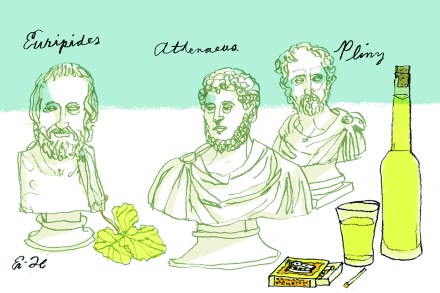
Some of my readers may be unfamiliar with Athenaeus of Naucratis, a shadowy Egyptian-born Greek who floruit somewhere in the Roman Empire during the reigns of Marcus Aurelius, Commodus and Septimius Severus, i.e., around 200 AD. Athenaeus was a rhetorician, grammarian and epicure. But he is known to posterity primarily as the author of The Learned Banqueters (Δειπνοσοφισταὶ), a sprawling, miscellaneous work that touches on, well, just about everything: food, philosophy, fermentation, fabulation and many other subjects, not all of which begin with the phoneme “f.” Henry James called the three-volume Victorian novel a “loose baggy monster.” None was so loose or so baggy as Athenaeus’ compendium. There is a bit of Petronius’s Satyricon (c.

athenaeus

Twitter has taken the place of the ancient curse-tablet

Twitter and other easily accessible means of online communication have encouraged the public to believe that Their Voice Will Be Heard. When it isn’t, they express their frustration through abuse and threats or by blocking roads. In this way, the mentality of the ancient curse-tablet lives on. In the Ancient world, the purpose of the curse was to “bind” the person you disliked — i.e. frustrate them from achieving the end they wanted and you did not. It was written on a thin lead plate, rolled up tight, sometimes twisted (to “hobble” the victim) and pinned (to constrain him), then placed into the tomb of someone who had died before his time. The belief was that the dead man, resentful of his early demise, would be happy to enact the curse against the named victim.

curse-tablet

American Athens

I never understood why Plato wrote so harshly about democracy. Was he simply bitter over the death of his beloved mentor Socrates? And could his criticism of direct democracy in ancient Athens apply to a representative democracy like ours? Right now, the United States is looking increasingly Athenian. Plato characterized the birth of Athenian democracy as a rejection of expertise. The masses, previously content to defer to experts who knew what was good for the city, were led to believe that they could determine the good for themselves — and that the ‘good’ was whatever they subjectively found pleasurable.

athens

Plato, Socrates and Glaucon’s Fate

The astronomer Nicolaus Copernicus studied Plato’s writings in the original Greek, and found in him a kindred spirit. In his main work, On the Revolutions of the Heavenly Spheres, Copernicus draws on what the philologist František Novotný describes as Plato’s ‘metaphysical heliocentric argument from the Republic’ — his characterization of the sun as the god and ruler of the visible sphere and image of the Good, the unifying source and highest principle of reality.

plato glaucon