How can Britain cut its spiralling benefits budget and the number of alienated youths spending taxpayer-generated monies on frivolous consumer goods, facing off against the police and making life unpleasant for those of us not involved in creating poverty porn documentaries? Traditional answers – such as colonising Africa or declaring war on, let’s say, Russia – are off the table. Drones, AI and our defence budget mean that there is no prospect of a Crimean War II, led by the kind of martial Britons who so frightened the Duke of Wellington on the Peninsular campaign.
What then? Britain’s current problem is one that the heroes of Joad Raymond Wren’s scintillating book never had: a complete want of thinking outside the box.
In the 19th century, the utopian socialist Robert Owen proposed an interesting solution that might have 21st-century applications. In his 1817 Reports to the Committee of the Association for the Relief of the Manufacturing and Labouring Poor, he advised MPs examining the poor laws that charity and poor relief compounded both poverty and the vices of the poor, and the problem of crime was not addressed by executing or incarcerating the starving man who steals food. Instead, he proposed planned towns for 500-1,000 people, composed of residential squares. Imagine, if you can, tiny versions of Leon Krier’s Poundbury or Ebenezer Howard’s Letchworth, without Waitroses and populated by society’s most disadvantaged, ignorant and vicious.

I’m not sure how the citizens of Owen’s utopia were to be induced to live in these glum-sounding burgs, but it is not impossible that something like the feminist utopia imagined in Joanna Russ’s 1975 science fiction The Female Man could have acted as a spur. In Russ’s Whileaway, the only capital offence is refusing to work.
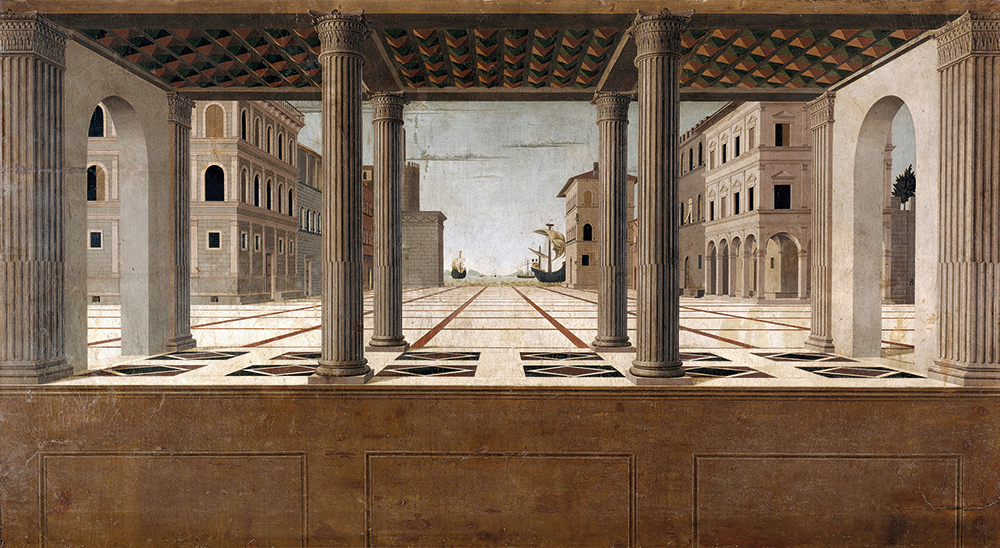
The poet laureate Robert Southey derided his friend’s plans as a ‘utopia of quadrangles’, and Wren wonders why Owen came up with a geometrical solution to a social problem. Squares, Wren suggests plausibly, meant that residents would look out and see each other, which, ideally, would foster a sense of community. At the same time, in line with Owen’s friend Jeremy Bentham’s notion of a panopticon – a prison in which all inmates are visible at all times (that penal prefiguring of the reality show) – the fact of being theoretically on view 24/7 would make residents behave as if they really were being observed. Factories, slaughterhouses, farm buildings, breweries and stables would surround these squares, and economic activity would make these little towns economically productive.
Result? A fall in crime and, presumably, a rise in that stickiest of British metrics, productivity. In Owen’s imagined utopia, there would also be communal kitchens to ensure good diets, perhaps overseen by utopian Jamie Olivers, decent education and a lecture room for adults. These, Owen thought in his whimsical way, would like to spend their leisure listening to Coleridge reciting poetry or telling them about the latest new philosophical ideas coming from Germany – all phenomena very much not commonplace in 1817 Britain. Such was Owen’s answer to the chicken-and-egg question that possesses Wren in this book: are good people made from good architecture, wise rules and rational organisation, or the other way round? He cleaved to the former, but maybe he was 180 degrees wrong.
Karl Marx hated Owen and other 19th- century blue-sky thinkers since he feared their utopias, if realised, would divert energies needed for the class-based socialist revolution necessary to produce another communist utopia. Yet Owen, perhaps more far sighted than 19th-century Marxists, regarded the utopias he attempted to realise in Lanark and Pennsylvania as a means by which both poverty and the catastrophic appetite for consumption attendant on the industrial revolution might be combated. For he had noticed something in 1817 that is profoundly relatable to us two centuries later, namely, as Wren puts it, that ‘the desire for wealth and its commodities and symbols, has damaged the lives of those who produce this wealth, the labouring poor’. To which might be added those who do not produce the wealth that sustains them, be they ever so rich or poor.
Utopian thinking has long involved writers imaginatively conceiving new worlds with charmingly whackadoodle features. Accordingly, one great pleasure of Wren’s book is to immerse oneself in the dotty details. In Edward Bellamy’s 1888 utopian novel Looking Backward 2000-1887, there are pavements with retractable roofs so that people don’t have to carry umbrellas. In William Morris’s 1890 News from Nowhere, the Palace of Westminster has been repurposed as a place for the storage of manure. In my favourite utopian novel, Charlotte Perkins Gilman’s 1915 Herland, a female-only society is saved from extinction when one of the women begins to reproduce by parthenogenesis (take that, patriarchy!) and the fortunate ladies of this blissful realm wear simple, functional clothing – with pockets! – so unlike what respectable women were wearing at the time. In Hamja Ahsan’s 2017 novel Shy Radicals, with a utopia for introverts called Aspergistan (run, naturally enough, according to Sharia law and appealingly in opposition to consumerism, celebrity culture and loud dance music), the national anthem is the sound of a seashell raised to the ear.
Residential squares meant that people would look out and see each other, fostering a sense of community
Wren’s romp through unrealised or disappointingly realised utopias (Owen’s New Lanark or Oscar Niemeyer’s Brasilia) from Plato onwards could have been a disaster. It could have been a Wikipedia cut-and-paste of the utopias of Thomas More, Gerrard Winstanley, H.G. Wells, Italo Calvino, Monique Wittig et al with linking sections. It’s much better than that, though there is a diminishing rate of pleasure to reading the details of successive utopians’ wish lists. Features recur: shorter working weeks, the abolition of private property, grim communal dining and unspeakable grid-like cities that make lovable jumbles like London seem what they are not, dystopias that should be bulldozed. Indeed, many of the imagined utopias described here so resemble Nineteen Eighty-Four’s dystopia that it’s easy to suppose they were devised by writers with the temperaments of Big Brothers and Big Sisters.
My leading takeaway (apart from thinking I must listen to more Sun Ra, the Afrofuturist free jazz visionary who believed he was born on Saturn) is that I would ideally live in a separatist feminist utopia. Negative eugenics notwithstanding, these sound like lovely places – as clean as Kyoto, devoid of poverty and manospheric yahoos, while amply supplied with interesting women. Sadly my gender precludes me. Utopias are often as exclusive as the private gated estates that have replaced Winstanley’s 17th-century Digger community at Saint George’s Hill in Weybridge, Surrey.
Yet the book rises up as a monument against our age of short-termism. Wren writes on the last page: ‘By virtue of being a fantastical glass, utopia shows us as we are not… Even here in the world that utopians reject, utopia never stops challenging us to reconsider where we stand.’ Utopias, that is to say, are not places where you might want to live but imaginative challenges to the status quo, to the prevailing nonsense that things have always been done this stupid way and must continue to be so until the last syllable of recorded time.





Comments