Plato

Nick Robinson could learn a thing or two from Plato

From our UK edition

Today presenter Nick Robinson has been reflecting on the political interview. He contrasts his interviews with scientists about Covid with those with politicians about policy, and thinks that it is the politicians’ fault that he never gets very far with them. It seems not to have crossed his mind that it might be his. Perhaps Plato (d. 348 bc) can help. Plato’s dialogues are the first examples the West has of extended discussions between interested parties on big topics — what we mean by justice, knowledge, goodness and so on. Socrates is at the centre of most of them, and is presented as a most delightful interlocutor — kindly, encouraging, gently ironic, rarely (one senses) even raising his voice, let alone hectoring his fellows.

Spellbinding stuff

From our UK edition

With the briefest of introductions to each chapter, it is up to the reader to decide how they want to tackle nearly 600 pages of extracts from religious discourses, scientific tracts, demonologies, and literary works, expertly chosen and translated by Brian Copenhaver, an eminent scholar of intellectual magic and professor of philosophy and history at the University of California. The structure is chronological, beginning with passages from the Hebrew Bible and the Greek New Testament, then moving on to the Greco-Roman writings of the likes of Plato, Pliny and Ptolemy.

The Socratic approach to Covid

From our UK edition

Organs of the press are filled with opinion pages. The sublime confidence about Covid with which commentators advance these opinions, day after day after boring day, brings to mind the way in which Socrates dealt with such people. Plato, our major source for Socrates’s life and teaching, tells us that, on trial for his life, Socrates described how his friend Chairephon had asked the Delphic oracle whether anyone was wiser than Socrates, and the answer came back ‘No’. Baffled, since he was conscious of his own ignorance about almost everything, Socrates decided to put the oracle to the test and find someone wiser than himself. But his efforts were in vain.

American Athens

I never understood why Plato wrote so harshly about democracy. Was he simply bitter over the death of his beloved mentor Socrates? And could his criticism of direct democracy in ancient Athens apply to a representative democracy like ours? Right now, the United States is looking increasingly Athenian. Plato characterized the birth of Athenian democracy as a rejection of expertise. The masses, previously content to defer to experts who knew what was good for the city, were led to believe that they could determine the good for themselves — and that the ‘good’ was whatever they subjectively found pleasurable.

athens

Plato knew that home-schooling can have benefits

From our UK edition

Education is cumulative. The idea that it will be lost on a generation because, for one out of 42 terms of schooling, pupils will have to take more responsibility for their own learning, is obvious tosh. Indeed that term may yield considerable benefits for all, especially older, pupils, whatever their future plans. Let Plato explain. Plato’s Seventh Letter (its authenticity has been doubted) deals with his failed efforts to turn Sicily into a Platonic state. Greeks had settled there from about 750 bc, and in the 4th century bc Plato was invited to help turn the apparently willing tyrant Dionysius II into a philosopher king. Plato went over there, but found the court riddled with intrigue.

Covid-19 shows us that virtue trumps freedom

From our UK edition

Look at it this way: we’re all doing Desert Island Discs nowadays, and unless you’ve got the bug, it’s a damn good thing, too. I did the desert island bit around 30 years ago, when Sue Lawley was the presenter, and we got along fine, even after I commented on air that she had nice legs. I suspect it would have been a different story today, but another good thing about the virus is that it has knocked #MeToo off the front pages. For good, I hope, but I doubt it. Among my desert island picks was a version of ‘Lili Marlene’ sung by an army choir that I first heard as a four-year-old in an Athens street sung by a group of marching German soldiers.

Extinction Rebellion proves Aristotle was right about the follies of youth

From our UK edition

Extinction Rebellion is blocking the streets again, foolishly demanding the impossible on a very important issue. But what does one expect from the young? As Aristotle pointed out, since they have no experience of life, they always have exalted notions and think themselves equal to great things. As a result, never having been duped before, they readily trust others and are easy meat for adult exploitation. Platonic criminal theory can help them. The ancients generally argued that society was held together by systems of rewards and penalties, and revenge, recompense and deterrence were the main features of their penal thinking. Plato, however, took a different view. He thought of crime as a disease. The point about a disease was that it was not your fault: no one willingly caught one.

Plato, Socrates and Glaucon’s Fate

The astronomer Nicolaus Copernicus studied Plato’s writings in the original Greek, and found in him a kindred spirit. In his main work, On the Revolutions of the Heavenly Spheres, Copernicus draws on what the philologist František Novotný describes as Plato’s ‘metaphysical heliocentric argument from the Republic’ — his characterization of the sun as the god and ruler of the visible sphere and image of the Good, the unifying source and highest principle of reality.

plato glaucon

An unlikely heart-throb

From our UK edition

If western philosophy is no more than ‘footnotes to Plato’, so, arguably, is the myth of its founding hero, Socrates. While there is good evidence for certain aspects of Socrates’ life — his preoccupation with ethics, question-and-answer technique and his trial and death in 399 BC — most of it is shrouded in uncertainty. His only contemporary depictions are in a few satirical comedies by Aristophanes.

Health and personal choice

From our UK edition

Public health specialist Sir Michael Marmot has blamed ‘the cuts’ for the rise in dementia among the elderly, resulting in a decline in the rising rate of life expectancy. But parroting ‘the cuts’ does nothing to treat the cause. If Sir Michael wants to tackle that problem, the ancients can tell him how. It has to do with lifestyle. Ancient medicine, like ancient Gaul, was divided into three parts: drugs, surgery and lifestyle. This last part permeated every aspect of life. Food and exercise were taken to be the most important, but sleep, sex, bathing, massage, mental activity, and so on — even clothing — could all come into the equation.

Beyond words | 26 January 2017

From our UK edition

In his inaugural speech last week, the new President Trump said, among much else, the ‘American carnage’ of poverty, ignorance and criminal gangs ‘stops right here and stops right now’. Since nobody with the slightest intelligence would offer such hostages to fortune, there is no point in paying attention to what he says, any more than to what he tweets. This disrespect for words would have appalled the ancient Greeks, who were well aware of the power of language, both for good and ill. The sophist Gorgias, for example (d. c. 380 bc), talked of the superhuman might of logos (‘speech, utterance’) which was such that it could make you feel happy, putan end to fear, remove feelings of grief,and so on.

Secrets of the universe

From our UK edition

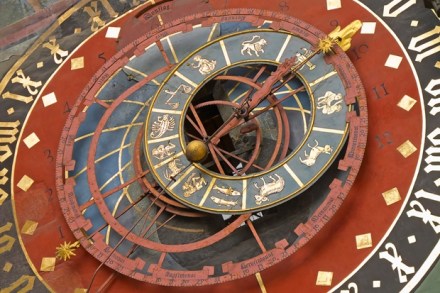
A few years ago, in Berne, I visited the apartment where Einstein wrote his theory of special relativity, which changed our understanding of the world forever. It’s a small apartment, plain and nondescript. The best thing about it is the view. From the window you can see Berne’s huge medieval clock, the Zytglogge. It was this clock which inspired Einstein’s great breakthrough. At the end of every humdrum day, in his dead- end job at Berne’s patent office, he took the tram home, past the Zytglogge, back to this apartment. As he gazed at that clock through the tram window, he wondered: what if his tram could travel at the speed of light? Logically, the light from the Zytglogge should never overtake him.

Shady past

From our UK edition

David Hockney: It is a kind of joke, but I really mean it when I say Caravaggio invented Hollywood lighting. It is an invention, in that he quickly worked out how to light things dramatically. I’ve always used shadows a bit, because that’s what you need below a figure to ground it, but mine are more like Giotto’s than Caravaggio’s. I use shadows that you see in ordinary lighting conditions; you don’t find ones like Caravaggio’s in nature. But there are other varieties of Hollywood lighting. The ‘Mona Lisa’ is one of the first portraits with very blended shadows. That face is marvellously lit, the shadow under the nose, and that smile. The soft transition from the cheekbone down to underneath the jaw is extraordinary.

Plato on grammar schools

From our UK edition

Theresa May wants to use grammar schools to create a meritocratic, ‘socially mobile’ society at a cost of £50 million. But that raises the question: merit in what, precisely? In his Republic, Plato envisaged Socrates wondering how society was created, with a view to determining how best to establish a just one. Socrates suggested that society originated out of universal needs which individuals could not necessarily satisfy themselves. Food, shelter and clothing were the most basic ones, demanding therefore farmers, builders and weavers; and since everyone had different aptitudes, workers best served the whole community by sticking to their last. Then again, the farmer needed his plough, the builder his tools, etc.

Corbyn’s shadow puppets

From our UK edition

Wrapped in his fantasy world of a Labour party ruling the country in accordance with the diktats of those of its members who support him, Jeremy Corbyn reminds one of Plato’s image of humans trapped in a cave, able only to see the wall in front of them. Behind them, at the opposite end of the cave, is a fire, and in front of that, a puppet show. The shadows of those puppets, cavorting on the wall in front of him, are man’s reality. And Corbyn’s. His MPs are right to want a party connected to the real world, but is a leadership battle the right way to go about it? The contest should be a purely rhetorical one, though Corbyn’s followers will not hesitate to use force instead.

Plato on the EU referendum

From our UK edition

Our politicians, realising that the referendum campaign will be settled not by themselves under the usual parliamentary constraints but by the Twitter-maddened populace under no constraints at all, have decided to abandon any principles they may have and play the straight populist game. Plato well understood the behaviour and its consequences. In his Republic, he envisages a man in charge of a large and powerful animal who studies its moods and needs. He learns when to approach and handle it, when and why it is savage and gentle, the meaning of the various noises it makes and how to speak to it to annoy or calm it. He might then deduce that he has a scientific understanding of animals.

People power then and now

From our UK edition

It does seem extraordinary that the increasingly puce-faced Mr Cameron offered us an ‘in-out’ referendum and is now telling us that ‘out’ would mean the end of the world as we know it. What on earth did he think he was doing? His reaction is to eviscerate MPs who support ‘out’, and intentionally deprive us who will actually make the decision of information enabling us to do so. People power is clearly not for him. One of the great virtues of 5th-century bc Athenian direct democracy was that those who made the policy decisions were citizens meeting weekly in Assembly. Parties did not exist. So there were no such things as party policies, party positions (Clause 4s and so on), or party members, let alone MPs.

Quintilian on lecturers

From our UK edition

Professor Louise Richardson, Oxford’s new vice-chancellor, is worried about a new government plan to judge teaching quality. Her reason is that she does not know how to measure it. One wonders what else she does not know about assessing a university’s basic function. Plato made a distinction between the art of teaching and the pupil’s desire for learning. Without the latter, the job was impossible. A good teacher did his best to strike that spark of desire which would turn into a flame. Success was not guaranteed: Plato knew students who preferred a suntan education (his image), turning over now and again till lightly educated on both sides. As for pedagogy, the orator and teacher Quintilian (c.

Drinking at school with Plato

From our UK edition

Rugby and Ampleforth schools have decided to give their charges experience of sensible drinking by introducing a little alcohol, under close staff supervision, at dinner. But, as Plato realised, what they actually need is experience of senseless drinking. Plato’s last work, Laws (c. 350 bc), depicts a new utopia, quite unlike that of the Republic with its philosopher-kings. Called Magnesia, it lays down a detailed code of laws which its inhabitants must obey without question because the code will inculcate moral goodness. A key feature of that is self-control, which the speaker (‘the Athenian’) proposes to achieve by means of symposia, or drinking parties.

Plato and think-tanks

From our UK edition

In Living with Difference, a think-tank report on the problems raised by a multi-faith UK, the chair Baroness Butler-Sloss says that the recommendations amount to a ‘new settlement for religion and belief in the UK’ and are aimed at providing space and a role in society for all citizens, ‘regardless of their beliefs or absence of them’. This is what happens when good people decide this messy world needs to be hammered into an intellectually satisfying shape. Plato’s Republic is a very good example of the genre. It is an extraordinarily interesting document, telling one a very great deal about Plato and the ancient Greeks, deeply influential on intellectuals down the millennia, and complete tosh from start to finish. Composed c.