Paywall

Out of Nam’s way

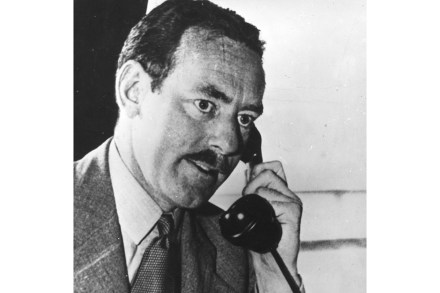
When I was a teenager whiling away the endless hours with VHS video rentals, Vietnam movies were pretty much the only game in town. I must have watched The Deerhunter a dozen times, and the scene in the rat-infested river cage well over a hundred times. Even now, I can’t watch it without being surprised at how De Niro manages to pull off that extraordinary escape stunt. My, how I covet those tiger-stripe Special Forces camouflage fatigues. The problem is, The Deerhunter has loads of boring non-war stuff either side of the good bits. That’s why I much prefer Platoon — controversial choice, Oliver Stone being a pinko — all of which takes place in-country.

nam

How democracy dies

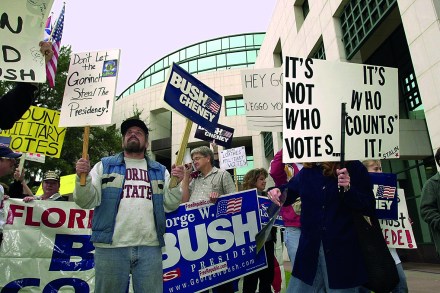
What would happen if Americans voted on different days? Suppose Republicans voted on Tuesday and Democrats voted on Wednesday. Would this be better than everyone voting on the same day? Would it be more fair and less confusing? Like hell it would! One reasonable complaint Republicans had about the 2000 presidential elections — famously decided, in the end, at the Supreme Court — was that some television networks called the State of Florida for Al Gore before polls had closed in the westernmost Florida Panhandle, which lay in the Central Time Zone, an hour behind the rest of the state in the Eastern Time Zone. Declaring a winner prematurely amounted to telling Panhandle voters not to bother casting their ballots.

mail

Mart and marketing

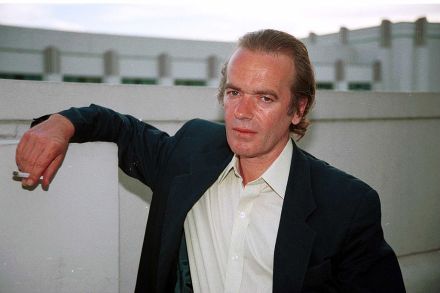
George Orwell once proposed that the specimen literary career takes the form of a parabola in which the downward curve is implied in the upward. You can see immediately how this theory might work with a major-league titan such as Thackeray (promising early sketches leading to Vanity Fair, then downhill to the trackless waste of The Virginians) or James Joyce (peaks in the early stretches of Ulysses before descending to the dream language of Finnegans Wake). But how does it apply to the 71-year-old former enfant terrible and, to borrow another useful French phrase, one-time jeune premier of English fiction, Martin Amis?

martin amis
steinberg

The eyes have it

Art historians do not generally become household names, as Kenneth Clark did later in life after embracing television, most famously with Civilisation (1969). They can, however, acquire legendary or semilegendary status within the profession and among amateurs. One such was Leo Steinberg (1920-2011), who taught for many years at the City University of New York and the University of Pennsylvania. Academic art historians are expected to ‘publish or perish’: college texts, monographic studies on individual artists, or down-the-rabbit-hole treatises on arcana that seem to require more pages of footnotes than text. Steinberg mainly wrote for professional journals. He also lectured widely, testing ideas that later might make their way into print.

voting politically homeless

Letters from the politically homeless

Americans aren’t just fleeing liberal strongholds like California, Chicago and New York in droves. We are moving politically, too. As I often find myself caught in the crossfire of the culture wars, I also find myself at the crossroads of this migration. Since my last column, headlined ‘Why I won’t vote’, I’ve received hundreds of emails from others who feel politically homeless. I’ve also heard from many who have voted Democrat or Republican their entire lives and, for the first time, in 2020 will vote for the opposite party. Lifetime conservatives are voting for Biden. Independents are being radicalized to vote red or blue. People who didn’t vote for Donald Trump in 2016 are enthusiastically voting for him now.

Pompeo’s principles

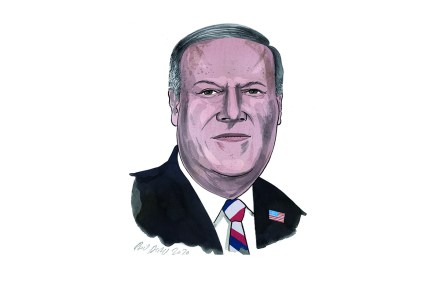
‘Come in.’ Burly, brisk and maskless, Mike Pompeo indicates a chair before the marble fireplace. ‘It’s all right if we’re six feet — or two meters — apart.’ We are meeting at the State Department the day after Pompeo’s return from Qatar, where US negotiators have opened discussions with the Taliban and other Afghan factions on an end to the war in Afghanistan. It’s also the day before the signing of the Abraham Accords between Israel and the UAE and Bahrain. Cheerful and perhaps a little tired, Pompeo exudes forceful confidence: a man who knows what needs to be done. As Secretary of State since 2018, Pompeo has been the strategist who has translated Trump’s generalities into the specifics of policy.

A leaf from Verdi’s book

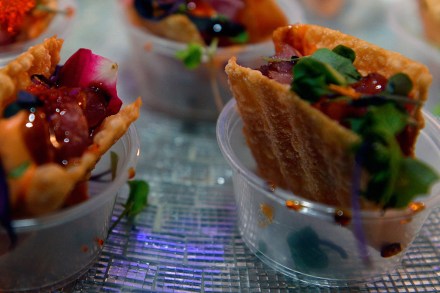
Radicchio, radicchio, wherefore art thou radicchio? A red-leafed chicory by any other name would doubtless taste as bitter — but it certainly wouldn’t sound as pedigreed. Consider the following bit of dialogue: ‘Would you like a chicory salad?’ The natural response is a hasty, ‘Not just at the moment, thank you,’ the very name of chicory summoning up painful memories of undercooked chickpeas and bowls of foliage into which well-meaning persons have seemingly shaken the broken fragments at the bottom of the cereal box. Compare and contrast with the following overture: ‘Would you care for some grilled Chioggia radicchio embellished with small cubes of buffalo mozzarella and drizzled with a reduction of Balsamico di Modena?

radicchio

We’re not going to take it — again

The everyday experience of 2020 includes televised demagogy and a national media making pure spectacle out of domestic terrorism and race riots. The less we believe what we see, the stranger the sights become. These experiences are also the story of Network, the 1976 Paddy Chayefsky/Sidney Lumet hit which won four Oscars out of its 10 nominations. We must ask ourselves why are we living out the 1970s again and, indeed, enacting its satire in deadly earnest. Marx said history repeats itself, first as tragedy, then as farce, but what did he know of Hollywood? A remake is the safest bet. We, however, have reversed Marx’s sequence.

network
stephen miller

Is Stephen Miller pursuing policy — or power?

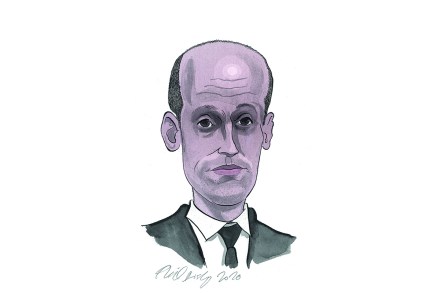
What does Stephen Miller really want? His immigration obsession has shaped some of the Trump administration’s most aggressive policies, and he has clawed his way from speechwriter to senior policy adviser. But is his dream a restrictionist immigration agenda or, as sources close to the White House tell me, the pursuit of power, not policy? Is he taking Lady Macbeth’s advice and playing ‘the innocent flower’ to mask ‘the serpent under’t’? Miller is a true believer in the Trump agenda: they say he even praises the President in private. That might explain his survival in an administration with a turnover rate higher than that of a cheap motel.

Reflections of an outgoing President

January 20, 2025 Dear Diary, In a few hours, I’ll be handing the reins of government over to Mike Pence. Good man. Quiet. He can afford to be after the tremendous job I have done making the country great again. It was touch and go there for a while. My whole first term the fake news, the Democrats and even some terrible people in my own party tried to sabotage me. It seems like ancient history now, but the whole Trump-Russia hoax actually had me worried for a while, much more than that the preposterous effort to impeach me for talking to the president of Ukraine. Funny how things happen. When John Durham — I wonder if anyone remembers him? — finally brought in his indictments, a lot of people were shocked. Not me.

reflections outgoing president

We are living in an age of cultural climate change

A free society is a moral achievement. Over the past 50 years in the West this truth has been forgotten, ignored or denied. That is why today liberal democracy is at risk. Societal freedom cannot be sustained by market economics and liberal democratic politics alone. It needs a third element: morality, a concern for the welfare of others, an active commitment to justice and compassion, a willingness to ask not just what is good for me but what is good for ‘all of us together’. It is about ‘Us’, not ‘Me’; about ‘We’, not I’.

climate
notre-dame poirier

Our lady of hope

From the kitchen of her apartment on the Quai de la Tournelle in Paris, the journalist and broadcaster Agnès Poirier could see the bright yellow plumes of smoke rising into the sky. Notre-Dame de Paris was on fire, and suddenly, in that tourist-crowded, hyper-expensive ‘cradle of France’, nothing was certain — ‘democracy, peace and fraternity’ — anymore. The following morning, children living on or near the Île de la Cité took to school little plastic bags filled with blackened bits of roof picked up from balconies and pavements (as well as probably quite a lot of lead dust) which ‘dated back to the Crusades’.

pita shack

Pita Shack flashback

Friday afternoon in the Pita Shack diner in the northern suburbs of Austin, Texas and I was surrounded by Iraqis. There was even a picture of a sweet-looking Marsh Arab girl in her papyrus boat hanging on the wall. It was all unexpected but strangely familiar, stirring memories of Delta-30’s turret-scanning the junction of Red 11 in downtown Al Amarah back in 2004. During the first Gulf War in 1991, the Maysan province around Al Amarah was the site of local uprisings against Saddam Hussein. In retaliation he drained the region’s marshes to deprive the local Marsh Arabs of the waters on which their livelihoods and 6,000-year-old culture depended.

Jason Peters writes to entertain his friends and exasperate his enemies

Batavia, New York H.L. Mencken mocked the authors of I’ll Take My Stand, the classic 1930 manifesto of Twelve Southerners, as ‘typewriter agrarians’. The gibe was partly fair and partly not, but then a strict adherence to fact is a disability in a humorist — it is what adds those warning braces to his title and makes him that deadliest enemy of the lively reader: the ‘humorist’. Always self-reproving, never self-improving, Jason Peters, a scapegrace professor of something-or-other at Augustana College in Rock Island, Illinois, gemstone of the Quad Cities, is no ‘humorist’. Though his new book is titled The Culinary Plagiarist, he is no keyboard kebabist either.

jason peters
polymath

Know better

We live at a time of universal polymathy. We don’t know everything, but there’s not much difficulty in being able to discover any given truth. But it’s also worth remembering just how hard it used to be to find things out. Thirty years ago if you wanted to research it meant a trip to the public library — and perhaps filling out a form for an inter-library loan. Or you could try your luck in a bookshop, new or secondhand. The whole process took a long time, and most people stayed within their professional competence or enthusiasm, frankly admitting to ignorance outside those limits. It was the age of the specialist, memorably captured by Michael Frayn in Donkeys’ Years and the character of Kenneth Snell.

The return of the Blob

For decades, Washington think tanks were vital to a virtuous revolving door. Young policy professionals, both Democrats and Republicans, would serve time in government, then remove themselves to think tanks where they further honed their professional skills and rethought issues, then go back into government at a slightly higher level. Donald Trump’s election in 2016 put a spike in that revolving door, shattering its mechanism. Not only were Democrats barred from the Trump administration, but so were the most talented of Republicans who, having assumed Trump would lose, declared themselves in opposition to him and thus disqualified themselves from work in his administration.

blob
cultural appropriation

Eye on the pies: food in the age of ‘cultural appropriation’

I walked into a party with a friend a few years ago and told her I felt uncharacteristically uncomfortable. ‘That’s because you’re not carrying a pie,’ she said. It’s true; I usually have a pie as my calling card. The offering of a homemade pie makes no one unhappy. It’s a nice presentation, sure, but the handoff is magical, a conjuring the baker does when deciding whether the recipient is a pumpkin or cherry pie kind of guy. People think you’re being generous when you show up with pie, but really it’s quite selfish. First, baking carries me away. Second, I love to see people’s faces when handing them pie.

populist

The future of populist conservatism

Laramie, Wyoming William Kristol, a Grand Poobah of neoconservatism, is leaving the Republican party to join the donkeys of the Democratic one. As Dorothy Parker remarked on being told that Calvin Coolidge had died, ‘How could they tell?’ Mr Kristol, of course, was never a Republican to begin with, only a conservative Democrat. Still, it is true that with Donald Trump’s election and ascendance to the Oval Office, the Republican party has changed considerably, at least for now. So has American conservatism. Whether or not the GOP remains the party of Trump after he steps down from the White House or is dragged out of it by his gilded forelock, conservatism in this country will continue to be Trumpist, and probably for a very long time.

Liberty and death: Jacob Lawrence’s struggle for freedom

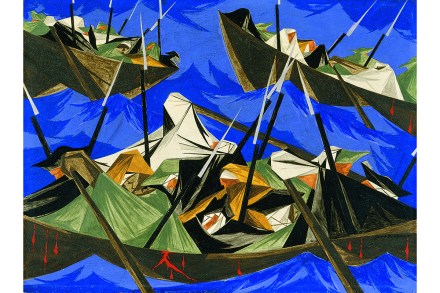
Few artworks could be more responsive to the current upheaval than Jacob Lawrence’s 1954-56 series ‘Struggle...From the History of the American People’. Painted during the dawn of the Civil Rights movement, the cycle of 30 panels tells a history of the American Founding through punchy modernist vignettes, engaging with timely and timeless topics such as brutality, race, memory, justice and our shared national heritage. At the Metropolitan Museum of Art, 24 of the original panels have been reunited for the most complete exhibition of the series since its original showing more than six decades ago. The exhibition will travel to Birmingham, Seattle and Washington, DC from New York.

jacob lawrence
champagne

Bubbles in paradise

I remember being taken aback when reading, in Geoffrey Madan’s delightful Notebooks, a cynical remark by Lord Lyons: ‘If you’re given Champagne at lunch, there’s a catch somewhere.’ Au contraire, my dear Lord. But then that same peer stated that ‘Americans are either wild or dull.’ Obviously he was an unreliable source. Lily Bollinger, former manager of the Champagne producer, admirably summed up my own view. ‘I only drink Champagne when I’m happy,’ she said, ‘and when I’m sad. Sometimes I drink it when I’m alone. When I have company, I consider it obligatory. I trifle with it if I am not hungry and drink it when I am. Otherwise I never touch it — unless I’m thirsty.