Parliament

MPs are finally engaging with the gender identity debate

From our UK edition

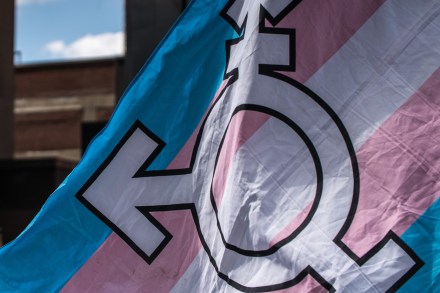
I used to write a lot about sex and gender here. I don’t do so quite as much these days for a few reasons, one of which is that the issues involved are now better recognised and better handled by people whose job it is to deal with the complexities of policies and conflicts of rights and arguments. An example of that came at the weekend when Baroness Falkner, the new chair of the Equality and Human Rights Commission, told the Times that women should not be penalised or abused if they believe that transgender women do not become female by dint of their professed identity. ‘Someone can believe that people who self-identify as a different sex are not the different sex that they self-identify,’ she said.
Cladding risks creating a political crisis for the Tories

From our UK edition

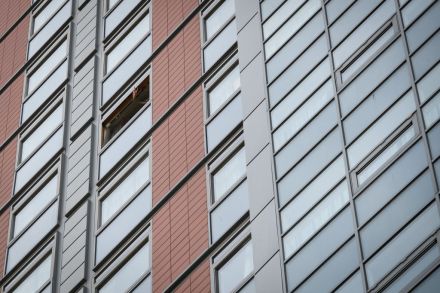
Today, for the third time in as many months, MPs will vote on an amendment to prevent the costs of removing cladding and fixing other fire safety defects being passed on to residents. For some time now, thousands of British homeowners have been left fearing for their lives and facing ruinous bills after fire safety issues following the Grenfell Tower fire were identified in tens of thousands of tall and medium rise buildings across the country. In most cases, building owners have been able to charge individual flat owners to fix the defects, even though their apartments were signed off as safe under government regulations at the time.

Will MPs back compensation for gay veterans?

From our UK edition

Campaigners for LGBT+ rights have recently been most occupied with proposals to ban gay conversion therapy and the rights and wrongs of such a move. But could another battle soon be underway on an appropriately military subject? The Armed Forces had a ban on homosexuality until 2000 when the Blair government lifted it following a ruling in the European Courts of Human Rights. Veterans dismissed or forced to resign for their sexual orientation or gender identity before this date often suffered loss of ranks or pension. Some were given criminal convictions or placed on the Sex Offenders register, affecting them to this day.

The dangers of televising lobby briefings

From our UK edition

Like a tongue searching for an absent tooth, I keep wondering if I’m missing anything from my two decades as a lobby hack. Friends, of course, and perhaps the vast, grey field of sloping slate as seen from the Times’s parliamentary office. That empty and silent space, the roof of Westminster Hall, seemed austere and indifferent, a mental refuge from the babble beneath and within. The opposite aspect, towards the crumbling guts of the Palace of Westminster, elicits more complicated memories. I arrived in the press gallery aged 30 to take a job as Westminster correspondent for a clutch of provincial papers. On my first day my new colleagues took me to tea at 4 p.m. in the dining room. There was also a bar with its own barflies and a barman named Clive.

Why has coronavirus not closed parliament?

From our UK edition

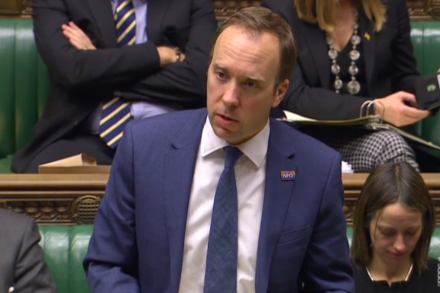
Why hasn't parliament been closed after Health minister Nadine Dorries contracted coronavirus? Why isn't the government demanding the cancellation of large events and school closures to help limit the spread of the illness? Why isn't it copying other countries who have introduced much more draconian measures, to the extent that Atlético Madrid fans arriving in Liverpool are watching a game that would have been closed to them in their home country? Health Secretary Matt Hancock updated the Commons on the outbreak this evening, and ended up having to answer all of these questions.

Revealed: the secret trans-rights lobbying operation in parliament

From our UK edition

This is a story about politics and influence and openness. It’s also about the drive for trans rights and some of the people involved in that push, but in a way, that’s secondary. Because the issues involved here and the questions raised are bigger even than sex, gender and the rest. This is, in the end, about how rules and laws and policies are made, and who gets a say on that. A lot of this story is about something called an All Party Parliamentary Group. APPGs are, as the name says, groups of MPs and peers who work together to investigate, report and campaign on a particular issue. They are not parliamentary bodies in the sense of being part of the legislature; unlike select committees, they have no constitutional status or legal powers.

The pointlessness of PMQs

From our UK edition

It’s a different game at PMQs. With fewer than 40 members present, the debates feel more like a committee meeting than a full-throated parliamentary session. It’s bad for democracy if the highlight of the parliamentary week looks so static and uninspiring. When the weather cheers up they should move to a secure location outdoors, (like the gardens of Buckingham Palace), where more members could attend and the sessions would be livelier. Meanwhile, MPs are chafing under the restrictions. They’ve started to mess about like schoolkids in detention. They play games. They needle each other. They stretch the rules, and they dare the Speaker to shut them up or tick them off. Today they debated border closures.

The truth about the new BBC chairman? He won’t make much difference

From our UK edition

The ‘pre-appointment hearings’ system overseen by parliament’s select committees doesn’t exactly set the heart racing; a pale imitation of the American system, where presidential nominees (to the Supreme Court for instance) are savaged by senators sitting as a kind of hanging jury, our version is generally bloodless. Certainly Richard Sharp, the government’s candidate for chairman of the BBC, who dutifully presented himself for cross-questioning last week, emerged with never a scratch on him.

What we learnt from the PM’s Liaison Committee hearing

From our UK edition

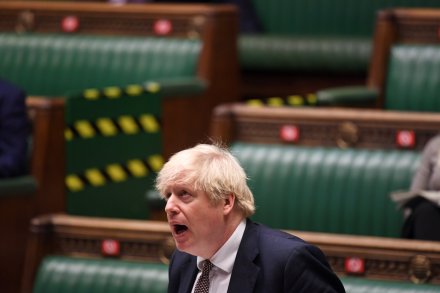
Boris Johnson has previously enjoyed Liaison Committee hearings rather too much, trying to get through the long session with select committee chairs using humour and optimism. Both were in rather short supply on Wednesday, as you might expect given the UK's current predicament in the pandemic. The Prime Minister covered a lot of ground, and not just when it came to coronavirus. On the pandemic, he warned that the 'risk is very substantial' that hospital intensive care capacity is 'overtopped'. He also said that the government did not know whether the vaccines stop transmission of the virus as well as reduce the severity for each person, or indeed whether the South African and Brazilian variants of the virus were vaccine resistant.

Watch: Lindsay Hoyle ticks off Boris Johnson

From our UK edition

A feisty exchange took place at Prime Minister’s Questions today, on the subject of free school meals, after widely-shared images showed children being provided with substandard food packages. Keir Starmer went on the attack, and suggested that the meagre meals were in line with the government’s current guidance. But it was Boris Johnson who provoked the ire of the Speaker Lindsay Hoyle, after the PM suggested that Starmer’s stance on the matter was hypocritical. The remark led to the visibly angry Speaker giving Johnson a dressing down, with Hoyle calling on the PM to withdraw the remark. Watch here: https://twitter.com/itvnews/status/1349332819374432256?

Parliament matters more than ever after Brexit

From our UK edition

My contention in this speech is that it is our constitution that makes us prosperous and that returning powers to Westminster from Europe will boost our economic growth. But explaining why our nation has been so successful over the centuries relies first on recognising the existence, and then identifying the nature, of an unseen dark matter which lies at the heart of British governance. I fear this missing link, this secret ingredient, has not received sufficient acknowledgement - despite its presence being detected by many members of the Study of Parliament Group over the years.

Watch: Tory MP defends arrested lockdown protestor

From our UK edition

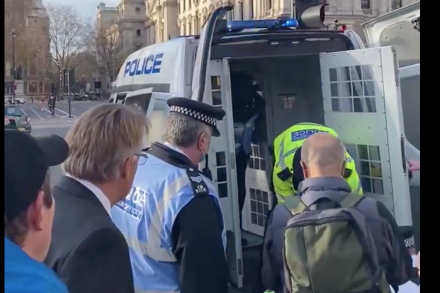
The Tory MP and former 1922 committee chair Charles Walker appears to have become involved in a lockdown protest outside Parliament today. The MP was outside the House of Commons when he witnessed an elderly woman being arrested by police. In response, Walker told the officers that their arrest was an ‘outrage’ and was not necessary: https://twitter.com/Tridg98/status/1331236485748678657?ref_src=twsrc%5Etfw Walker then appeared in the House of Commons to make a point of order. He said that the woman had been taking part in a peaceful protest outside Parliament before she was carried ‘spread-eagle’ to a police van.

Watch: Boris Johnson’s Zoom nightmare

From our UK edition

Oh dear. You would think with the Prime Minister still isolating (after coming into contact with a Covid-infected MP) that the Downing Street boffins would have set him up with a decent enough internet connection by now. Unfortunately though, it appears that the PM is still struggling when it comes to the tech. Boris Johnson dialled in virtually to Parliament today to announce his new tiered system for after lockdown. Only things started to go downhill rather quickly when the his audio cut out in the middle of an answer.  The Speaker of the House was left quizzing the PM to see if he’d hit the mute button, before eventually subbing in Matt Hancock to deal with questions instead.

Clinically vulnerable MPs are still being excluded from parliament

From our UK edition

Why is the government refusing to allow clinically vulnerable MPs to take part in debates on legislation? This row has been rumbling on for months, with no apparent enthusiasm from ministers to change the current situation. Today, senior MPs have told Coffee House they believe the government's actions would be in breach of the Equality Act were this taking place outside parliament. Currently MPs who are shielding at home can ask questions and vote remotely, but they cannot give speeches or intervene in debates on legislation, as well as backbench business and Westminster Hall debates.

How Boris should pick his peers

From our UK edition

It is no credit to British democracy that we have the second largest legislative chamber in the world. The only one larger than the 792-strong House of Lords is the 2,980-member Chinese National People’s Congress. In the coming days the House of Lords will grow even bigger as the Prime Minister announces another batch of peerages. We can expect a bad-tempered reaction if, as expected, a slew of Brexit campaigners such as Ian Botham are included while former speaker John Bercow is left out. But no one should be too surprised. Prime ministers have always used their patronage to appoint likeminded peers, as have leaders of the opposition.

Will all roads soon lead to York?

From our UK edition

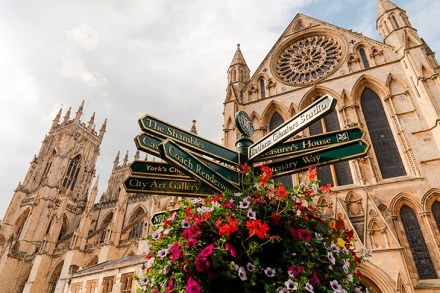
Should the PM move parliament to York? There is, of course, historical precedent for such a move, as he very well knows. Rome was founded in 753 bc and when it became a republic in 509 bc it had a population of about 40,000. By about 260 bc it commanded manpower across Italy of about 730,000. At the collapse of the republic in 31 bc when Augustus became its first emperor, Rome controlled all Italy and an empire from Gaul to North Africa and Syria.

What will the Zoom Parliament change?

From our UK edition

Parliament will return today, albeit in a very odd way. There will be some MPs in the chamber and others Zooming in. It will not be parliament as we are used to. This hybrid model will mean that debate will be stilted, but it is better than nothing. It is also essential that parliament sits in some form given the powers that the executive has taken on to deal with this crisis. One thing that the Zoom Parliament will change is that it will give an indication of where parliamentary opinion is on the lockdown. I have been struck talking to Tory MPs over the past week or so by how many of them want the government to set out a much clearer exit strategy.

Parliament must return to defend our liberties

From our UK edition

MPs seem to have lost interest in defending our liberties. On 25 March Parliament went into recess a week early when our fundamental freedoms are under threat, our economy is being shredded, and our most independent-minded individuals, such as the self-employed and entrepreneurs, are being required to plead for state aid or bank loans. Above all, Parliament did not even scrutinise the most draconian measures enacted since the second world war. Both houses went into recess on 25 March. The coronavirus regulations were laid before Parliament at 2.30 pm on 26 March and came into force immediately.

Sunday shows round-up: Shop just for what you and your family needs

From our UK edition

Robert Jenrick - We will do 'whatever it takes' to support those at risk Sophy Ridge was first joined this morning by the Housing Secretary, Robert Jenrick. With the threat from coronavirus still looming large, Jenrick told Ridge that the Chief Medical Officer was now officially advising around 1.5 million people at particular risk from the virus to remain indoors for potentially as long as three months. He pledged that the government would do its utmost to support them: https://twitter.com/RidgeOnSunday/status/1241645655703146497?ref_src=twsrc%5Etfw RJ: We are writing to these people... and we're asking them, as soon as practical, to stay at home and to do so for a prolonged period, perhaps as long as 12 weeks...

What happens to ex-MPs?

From our UK edition

Parliament returns tomorrow - without 47 of the people who were MPs just a few weeks ago. Some, like those standing as independents, had a pretty good hunch that they'd be booted out by the electorate on Thursday. Others had less notice, and realised only as the campaign wore on that their constituencies, many of which had been solidly Labour for decades, were turning away from them. Many of them will be in Westminster in the next few days to clear out their offices and make their staff redundant. You can usually tell the difference between a re-elected MP and one of their colleagues who lost as you watch them walk through the corridors of parliament.