Paris

Notre-Dame rising

Five years have passed since a major fire swept through the Cathédrale Notre-Dame de Paris on April 19, 2019, bringing down the church’s roof but sparing the rest of the building. In response, French president Emmanuel Macron immediately promised that the structure, which is owned by the state, would be rebuilt quickly, and more beautiful than before. He further promised that the cathedral would be ready to receive worshipers and visitors in time for the 2024 Paris Summer Olympics. Since his announcement, however, things have not gone entirely to plan. Notre-Dame will not be finished in time for the Olympics; as of this writing, completion has been pushed off to December 2024.

notre-dame

Macron tries to be the Xi whisperer

God bless Emmanuel Macron for his perseverance and self-confidence. The French president seeks to lead Europe and turn the continent into a strong, independent player in its own right. And he is eager to take on the hard, thankless diplomatic work that few of his peers are willing to do. Whether it was his ploy in 2019 to connect then-US president Donald Trump and then-Iranian president Hassan Rouhani on the phone or his months-long, intensive personal dialogue with Russian President Vladimir Putin before the war in Ukraine, Macron invests a lot of time and capital into these gambits. Unfortunately for him, many of them fail to accomplish anything of substance. Macron wasn’t able to convince Rouhani to speak with Trump (although Trump reportedly agreed to the call).

napoleon macron tantrum diplomacy

Paris: the place to be as a royal in exile

When rulers are thrown out of their countries, they cannot expect all that much. Think of Napoleon, first cooling his heels in Elba, then ending his days in the damp-infested confines of Saint Helena. Which is why the former Edward VIII, later the Duke of Windsor, was comparatively fortunate that the Parisian spot in which he found himself living after his abdication in December 1936 was Le Meurice in Paris: then, as now, a hotel that offers not only glitteringly luxurious accommodation to its well-heeled denizens, but a tangible sense of history — its lavishly appointed suites and restaurants exude an atmosphere that’s simultaneously relaxing and conspiratorial. Turn an unexpected corner, and you half-expect to see the ghost of Wallis Simpson, barking orders at some hapless minion.

Paris
virus

Fear, guilt and the virus

Fear and the frisson of fear are two very different emotions. The one is horrible and the other delightful or at least often sought after.Who, after all, does not enjoy a good fright in a cinema or while reading a thriller? When I arrived in Paris just before the lockdown was announced and one was no longer allowed out of the house without a laissez-passer (signed by oneself), all the places of public resort such as bars, restaurants and cinemas, had already been closed: but the atmosphere was still one of frisson of fear rather than of fear itself.

Paris match

“If you wish to meet intellectual frauds in quantity,” V.S. Naipaul once said, “go to Paris.” After two years of pandemic-induced shutdowns and travel bans — some of them instituted, it seemed at times, with the sole purpose of harrying visitors from Britain — it was oddly satisfying, rather than irritating, to be assailed once again by the sciolistic outpourings of aspiring novelists. On mild spring evenings, the Left Bank echoed with the chatter of students and veterans of the creative writing mills of North America. Paris, finally, was emerging from the thickets of depression and terror occasioned by disease, ennui and patrols of gendarmes hunting for delinquents out for a walk.

Paris

Imagining Rimbaud

The life of poète maudit and gunrunner Arthur Rimbaud is a puzzle to nearly everyone who knows it. A precocious student who won a regional concours académique for a poem in Latin, Rimbaud left school at fifteen, shortly after the start of the Franco-German War. After two attempts to escape home for Paris, he finally moved in with the poet Paul Verlaine in the fall of 1871, where he succeeded in insulting all the literary lights of Paris in three months. The two men began an affair, which ruined what was left of Verlaine’s marriage to Mathilde Mauté (whom Verlaine regularly beat). They made two debauched trips to London and eventually fell out in Belgium, where Verlaine shot Rimbaud in the wrist.

rimbaud noguez

Fall and decline

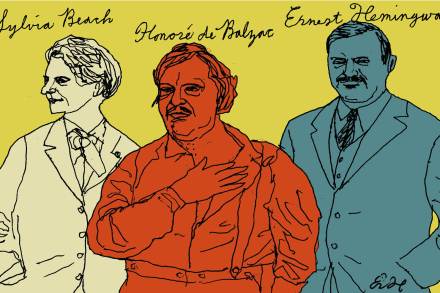
In December 1921, a twenty-two-year-old Ernest Hemingway, then the European correspondent for the Toronto Star, came across the oddest group of immigrants in history — the White Russians who had fled the Bolshevik Revolution. “Paris is full of Russians,” Hemingway told his readers. “They are drifting along in Paris in a childish sort of hopefulness that things will somehow be all right, which is quite charming when you first encounter it and rather maddening after a few months. No one knows just how they live, except by selling off jewels and gold ornaments and family heirlooms that they brought with them to France.” Hemingway neatly summarized the meat of this gripping latest book by Helen Rappaport, the author of The Romanov Sisters and Caught in the Revolution.

russian

Style and substance

In Ravelstein, Saul Bellow’s thinly disguised account of the final years of the University of Chicago professor Allan Bloom, the narrator Chick and his close friend Abe Ravelstein go on a shopping spree in Paris sometime in the 1990s. For all their highfalutin philosophical talk about Athens versus Jerusalem and the like, Bellow makes it clear that there is a Dionysian as well as Apollonian cast to the bond between Chick and Abe. After departing the Hôtel de Crillon, their first stop is Lanvin. There, Abe is smitten by a beautiful flannel jacket retailing for $4,500. He buys it.

de mans

Kamala in Paris

Ah, the French. Is there any other people Americans so love to antagonize? Recall that after France (rightly) decided to abstain from the Iraq war in 2003, we didn't just express our discontent; we introduced the term "cheese-eating surrender monkeys" into the Kissingerian lexicon. We then canceled French fries, which are Belgian. Call it a sibling rivalry between children of the Enlightenment; call it a clash between social democracy and rugged individualism. Whatever you call it, just don't go canceling a submarine agreement at the last minute for the love of God. That's what Joe Biden did last month when Australia suddenly nixed a plan to purchase subs from the French in favor of American and British vessels. And stop the presses! A conspiracy of the Anglophones was afoot!

France wakes up to Woke

One crisis can conceal another. While France has been distracted by COVID, a new menace is lurking. The specter haunting the republic is le Wokisme, the mutating ideology of race and identity that has found unexpectedly fertile ground here. French elites are unsettled. Those who assumed the French possessed herd immunity against such barbaric American ideas are having their complacency tested. Superficially a modern country, with iPhones, Amazon and electric cars, France is still often introspective and late to understand what’s happening in the wider — especially Anglophone — world, which is how wokeness has somewhat taken it by surprise. Woke had been happening in America for many years before the French noticed.

woke

Culture and anarchy

Paul Signac’s portrait of Félix Fénéon is a striking and historically important painting. But is it a good one? Its subject didn’t think so. Signac profiles Fénéon against a swirl of complementary colors and kaleidoscopic shapes, as if anticipating an acid-trip scene from a Roger Corman movie. This radioactively abstract background was bold stuff for Paris in 1890, when the picture was made, but contemporary critics disapproved, one finding the work ‘cold and dry’, another calling it ‘neither decorative nor comprehensible in terms of feeling’. Fénéon himself was similarly vexed by the final result, though he held onto the portrait throughout his life out of loyalty to his painter friend.

Féneon anarchy

Our lady of hope

From the kitchen of her apartment on the Quai de la Tournelle in Paris, the journalist and broadcaster Agnès Poirier could see the bright yellow plumes of smoke rising into the sky. Notre-Dame de Paris was on fire, and suddenly, in that tourist-crowded, hyper-expensive ‘cradle of France’, nothing was certain — ‘democracy, peace and fraternity’ — anymore. The following morning, children living on or near the Île de la Cité took to school little plastic bags filled with blackened bits of roof picked up from balconies and pavements (as well as probably quite a lot of lead dust) which ‘dated back to the Crusades’.

notre-dame poirier

The haunting beauty of empty cities

COVID-19 has a horrid ability to turn fiction into fact. Deserted modern cities are usually the realm of post-apocalyptic sci-fi movies. Now, many of us live in them. The world's greatest streets are dramatically empty; suspended suddenly in a dream-like quiet. It's eerie and also very beautiful. We usually often don't notice how remarkable our cities are the commotion. We are distracted by the crowds, the commotion and the congestion. Now it is hard for urbanites to notice anything else. The Spectator has looked around the world, and asked various writers in various places to describe where they live in lockdown.

empty cities london

Epicenes and epicures

The last time I saw Paris, it was the early spring of 2017. A pallor hung over the city, the grands boulevards had lost their charm and downcast Parisians hurried about the streets with uncharacteristic alacrity. The day I arrived, a letter bomb exploded at the IMF’s headquarters on the Avenue d’Iéna, blocks away from where I was sitting on the terrace of a café on the Avenue Kléber. That the bomb turned out to be from Greek anarchists and not the usual Islamist suspects was little comfort; it had already ruined my café express. Two days later, a French-born Muslim took a female soldier hostage at Orly airport. A standoff ensued, with him holding a pistol to her head while her comrades aimed at his. ‘Put down your weapons!

paris

Leonardo da Virtual

This article is in The Spectator’s December 2019 US edition. Subscribe here. The first time ever I saw her face, she was smiling. I knew her face before I saw it, but I cannot remember when I first knew it, because I had always seen it. But when I first saw her in the flesh, I couldn’t really see her at all. She was behind thick glass and a waist-high wall, and a crowd of people 20-deep were pushing toward her, shouting and pointing and taking photographs. She was still smiling, but as I forced my way out of the crowd, I felt as though the smile no longer expressed the mysterious inner mood of a high-born Florentine sitting in a loggia, but the bemused contempt of a woman sitting in the stocks for the entertainment of the mob.

mona lisa leonardo