Oxford union

The performative hypocrisy of the pro-Palestine mob

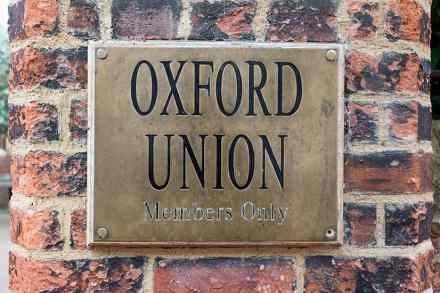
You haven’t really made it in life until you’ve addressed the Oxford Union. That’s how I feel upon reading the flattering invitation to debate the proposition, ‘This House Believes Modern Youth Activism is Primarily Performative’, which tells me that I am ‘a sharp and independent voice’ with ‘a historically informed perspective’ who challenges ‘orthodoxies across the ideological spectrum’. Unfortunately, the 200-year-old body cannot cover the airfare from Washington to London, let alone an honorarium. But with an appeal like that, how can I say no? As an undergraduate, I was a member of the Yale Political Union, which, like the Oxbridge institutions on which it was modelled, is a boot camp for future politicians.
Nostalgia for snooker’s glory days

Forty or so years ago, when I was at university, my friends Richard, Terence, Harry and I would often go to the Oxford Union to play snooker. There were two immaculate snooker tables in a large room at the top of the building and almost no one ever went there except for us. Unfortunately, our enthusiasm was not matched by concomitant talent. On one occasion it took us 34 minutes to pot a single ball. At a certain point in that endless non-break, Terence had an easy pot to a distant hole. Saying ‘I was going to pot the ball, but instead I’m going to do this’, he hit the ball with such misapplied force that it leapt in the air, off the table altogether and very nearly out of the door. Our frames would take hours.

John Power, Nick Carter, Elisabeth Dampier, Maggie Fergusson & Mark Mason

26 min listen

On this week’s Spectator Out Loud: John Power argues the Oxford Union has a ‘lynch-mob mindset’; Elisabeth Dampier explains why she would never date a German; Nick Carter makes the case for licensing MDMA to treat veterans with PTSD; Maggie Fergusson reviews Island at the Edge of the World: The Forgotten History of Easter Island by Mike Pitts; and, Mark Mason provides his notes on guided walks. Mark will also be hosting a guided walk for the Spectator, for tickets go to spectator.com/events Produced and presented by Patrick Gibbons.

Why Danny Kruger’s defection changes everything & could Boris Johnson be next?

54 min listen

This week Michael and Madeline unpick the shock defection of Danny Kruger to Reform UK’s ‘pirate ship’ – as described by Michael – and ask whether this coup could mark the beginning of the end for the Conservative party. They also dive into Westminster’s most charged moral debates: the assisted dying bill in the Lords and the quiet decriminalisation of abortion up to birth. What do these changes say about parliament’s ‘intoxicated liberal hubris’ – and the protections given to the vulnerable? Also, Donald Trump lands in Britain this week – but why is it that the Prime Minister acts ‘like Carson the butler’ in his presence, and who exactly is the ‘diplomatic secret weapon’ that the Palace deploys to manage ‘the Donald’?

The joy of being cancelled

New York I’ve never met anyone called Othello, certainly not in Venice nor in Cyprus, but perhaps there are men by that name in Africa. Someone who was referred to as Othello, but always behind his back, was the greatest of all Russians, Alexander Pushkin: a ‘raging Othello’ was how les mauvaises langues in court described the great poet. Pushkin’s great-grandfather, General A.P. Gannibal, was Ethiopian. I’ll get back to Othello in a jiffy, but first a few words about marital jealousy and Pushkin. The poet got a bee in his bonnet soon after marrying the beautiful but coquettish Natalia because she flirted, harmlessly but nevertheless disastrously.