Nhs

The new Equalities Act only increases the risks for mental illness sufferers

From our UK edition

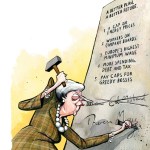
Mrs May promises to amend the Equalities Act to prevent employers from ‘unfairly’ dismissing those with mental disorders. It is a laudable aim, but imagine what would happen if businesses had to keep on a disturbed worker. Imagine what it would be like, not only for the employer, but for the other employees. In her speech on ‘the shared society’ in January, Mrs May pitched into the ‘burning injustice of mental health and inadequate treatment’. In doing so, she praised the ‘tremendous campaigning work by Black Mental Health UK’. Again, this was rash. Mental health is an over-politicised subject, and organisations like Black Mental Health UK help make it so.

Letters | 18 May 2017

From our UK edition

Libyan solution Sir: Boris Johnson correctly reports glimmers of hope in Libya, but to say its problems can be solved by political will risks falling into the same trap of wishful thinking that has hobbled the international community’s intervention there (‘Libya’s best hope’, 13 May). To fix Libya, its political process must be restructured to incentivise cooperation between its various factions. One thing nearly all Libyans can agree on is that the country’s oil should flow freely, since oil revenues pay for everybody’s fuel, medicine and salaries. In recent years, oil production has been repeatedly blockaded by criminal militias and politicians alike; sometimes by the same people engaged in people-trafficking.

The Spectator Podcast: The May manifesto

From our UK edition

On this week’s episode, we discuss Theresa May’s lurch to the left, the NHS’s looming crisis, and how Americans should talk about Trump. First up: Theresa May has launched the Conservative party's manifesto this week, but whilst much has been made of the slow death of the Labour party, the Tories appear to have borrowed rather liberally from Ed Miliband's 2015 offering. This is what Fraser Nelson says in his cover piece, claiming that the Conservatives have become 'the party of Brexit' rather than of low taxation. He joins the podcast along with David Goodhart, who writes this week on how Theresa May is finding a new middle way.

This is an emergency

From our UK edition

The NHS as we know it is dying. It’s no longer a matter of if it will collapse, but when. Those of us who work on the front line have known this for some time, and it’s heartbreaking. Last week’s ransomware cyber-attack served to highlight how frail and vulnerable the health service is. While many tried to blame Health Secretary Jeremy Hunt for failing to prevent such a disaster, the archaic IT system is actually emblematic of how the NHS as a whole has struggled to keep up to date and adapt to the modern world with the necessary speed. I trained as a doctor specifically because I was so proud of the NHS and the ideologies underpinning it. It is one of this country’s greatest achievements: a fair, equitable and cheap way of delivering healthcare.

The government has some big questions to answer over the NHS cyber-attack

From our UK edition

Are there any words which have such an affinity as ‘NHS’, ‘IT’ and ‘cock-up’? Older readers might remember how the Department of Health blew £10 billion of taxpayers’ money on a computer system which was eventually abandoned. Today comes news that two dozen hospitals have been affected by a massive hack of computer systems. Patients in Stevenage and Blackpool have been told not to visit their local A&E departments unless they are desperate. Operations have been postponed. Phone systems have gone down and doctors are unable to prescribe drugs. The culprit is a piece of ‘ransomware’ which seems to be capable of locking computers which it says will only be unlocked if a payment is made in bitcoin.

At the cutting edge

From our UK edition

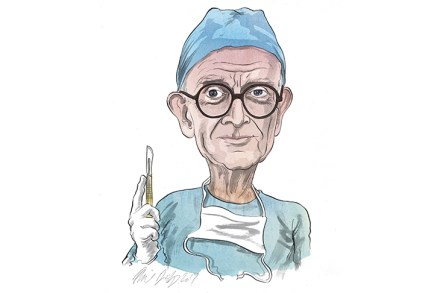
There’s a graveyard inside Henry Marsh’s head, though you’d never guess it to look at him. There he sits in his elegant flat in a small castle on a small island in the Oxford Thames: 67, attractive, restless. There he sits with the world all around him: Persian rugs, French tapestries, Japanese prints and his beautiful blonde wife (the anthropologist Kate Fox) in a separate flat below. But the ghosts of past patients are never far away. Henry Marsh is a brain surgeon, celebrated for his skill in operating on patients under just local anaesthetic. He’s famous also for his astonishing memoir Do No Harm, to which he’s now written an equally remarkable sequel, Admissions.

Numbers 10 & 11 need to find a better way of working together

From our UK edition

Philip Hammond should be sending George Osborne a case of the finest claret. For Osborne’s decision to accept the editorship of the Evening Standard, has distracted Westminster’s from  this week’s spectacular Budget reversal. But, as I say in The Sun this morning, the fallout from it will be felt for some time. Even Hammond’s Cabinet allies admit that ‘Of course, he’s damaged’ by the whole issue. But those in May’s circle are blunter. Pointing out the mistake was ‘staring you right in the face’ before he made it and that the National Insurance hike on the self-employed ‘was pushed back several times' by Number 10.

Diary – 16 March 2017

From our UK edition

In the NHS clinic where I work, adults who suspect they may have Asperger syndrome wait almost a year for a diagnosis. The clinic takes referrals from all over Cambridgeshire and Peterborough (a population of 860,000), but we have to see all of them in the hours of a single full-time doctor. And the clinic is not given funds to run a follow-up support service once someone has been diagnosed. These individuals struggle to socialise, are neurologically different, and are overlooked because their disability is invisible. Many have experienced bullying in childhood, underemployment in adulthood and exploitation because of their social naivety. Many are made to feel inferior despite their often considerable talents. No surprise that many develop depression.

The Budget exposed a myth: people don’t want to pay more tax to fund the NHS

From our UK edition

Perhaps the most interesting thing about the debate on the increase in National Insurance Contributions for the self-employed is that it lays bare the lie that people are happier to pay more tax to fund the NHS. In December, the Guardian reported a study that suggested that 70 per cent of people would 'happily pay an extra 1p in every pound if that money was guaranteed to go to the NHS', while almost half of the 1,000 people surveyed said that they would even pay an extra 2p in the £. Where are these people now?

Labour haven’t hit rock bottom yet

From our UK edition

Copeland was a truly awful result for Labour. But as I say in The Sun this morning, the really alarming things for Labour is that things can get worse for them. Many Labour MPs have been operating on the assumption that the NHS will keep the party’s loses down to a manageable level in 2020. But Copeland suggests that this hope is misplaced. Labour went all in on the health service there and had no shortage of material to work with, the maternity unit at the local hospital is under threat. By the end of the campaign, Labour’s message was perilously close to vote for us or the baby gets it—and yet people still didn’t vote for them. The other thing that should really worry Labour is that the Tories’ Corbyn card will be even more potent in 2020.

What you need to know before buying health insurance for kids

From our UK edition

If you’ve had enough of battling to get the kids a doctor’s appointment, or don’t want them waiting months to be seen by a specialist, there is an alternative. You could take out children’s private medical insurance that will pay for some or all of the diagnosis and treatment your child may require. Such policies come with a long list of benefits. For example, most offer same-day video and phone consultations and can arrange specialist appointments and procedures much faster more than through the NHS. 'Another valued benefit,' says Kevin Pratt, consumer affairs editor at MoneySupermarket.com, 'is the cash payment that is made to the parent for each night that a child has to stay in hospital.

Corbyn fumbled his NHS attack at today’s PMQs

From our UK edition

When Ed Miliband was asking the questions at PMQs, we didn’t think we were living through a vintage age of parliamentary debate. But every week, Miliband’s performances looks better by comparison. Jeremy Corbyn went on the right topic today, the NHS, but his questions were all over the place and lacked coherence. Indeed, at one point it was hard to tell what the actual question was. But, I suspect, that Labour will feel that if Corbyn has managed to bump the NHS up the agenda ahead of the two by-elections on Thursday, then it will have been a worthwhile exercise. But it is telling that any advantage Labour gained from the session came not from Corbyn chivvying information out of Theresa May, but just the obvious topic that he and his team decided to go on.

Why wouldn’t our NHS saints help a dying man? | 11 February 2017

From our UK edition

We all think pretty highly of ourselves these days, free from old-fashioned ideas about sin. We’re good people. And yet… I read in a letter in a local newspaper recently a description of an event in the writer’s own home which shows that we might also be becoming monsters. The letter-writer, Jane, was a lady in her late fifties who cared at home for a husband, Fred, with terminal brain cancer. As Jane’s letter explained, Fred had fallen recently on to the bathroom floor, and as she was unable to lift him, she telephoned for help. Seven medics arrived and rushed to the scene. All seven then stalled. Though Fred was not obese, though there were seven of them, they told Jane that they were not allowed to help him up.

Why wouldn’t our NHS saints help a dying man?

From our UK edition

We all think pretty highly of ourselves these days, free from old-fashioned ideas about sin. We’re good people. And yet… I read in a letter in a local newspaper recently a description of an event in the writer’s own home which shows that we might also be becoming monsters. The letter-writer, Jane, was a lady in her late fifties who cared at home for a husband, Fred, with terminal brain cancer. As Jane’s letter explained, Fred had fallen recently on to the bathroom floor, and as she was unable to lift him, she telephoned for help. Seven medics arrived and rushed to the scene. All seven then stalled. Though Fred was not obese, though there were seven of them, they told Jane that they were not allowed to help him up.

Jeremy Hunt has promised to get serious about NHS health tourism before. Is he serious this time?

From our UK edition

This morning, we wake up to the news that the government is now serious about collecting money from health tourists – those who come to the UK to use the NHS without being entitled to it. We have, alas, heard this before. For weeks now, we have been reading about a crisis in A&E — a symptom, we’re told, of a funding crisis in the National Health Service more generally. Since I started working for the NHS almost 45 years ago, this has been a familiar theme: the system is creaking, but a bit more tax money should suffice. To many of us who have seen the system close at hand, another question presents itself: what if the NHS were to cut down on waste? And perhaps recover costs from the health tourists who turn up for treatment to which they are not entitled?

What the papers say: Will the Government’s plan to tackle health tourism work?

From our UK edition

NHS hospitals will charge foreign patients who are not eligible for free, non-emergency treatment up front from April, Health Secretary Jeremy Hunt will announce today. It’s a controversial step, but one likely to go down well with voters angry at people from abroad using NHS services without paying. The move is designed as a way of finally meeting a target for hospitals to recoup some £500m from overseas patients - something hospitals have, until now, fallen well short of doing (just £289m was collected in 2015/16). It’s a step which, unsurprisingly, has been greeted with praise in this morning’s newspaper editorials.

Rules for loneliness

From our UK edition

An old acquaintance died recently. A friend of mine, who was closer to him than I was, rang to tell me. She’d known him for 40 years and looked after him at various times when he fell ill. He was diagnosed with cancer three weeks ago and died suddenly in hospital last week. She tried to find out what happened, but as she is not next of kin (he had no relations) she will probably never know. Within the monolith of the NHS, patients, particularly the elderly, are able to disappear from view as effectively as prisoners in the Soviet gulag. If they don’t re-emerge alive, no except a close relation can discover why. I first realised this two years ago when I moved from London to Oxford, and tried to carry on volunteering as a hospital visitor. A neighbour broke her leg.

Letters | 26 January 2017

From our UK edition

What is a university? Sir: As a former Russell Group vice chancellor, I think that Toby Young’s appeal for more universities (Status anxiety, 14 January) needs several caveats. First, what is a university? Recently some have been created by stapling together several institutions without any substantial element of research and renaming them as a university. There is even some suggestion that research is inimical to good teaching, because some university researchers with a duty to teach shirk it. But the presence of a weighty research community lends a university an invaluable ambience. In America, many colleges that teach only to the bachelor degree are well regarded without possessing the title of university.

Losing patients

From our UK edition

For weeks now, we have been reading about a crisis in A&E — a symptom, we’re told, of a funding crisis in the National Health Service more generally. Since I started working for the NHS almost 45 years ago, this has been a familiar theme: the system is creaking, but a bit more tax money should suffice. To many of us who have seen the system close at hand, another question presents itself: what if the NHS were to cut down on waste? And perhaps recover costs from the health tourists who turn up for treatment to which they are not entitled? I first made the case for doing so four years ago, in the pages of this magazine, when I was the senior surgeon of a rare cancers unit at the Royal Marsden Hospital in London.

Letters | 19 January 2017

From our UK edition

Particle of faith Sir: Fraser Nelson draws our attention to the most worrying aspect of economists getting it wrong, which is their reluctance to recognise it (‘Don’t ask the experts’, 14 January). Some economists, seduced by sophisticated mathematical models, aspire to the status of, say, particle physicists, who can tell us they have found something called the Higgs boson. The fact that we tend to believe the particle physicists despite being more familiar with prices, jobs and buying and selling than with quantum equations comes down to physicists having a long track record of heeding the biologist E.O. Wilson’s advice: ‘Keep in mind that new ideas are commonplace, and almost always wrong.