Medicine

Want babies? Get a job, lose the Lycra – and other fertility tips

Did you know that one in six couples in the UK have difficulty conceiving? That’s roughly 3.5 million not very happy people. A healthy diet, not smoking and not being too overweight or too underweight can all improve your chances of having a baby. Here are some other ideas worth a try. Take care with technology. Both mobile phones and laptops have been implicated in reducing sperm quality. Research has found that while using a phone increased testosterone, it also reduced levels of luteinising hormone, important in male fertility. Carrying your phone around in your trouser pocket is not great either and, as for laptops, using one on your lap if you’re a man should be considered a no-no – increasing scrotal temperatures over a long period is bad for your sperm.

Herbal medicine – not just for new-age hippies anymore

Lacking in pep? Looking for some extra zing as winter sets in? The Spectator recommends our energy conference on 1 December. Tickets are still available, sign up here. Society is changing fast because we live longer. But the NHS was designed for a different age where the gap between retirement and death was much smaller. The result is that the health service's financial footings are fragile and require new ways of delivering health to keep spending at sustainable levels. A new roadmap for reform of the NHS has been produced by Sir Simon Stevens. But there is a large hole where herbal medicine should be. Sadly, it does not merit a single mention in Stevens's otherwise inspiring blueprint, apart from a fleeting mention of 'supported self-care'.

Why the most important years in history were from 1347 to 1352

A group of retired Somerset farmers were sitting about in the early 1960s, so Ian Mortimer’s story goes, debating which farming invention had most changed their lives. Was it the tractor? Fertilisers? Pesticides? Silos? No, they agreed, it was the Wellington boot. Mortimer tells this old story to illustrate that ‘it is not always the most dramatic changes that make a difference to our lives’. And for all the wars, plagues, renaissances and revolutions documented in this lively survey of 1,000 years of western history, they are outweighed by quieter forms of change: the rise of peace in the 11th century, for instance, or that of record-keeping in the 13th. Later, there are all the ‘-isations’ — urban, industrial, liberal, global.

Smoking weed won’t make your kids smarter, but it won’t make them brain-dead, either

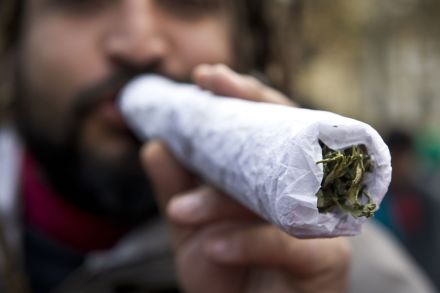
Lacking in pep? Looking for some extra zing as winter sets in? The Spectator recommends our energy conference on 1 December. Tickets are still available, sign up here. I don't want this to become the 'Tom Tells You To Get High' blog, so this will be the last time I write about cannabis for awhile, I promise. Unless there's something interesting in the news about it again. Anyway, pass the dutchie on the left-hand side and all that. The Daily Mail, the BBC and the Telegraph report that teenagers who smoke cannabis regularly do worse in their exams. Per the Mail: 'The findings. . . add to a growing weight of evidence that suggests cannabis is more harmful than legalisation campaigners would have us believe'. They're half right.

How to cure bad breath (and continue eating smelly foods)

Have you ever tried that good old test for halitosis – licking your wrist, letting it dry, then having a good whiff – and been shocked at the result? The bad news is that mints don’t work, but here are a few tips that might succeed in making your breath smell sweeter. Brush your tongue As well as brushing your teeth, you need to brush your tongue, if an American study is anything to go by. Levels of smelly sulphur compounds caused by food bacteria dropped by 53% in people who brushed both teeth and tongue for a minute twice a day for a fortnight. Scrape your tongue Even better, according to other research, is using a tongue scraper. But the effect might only be temporary, we’re sad to say.

Sod the diet and lose weight anyway – here’s how

Who enjoys all that calorie counting? If you hate diets but love the idea of losing a bit of weight, these quick fixes might just help you shift a few pounds – or prevent you from putting on any more. Get enough shut-eye. Research has shown that people who are sleep-deprived eat a lot more the next day than those who are well rested. In one study it was an average 600 calories more. Why? Quite simply, if you stay awake for longer, you’re more likely to have the munchies. Down the dairy. A few studies have suggested that people who eat more dairy products when they’re trying to lose weight get slimmer faster.

Keep calm and address Ebola: a brief history of pandemics at The Spectator

Ebola clinics in many parts of West Africa are full, so more and more people are being told to stay at home and take Paracetamol and fluids if they become infected. It means if someone in your family gets Ebola, you all have to stay in the house, which is effectively a death sentence. At the moment, the disease is killing 70 per cent of the people it infects, but that’s likely to go up. People who need other medical treatment can’t get it, and in Sierra Leone 40 per cent of farmland has been abandoned. Western governments are building secure military encampments for health workers, fearing civil unrest and angry mobs. In 1898, there were plague riots in India after authorities brought in sanitary measures, including quarantine camps.

The limits of ‘superfood’ – debunking broccoli

Over in my day job, I recently wrote a piece about 'superfoods' and the myths that a particular kind of food can protect you from illnesses. The only food advice for which there is consistent evidence is that you should eat a balanced diet with plenty of fruit and vegetables; all this stuff about how you should eat pomegranate to make your liver healthy, or whatever, is complete nonsense. One of the items that keeps cropping up was broccoli. It contains a chemical called sulforaphane, which supposedly helps with diabetes, lung disease and breast cancer. Naturally, the evidence for all this is lacking: the tests were all carried out with the chemical, extracted from broccoli, on cells in a petri dish, or on mice.

Five ways to fight the flu – or why you should curl up with hot fruit cordial

No one likes getting the flu and for some people, in particular the sick and elderly, the virus can prove deadly. So it’s worth taking a few simple steps in a bid to stave it off. 1. Wash your hands. Use soap and water to wash off the germs you pick up on all the surfaces you touch (and make sure you clean them too). Wash hands often and thoroughly – sing “Happy Birthday” or another short song to yourself while you’re doing it. And grasp the tap with a piece of loo paper when you turn it off. Overkill? Maybe. But who wants the flu? 2. Don't smoke. You’re more likely to catch the flu if you smoke and the chances are your symptoms will be worse.

Meet the bloated, useless General Medical Council

There was a time, not long ago, when British GPs provided the best home doctor service in the world. Patients could telephone their doctor 24 hours a day, seven days a week (including Christmas), ask for a home visit and get one. Patients prepared to visit the surgery could expect to see a doctor the day they called. Today, it is easier to find a plumber than a doctor at night and weekends. Patients wanting emergency help out of office hours must visit their nearest major hospital and spend hours queuing in the A&E department.

Lord Freud was right and Miliband shameful

Markets are amoral. If a severely disabled person cannot produce more than the minimum wage’s worth of work, no employer will be able to profitably employ them. Some generous ones might do so at a loss, but we cannot assume that there will be enough of them. Many severely disabled people who would like to work thus cannot do so. Lord Freud, a businessman turned welfare advisor to Tony Blair turned Tory minister, made this point at a fringe event at the recent Tory conference. He suggested that we could allow firms to employ severely disabled people at below the minimum wage. He also said we should use something like the Universal Credit financial-support scheme to make up the difference – although this has been much less widely reported.

Stop ‘Stoptober’: seven health benefits associated with smoking

James Delingpole's latest Spectator column laments the pernicious portmanteau afflicting this fine month: Stoptober. Geddit? That’s ‘-ober’, as in the second half of ‘October’, with the word ‘Stop’ cunningly positioned where the ‘Oct’ would normally be. And what marketing genius was responsible for this rebranding? Why, someone from an Orwellian body which you’d probably much prefer didn’t exist, let alone to have to fund with your taxes. Public Health England. James closes with his own call to action: 'Let's start by reclaiming October.

Of course marijuana isn’t ‘safe’ – but should it be illegal?

Sometimes I read things that really get on my wick, and last week was one of those times. A new, 'definitive' 20-year study has 'demolished the argument that the drug [cannabis] is safe', according to the Daily Mail. Has it, though? There are various things wrong with that claim. One, no study is 'definitive'; two, the research was not a '20-year study', but a review of other studies carried out over the last 20 years. There are lots other things wrong with the coverage, too, including the startlingly ridiculous claim that cannabis is 'as addictive as heroin'. Even according to the research itself, less than one-tenth of people who try cannabis become addicted to it, compared to nearly a quarter for heroin.

Six rivals for the name Isis

Not in their name The BBC decided to start calling the Islamic terror group Isis by the acronym IS instead. Some organisations who are retaining the name: — Isis Equity Partners London-based private equity group — The Isis Student magazine at Oxford University — Isis day spa and hair salon in Oxford (not to mention hair salons in Birmingham, Ascot, Sunningdale and Writtle) — HMP Isis Young Offenders’ Institution in Thamesmead — Isis Motors Secondhand car dealership in Hayes, Middlesex — Spirit of Isis Ethically sourced crystal shop in Bedford Fighting faiths It was claimed that more British Muslims are fighting for jihadist forces than have joined HM Forces. What is the declared religion of British servicemen? Christian 86% No religion 12.

Rotherham has proved it again: social work just doesn’t work

In 1980, June Lait and I published Can Social Work Survive?, the first critique of British social work aimed at the general public. She was a lecturer in social policy and a former social worker; I was a psychiatrist who had regular and friendly contact with social workers. But we both felt that social work had become vague and grandiose, and we compiled quite a lot of evidence to make our case. We even reported studies showing that well-intended social work interventions could be not just unhelpful but harmful. Our work was published in The Spectator, and it touched a nerve. ‘Of course social workers don’t do harm,’ one critic fumed.

This strategy won Eurovision. It could also save your life

Oskar Morgenstern grew up in Vienna, John von Neumann in Budapest. Clearly the same Austro-Hungarian intellectual spirit which gave rise to Zur Theorie der Gesellschaftsspiele and their seminal joint work Theory of Games and Economic Behaviour is still alive in that part of the world, because the Austrians chose a bearded transvestite to represent them in the Eurovision song contest. Oskar and John would have been very proud. If you want a really childish explanation of game theory, it is that when everyone else goes around shouting ‘rock’, a few smart people should start to shout ‘paper’. And perhaps a few really smart and really brave people, figuring out this ‘paper’ strategy in advance, might even be emboldened to shout ‘scissors’.

As a doctor, I’d rather have HIV than diabetes

'There is now a deadly virus, which anyone can catch from sex with an infected person. If we’re not careful, the people who’ve died so far, will be just the tip of the iceberg… If you ignore Aids, it could be the death of you.’ It has been hailed as one of the most memorable health campaigns ever created. The message couldn’t have been clearer and people were petrified. For anyone over the age of 30, the ‘Iceberg’ and ‘Tombstone’ adverts — as they came to be known — with John Hurt’s menacing voice-over, still bring back a sense of crushing dread.

Would you let parents destroy ‘gay’ embryos?

Because I’d like to have a child, and I’m getting on a bit, my husband and I have spent time recently with consultants. They’re an odd breed with distinct and shared characteristics. Invariably, after we’ve all sat down, their first move is to tilt their chair back, or give it a little twirl (design permitting), just to signal how free and easy it is at the top of the medical tree. When they speak it’s with a sort of hurried condescension, as if giving career advice to a hopeless niece. And they scribble as they go, on some scrap of paper. Ovary, ovary, arrow, hieroglyph, arrow, ‘Got that? Hmmm?’ Follicle, scribble, circle, square.

Spectator letters: Bernard Jenkin and the cabbies fight back, rising school fees, Nigel Lawson on aid

Private pain Sir: A line in Alec Marsh’s article (‘Britain’s one-child policy’, 1 February) caught my eye; that school fees have ‘almost doubled in the past decade’. I recently found an 1823 bill for an ancestor’s attendance at dame school (broadly equivalent to a prep school) that was approximately £3 a term for full boarding. In the 1970s, seven generations later, my own prep school fees were just over £300 a term. Whilst this represents, in nominal terms, a little more than a doubling every generation; in real terms the growth in school fees over the 150 years averages less than 10 per cent a generation.

Spectator letters: Aid, Arabs and how to spot a gentleman

The battle over aid Sir: Why Nations Fail, the book rightly lauded in The Spectator (‘Why aid fails’, 25 January), is one of the inspirations for many of the changes this government has made in international development policy. Those changes can best be described as driving value for money through the system, tackling conflict and instability, and building prosperity. Bringing together defence, diplomacy and development — not least through the mechanism of the National Security Council — has made a significant difference to the success of British development policy. Buried in the article is the sentence: ‘We do not argue for its [the aid budget’s] reduction.