Liz truss

Cockburn at the convention, days one and two

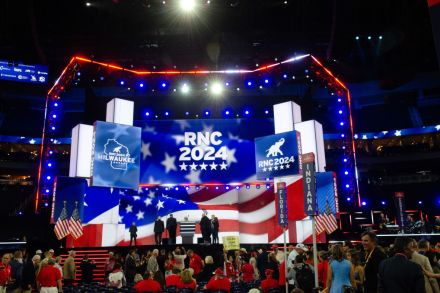
Milwaukee, Wisconsin Cockburn is currently drinking his first half-decent coffee of the Republican National Convention in the media filing center, bleary eyed after two nights of aggressive socializing. Wisconsin is supposed to be famous for its beer and cheese — but it’s overcooked burgers and watery cold brew that have been keeping your devoted correspondent functional in the sweltering Midwest heat. (If anyone has any food recommendations in Milwaukee, please, for the love of God, email them to cockburn@thespectator.com.) His first social soirée was an impromptu Monday cocktail with Liz Truss, the former British PM who was recently de-MP’d in Labour’s landslide victory.
rnc convention

Can politicians really pivot?

From our UK edition

‘That’ll be the old pivot again,’ said Amol Rajan on Today last week. He was interviewing Pat McFadden, who is the shadow chancellor of the Duchy of Lancaster, since the Duchy needs its chancellor shadowed. Amol, as I think of him since he sounds so young (though he is 41 on election day), suggested that it was hard to trust Sir Keir Starmer as he had campaigned for Jeremy Corbyn. Pat (as I don’t think of him at 59) said that, unlike Corbyn, Liz Truss was on the loose in Norfolk as a Tory candidate despite the mess she’d made. I took the subsequent pivot remark to be a metaphor taken from a pair of dividers, perhaps, with a point anchored in the question asked and the other turning to skewer a more distant topic.

If only Britain knew how it was viewed abroad

From our UK edition

A London-based foreign correspondent is probably not the target audience of Michael Peel’s latest book. Indeed, what Peel (himself a former Financial Times correspondent in Lagos, Abu Dhabi, Bangkok and Brussels) discusses in eight lively, well-researched chapters won’t come as a surprise to any of his UK-based foreign colleagues: how Britain is perceived abroad; and how little it seems to permeate the national consciousness. This blindness – or the British inability to realise how they appear to others, as opposed to the image they have of themselves – often has foreign correspondents pulling their hair in disbelief. If only Britain knew how it was seen! One senses that Peel’s return to London from Tokyo after 13 years of foreign postings must have felt like a crash landing.

Who will survive to lead the Tories?

From our UK edition

In spite of his conviction for falsifying business records, Donald Trump is still expected by many to make a remarkable political comeback in November’s US election. Could we see an equally remarkable comeback this side of the Atlantic, too, with Liz Truss returning to the stand for the leadership of the Conservative party? It’s possible to see a scenario where Truss is one of the few hopefuls remaining Today’s Electoral Calculus poll predicting that the Conservatives could be reduced to just 66 seats on 4 July raises the question: who would still be around to lead the party after the almost certain resignation of Rishi Sunak?

How the Special Relationship could be renewed after US-UK elections

A record number of countries will hold elections this, including Britain on July 4 and the United States on November 5. These two great powers — each with a veto at the UN — have enjoyed a bond that has survived for so long, is it known on both sides of the Atlantic as “the Special Relationship.” There have been stand-offs: Britain refused to join the war in Vietnam, and when Argentina seized the Falkland Islands in 1982, the US did not intervene. But Ronald Reagan and Margaret Thatcher worked in tandem to bring down the Berlin Wall. And if the view on Ukraine and Gaza is not always the same, there is a shared commitment to the sovereignty of Russia’s neighbors and to a peace in the Middle East that secures the rights of Jews and Palestinians alike.

special relationship

Sack Andrew Bailey? Let’s look at the case against him

From our UK edition

The Governor of the Bank of England, Andrew Bailey, is a loyal and well-intentioned public servant in a role that, by its nature, attracts constant blame and hindsight judgment. Liz Truss is a spectacularly failed 44-day prime minister with a book to sell. So when Truss says Bailey should have been sacked for his part in her downfall –when the Bank intervened to prevent a pension fund crisis after her chancellor Kwasi Kwarteng’s radical mini-Budget of September 2022 – and that he should be sacked anyway for being part of a Keynesian economic Establishment, with the Treasury and the Office for Budget Responsibility, that has delivered nothing but stagnation, my instinct is to stand up for Bailey.

Sunak’s Truss problem

From our UK edition

11 min listen

The day after her book was published, Rishi Sunak faced down questions from Keir Starmer and Labour members at PMQs about Liz Truss. While he had his replies at the ready, the questions underscored the main issue for Sunak: how should he deal with his predecessor?  Also on the podcast, there is more inflation news for the Government, and how will Starmer deal with internal party discipline? James Heale speaks to Katy Balls and Isabel Hardman. Produced by Oscar Edmondson.

Liz Truss’s American book tour

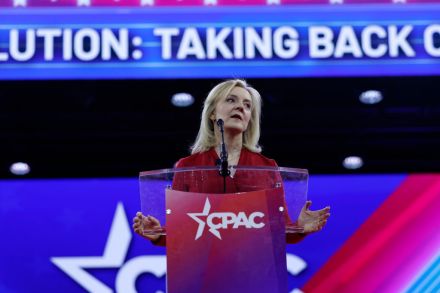
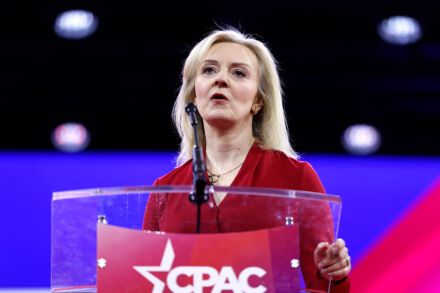
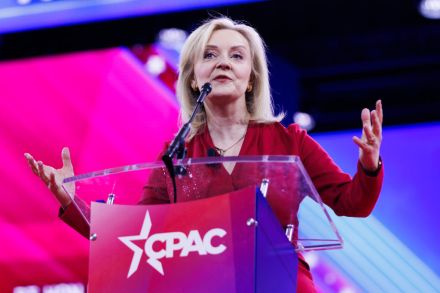
National Harbor, Maryland I’ve been visiting the United States for many years, but 2024 was my first time at the Conservative Political Action Conference in Maryland, where I spoke on the main stage, complete with American-style big hair. Compared to political events in the United Kingdom, people at CPAC take things to a whole new level: where else could you have a debate about the Constitution with a woman in a Statue of Liberty costume? Or meet a family of five in matching sweaters that each bear a letter to spell out “TRUMP?” The enthusiasm for the cause was infectious. And few speakers were more dazzling than the newly installed Argentinean president Javier Milei. I confess to bagging a front-row seat for his address.

CPAC

Liz Truss returns – again

From our UK edition

14 min listen

It's 18 months since Liz Truss left Downing Street and her new memoir, Ten Years to Save the West, is out. She gave her first interview to Fraser Nelson on Spectator TV, covering why she wants to abolish the Supreme Court, Donald Trump, her husband's warning that her leadership bid would end in tears, and so much more.   We also cover Iran's missile attack on Israel, and what might come next.  James Heale speaks to Katy Balls and Fraser Nelson.  Produced by Megan McElroy.

We need to talk about Truss

From our UK edition

15 min listen

Liz Truss continues to haunt Rishi Sunak. Labour leader Keir Starmer took aim at her recent exploits at CPAC in the US during prime minister's questions today. Starmer called on the prime minister to remove the whip after Truss claimed that her premiership was sabotaged by the 'deep state'. What's Truss up to this time?  Also on the podcast, chancellor Jeremy Hunt will deliver his budget next week. We expect that he will have made his final decision on the March 6th budget by the end of the week. What do we know so far?  Oscar Edmondson speaks to Katy Balls and Kate Andrews.  Produced by Oscar Edmondson.

Trump’s unlikely ally in the NYC case

Former president Donald Trump is getting support from an unlikely ally: former Florida governor and presidential candidate Jeb Bush. Bush co-wrote an opinion piece in the Wall Street Journal on Wednesday arguing that the judgment in the New York civil fraud case is an example of “dangerous judicial rulings” against the left’s political opponents.“The unusual New York law Ms. James used to investigate and sue Mr. Trump didn’t require her to prove that he had intended to defraud anyone, or even that anyone lost money. The Associated Press found that of the twelve cases brought under that law since its adoption in 1956 in which significant penalties were imposed, the case against Mr. Trump was the only instance without an alleged victim or financial loss,” Bush wrote.

Liz Truss works the crowd at CPAC

National Harbor, Maryland “Oh, that’s Liz Truss,” a young attendee says as the former British PM passes us in the corridor at the Conservative Political Action Conference. “She sucks. What’s she doing here?” Trying to sell books, apparently. Truss is one of two Brits — alongside mainstay Nigel Farage — addressing CPAC. Her visit forms part of the promotional tour for the US release of her book Ten Years to Save the West: Lessons From the Only Conservative in the Room, which has been handily retitled for US audiences: “Leading the Revolution Against Globalism, Socialism and the Liberal Establishment.

liz truss

What Liz Truss’s PopCon launch was really about

From our UK edition

11 min listen

Liz Truss is back! This time with a conference called 'Popular Conservatism', bringing together voices in the Conservative party and aiming to 'deliver popular conservative policies'. But what does the event really tells us about the state of right wing political thought in the UK today, and why were some of Truss's key allies not there? Cindy Yu talks to Katy Balls and Fraser Nelson. Produced by Cindy Yu.

Liz Truss, Brexit and the petulant anger at reality

From our UK edition

The time it takes to mount a political comeback gets shorter and shorter, doesn’t it? The last prime minister but one barely got his toes in the sand on his first holiday after leaving the post before he was flying home with thoughts of mounting a return to high office. Now his successor, too, is campaigning to get on track to get her old job back.  The first wallop of Liz Truss’s one-two punch was a long article for the Sunday Telegraph explaining why the mini-Budget that so spectacularly sunk her premiership was, in fact, absolutely the right thing to do; punch number two will be an interview with Spectator TV that goes up this very afternoon. I’m interested, as I expect we all are, to see how she develops there the arguments that her piece for the Telegraph set out.

How has the Conservative party’s ‘Dr No’ escaped everyone’s notice for so long?

From our UK edition

The reason conspiracy theories are so resilient, reproducing themselves from one generation to another, is that they are unfalsifiable. Evidence against them, however solid, has obviously been faked. Anyone who tries to demonstrate that Americans did land on the moon or that J.F. Kennedy was killed by Lee Harvey Oswald is obviously in the pay of people who stand to benefit. If you ask who those people are, since there seems to be no evidence of their existence, the answer is always the same: they are very good at concealing themselves. And so the theory finds credulous punters.

Sunak’s new strategy: hard truths

From our UK edition

The last time Tory activists and MPs gathered for their annual party conference, it didn’t end well. Liz Truss had barely checked in to her hotel before she faced a full-on attack from Michael Gove, who started a rebellion against her proposed tax cuts live on air. Truss U-turned on her mini-Budget and cabinet discipline quickly collapsed. ‘It was the worst four days of my life,’ recalls a former Truss aide. Sunak sees the conference as a potential moment of catharsis that could lead to a Tory recovery Rishi Sunak hopes to improve on this admittedly rather low mark. He sees the conference in Manchester as a potential moment of catharsis that could lead a Tory recovery.

Dominic Cummings understands Singapore. The Tories still don’t

From our UK edition

I’ve read Kwasi Kwarteng’s surprisingly positive review of my book, Crack-Up Capitalism. Although it was unexpected to see someone from the libertarian corner being so enthusiastic about what is clearly a critical book, the experience was not new. After my previous book, Globalists: The End of Empire and the Birth of Neoliberalism, was published in 2018, I was startled to find Deirdre McCloskey, a leading classical liberal historian, praising the book as a manual for ‘keeping a liberalism which has made us rich and free.’ Globalists explained how neoliberals wanted to keep decision-making from democratic electorates. I took McCloskey’s praise as a validation of my core thesis.

Trussonomics is slowly winning the argument

From our UK edition

It was self-indulgent, whinging. Dull in places while completely batty in others. All the usual insults will be hurled at former prime minister Liz Truss for her essay defending her short time in Downing Street, published today. Perhaps it would be better for her to retire gracefully from public life and let some ambitious young revisionist historian in the 2060s make the case that she was treated unfairly. Except she still has one key card to play. Events are gradually showing that she was right along: Trussonomics, or whatever it will be called next, is gradually winning the intellectual argument. Her argument has something else going for it: a ring of truth There won’t be many people in the Conservative Party welcoming Truss’s return, and certainly not in the government.

Sunday shows round-up: Truss thwarted by ‘powerful economic establishment’

From our UK edition

Liz Truss - Thwarted by a ‘powerful economic establishment, and a lack of political support’ After Liz Truss claimed in a Telegraph essay that the ‘economic establishment’, and flaws in the Conservative Party’s preparations, had prevented her from enacting her policies, Laura Kuenssberg pressed Business Secretary Grant Shapps on whether he agreed with any of Truss’ claims: https://www.youtube.com/watch?v=mAnhc3a5KWA Liz Kendall - Liz Truss is back with ‘no apology and no humility’ Former Conservative party chair Jake Berry told Kuenssberg that he still agreed in principle with Liz Truss’ policies, even if they weren’t delivered in the correct way.

Was Liz Truss denied a ‘realistic chance’ to succeed?

From our UK edition

‘I assumed upon entering Downing Street that my mandate would be respected and accepted. How wrong I was.’ This is the crux of Liz Truss’s defence of her 49 days in Downing Street: the shortest-ever stint for a Prime Minister. It is also the start of her attempt at a political comeback. Writing in today’s Sunday Telegraph, Truss gives us, for the first time, her account of things: 4,000 of her own words on ‘what happened’ last autumn and what she’s learned from it. Mistakes were made, she admits: in fact, they were all-but-guaranteed, she says, as she had ‘a vast amount to do and very little time in which to do it’. She repeats, as she did last year, that ‘communication could have been better.