Libya

The MH17 disaster

From our UK edition

Home David Cameron, the Prime Minister, told Parliament that President Vladimir Putin of Russia should end his country’s support for separatists in Ukraine, some of whom it had provided with a training facility in south-west Russia. Licences to export arms to Russia were found still to be in place. Theresa May, the Home Secretary, announced a public inquiry into the death of the Russian dissident Alexander Litvinenko, a former KGB officer who died in 2006 in a London hospital after he was poisoned with polonium. Nick Clegg, the Deputy Prime Minister, was criticised by some MPs from rival parties for appearing on television sampling tequila instead of somehow doing something about the crisis. Prince George of Cambridge celebrated his first birthday.
Libya is imploding. Why doesn’t David Cameron care?

From our UK edition

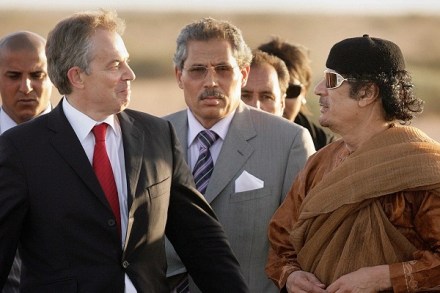
A few days ago I went to a talk about Syria; one of those events for the concerned layman, in which a panel of experts give a briefing. Everything sounded depressingly familiar until expert number three piped up: I hear people blame Saudi Arabia and Qatar for the Islamists in Syria, he said, but in fact, they more often come from Libya. The crowd shifted in discomfort. Isn’t Libya done and dusted? Oh no, said the expert, it’s full of al-Qa’eda training camps now, especially in Benghazi. My first thought, unusually, was to feel sorry for David Cameron. Remember how proud he was on his victory visit to Tripoli at the end of the Libyan war? There he stood in the five-star Corinthia hotel, by Sarko’s side, his arms full of flowers, his cheeks pink with pleasure.

Portrait of the week | 13 March 2014

From our UK edition

Home Ed Miliband, the leader of the Labour party, promised that, if elected, his administration would hold a referendum on membership of the European Union only if there was a new transfer of power to Brussels, which he called ‘unlikely’. If Scotland votes for independence, the Royal Bank of Scotland and Lloyds might have to move their legal homes to London under European Union law, the BBC reported. BBC Three is to be closed as an on-air channel, to go online only. The future of BBC Four is also in question. Mark Carney, the governor of the Bank of England, told the Treasury Select Committee that interest rates could reach 3 per cent within three years.

How did Colonel Gaddafi get away with such evil for so long?

From our UK edition

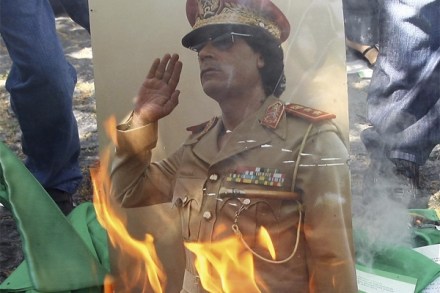
What a vile piece of work Colonel Gaddafi was. For some of you, perhaps, this will be a statement of the glaringly obvious. But I suspect there will be many others for whom, like me, this week’s Storyville documentary on the barbarity of his regime — Mad Dog: Gaddafi’s Secret World (BBC4, Monday) — was something of a revelation. Sure, we’d all heard about the funny stuff: the time John Simpson went to see him and he farted noisily (Gaddafi, not Simpson) through the interview; the ridiculous outfits; the bullet-proof Bedouin-style tent that he insisted on bringing on his last world tour, complete with live camels to graze decoratively outside.

Does Libya need a lesson in devolved government?

From our UK edition

Recent news from Libya has not inspired confidence. Terrorism, riots, murder, a temporarily kidnapped prime minster, oil stuck at export terminals – it’s a dispiriting litany of apparently unconnected events. Yet careful study of the region’s history and the aftermath of the uprisings against Colonel Gaddafi suggest that peripheral forces in Libya are, as they often do, resisting impositions from the centre. That is the central thesis of a collection of essays The 2011 Libyan Uprisings and the Struggle for the Post-Qadafi Future, edited by Jason Pack of Cambridge University. Pack & Co argue that the Libyan uprising was not homogenous.

Taki: My main gripe with Gaddafi is the quality of his cocaine

From our UK edition

 New York Libyans are among the most civilised people on earth. When a Russian hooker (I assume) killed a Libyan Air Force officer, a mob stormed the Russian embassy seeking revenge. They failed, but not for lack of trying. This time last year, another mob murdered the American ambassador and three others in a similar attack, although no Yankee gal had harmed any Libyan flier. The civilised Libyans also did democracy proud when they captured Gaddafi. They shot him up the bum with an AK47, dispensing with a boring trial. The bad guy that got away is Hannibal Gaddafi, who with wifey used to beat up and torture Filipino servants and intimidate the Swiss government by kidnapping Swiss citizens working in Libya and holding them on charges unknown.

Libya’s PM, Ali Zeidan, has been kidnapped

From our UK edition

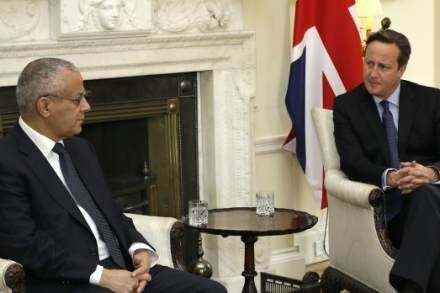
A few weeks ago the Prime Minister of the liberated Libya, Ali Zeidan was sitting in 10 Downing St talking to David Cameron. A few hours ago he was kidnapped, in what appears to be retaliation for the seizure of an al-Qaeda leader by the Americans in Tripoli a few days ago. The Libyan government has said Zeidan was 'taken at dawn this morning by gunmen to an unknown place for unknown reasons.' He had been living staying in the Corinthia Hotel, sister to the luxurious Corinthia Hotel in Whitehall. One guard at the hotel described it as an 'arrest' according to Reuters. Libya's justice minister says it was a kidnap, and that there are CCTV stills of Ali Zeidan being hauled out of the building by heavies (right). Word is that the heavies were loosely connected to the government.

David Cameron’s wars: How the PM learned to love precision bombing

From our UK edition

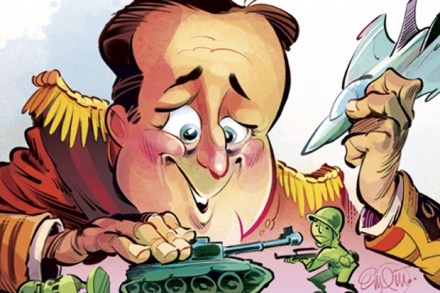
What is the one consolation for an MP who has beaten all their colleagues to the top job? It can hardly be the luxury of having your life, circle and income open to alternate snorts of envy and derision. Nor can it be the quagmire into which nearly all attempts to solve the nation’s domestic problems now fall.  Only one thing allows prime ministers of a country such as Britain to feel they have power. That is exercising it. And nothing exercises power more than deciding which wars to fight. In opposition, David Cameron did not much like the idea of war, and derided his colleagues for their admiration of Tony Blair. Yet in office — as Syria is revealing — he is treading a very similar path.

Egypt shows us that elections aren’t enough

From our UK edition

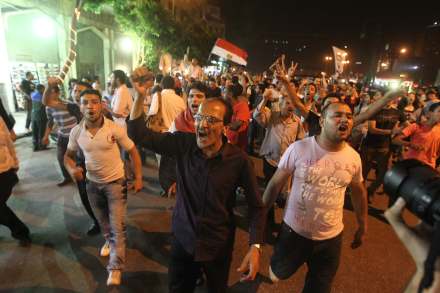
Democracy and holding elections are not the same thing. There could be no better demonstration of this than the experience of Egypt. Protesters who two years ago gathered in Cairo to force a dictator out of office, and to win the right to replace him with an elected governmentS, are back — this time to demand the resignation of the president whom they elected. The likely result is, by popular demand, a return to what preceded the Arab spring of 2011: a military dictatorship, for a period at least. From a western perspective this is inexplicable: why would people want to risk their lives to overthrow a military-backed president, only to come back two years later to reverse what they seemed to have achieved?

Lesson of Afghanistan? That you can, after all, bomb your way to the negotiating table

From our UK edition

It’s not just soldiers who risk their lives in Afghanistan. Anyone who enters the country’s judicial service becomes an assassination target. Only last week, six Afghan judges were killed by a suicide bomb outside Kabul’s Supreme Court. A Taleban spokesman said they had been ‘sentenced to death’ for playing an ‘important role’ in ‘legalising the infidels’. Such attacks have killed over 3,000 civilians in Afghanistan so far this year, according to the United Nations. Of these, some 600 were children. Barack Obama’s administration invites us this week to welcome the prospect of peace talks between the Taleban and Hamid Karzai’s government as a sign of progress.

Little Britain

From our UK edition

The foreign news pages read increasingly like some terrible satire on western military decline. Two years ago French and British forces, with the help of the US Navy, managed to help Libyan rebels topple Colonel Gaddafi. This year, the French needed British support to go to war against some tribesmen in Mali. It was a successful operation, but the ‘Timbuktu Freed’ headline rather summed up the extent of European military power today. The French have only two drone aircraft (the Americans have hundreds) and had to drop concrete bombs on Tripoli when they ran low on real ones. As the foreign policy rhetoric of our media and political leadership grows, the contrast with the resources grows starker.

Lockerbie Novel: It Was Iran, Not Libya – Spectator Blogs

From our UK edition

From a very entertaining New York Times profile of Gerard de Villiers, the French novelist who, though little known in this country, is seemingly better connected in the spy world than any mere hack novelist has any right to be: Why do all these people divulge so much to a pulp novelist? I put the question to de Villiers the last time we met, in the cavernous living room of his Paris apartment on a cold winter evening. He was leaving on a reporting trip to Tunisia the next day, and on the coffee table in front of me, next to a cluster of expensive scotches and liqueurs, was a black military-made ammunition belt. “They always have a motive,” he said, absently stroking one of his two longhaired cats like a Bond villain at leisure. “They want the information to go out.

Engagement in Libya was and remains the right answer

From our UK edition

In 2008, I packed my bags to head off to Tripoli, where I began my current vocation of advocating for Western diplomatic, economic, cultural, and humanitarian engagement in Libya. Ethan Chorin was my inspiration. He was the US Foreign Service Officer who wrote the Department of Commerce's commercial guide, which helps American companies operate in Libya. He also wrote a chapter in Dirk Vandewalle's definitive compendium Libya Since 1969: Qadhafi's Revolution Revisited, which brilliantly puts forth the case for the inevitable impact that American business presence would have on promoting political freedom in Libya.

Mali could be the gamble that defines Hollande’s presidency

From our UK edition

The crisis in Mali is yet another unintended consequence of the Arab Spring. Specifically, they are a result of the revolution in Libya, where Tuareg rebels who supported Gaddafi were forced to flee after his downfall. Heavily armed and regrouping in Mali, they created the National Movement for the Liberation of Azawad (MNLA) which effectively ended the government’s control over the north. Jihadist groups aligned with al-Qaeda then swooped in and established a semi-autonomous Islamic state in the north. As they pushed south it looked as if they might capture all of Mali, prompting interim President Dioncounda Traore to ask for French assistance. Francois Hollande responded by launching Operation Serval with overwhelming public support both at home and abroad.

‘Arab Spring’ is a misnomer

From our UK edition

What do you do when confronted with a prejudice so strong it takes your breath away? In my case, I did what was immediately necessary. I took a deep breath to replenish lost oxygen, and moved on. It wasn't the time or place to take on this particularly ugly example of intolerance; but it is an intolerance which needs to recognised. I was giving a lecture at a charity that trains journalists from around the world. Some are already making their way in the industry and are expected to do well. I was talking about my theory that the term 'Arab Spring' actually clouds our understanding of what has been happening in the region over the past 18 months.  From the Egyptian coup d'etat onwards, I've argued that calling these events the 'Arab Spring' automatically frames them as positive.

General Dempsey’s disastrous intervention

From our UK edition

When the Danish Cartoons affair broke in 2005-6 there was considerable pressure on the Danish Prime Minister, Anders Fogh Rasmussen, to issue a condemnation and apology. Demonstrating considerable statesmanship he nevertheless repeatedly said that ‘You cannot apologise for something you have not done.’ When so-called ‘community leaders’ insisted on seeing him he refused because he, as the Prime Minister, was not responsible for the contents of a Danish newspaper. The Danish press is not only free, but separate, from the Danish government. Rasmussen’s belief was that the sooner anybody who was unaware of this became aware of it the better. Fast forward to 2012 and we seem to have yet another set of eruptions in the cartoon/film/book wars.

Why a rough guide is better than none

From our UK edition

Like the most desperate of priests, and the most marginal of activists, Nick Cohen wants us all to be like him. He’s an angry journalist who can’t imagine why everyone doesn’t think like an angry journalist. In What lonely planet are they on? Cohen attempts a take-down of travel guide publisher Lonely Planet, implying that they’re all liberal lefties, happy to whitewash the crimes of dictators in order to sell more books. To do so he cites the work of Thomas Kohnstamm, a Lonely Planet author who admits making stuff up (though, here and elsewhere, Kohnstamm maintains that the job he was commissioned for was a desk-edit, rather than a research trip).

When spring doesn’t turn into summer

From our UK edition

A high-ranking member of Hosni Mubarak’s disgraced government, or someone from the Muslim Brotherhood? It’s hardly an enviable choice — but that is the choice facing Egypt in next month’s Presidential election, after the official results of the preliminary vote were released yesterday. For obvious reasons, neither candidate much appeals to the freedom-loving younger generation that set the country’s revolution a-rolling in the first place. So, overnight, we’ve seen a return to protests, anger, fire, etc. This is still an immensely divided polity. As grim as the situation is, it will come as little surprise to Spectator readers (or to anyone, really).

Ditching Brother Leader

From our UK edition

The date that rebel leaders chose for the final assault on Tripoli was auspicious: 20 August 2011 coincided with the 20th day of Ramadan by the Muslim lunar calendar, the date on which Muslim forces led by the Prophet Muhammad conquered the holy city of Mecca for Islamic rule in AD 680. It was also exactly six months since the Libyan people had risen against Colonel Muammar Gaddafi and his regime. The nomenclature of the operation — Mermaid Dawn — was no less bizarre than the regime it sought to overturn. Neighbourhood co-ordinators roused sleeper cells with the agreed code phrase ‘We’re going to have soup tonight.’ After sunset, when Muslims broke their Ramadan fast, the assault began.

War Games: Syria & Iran Edition

From our UK edition

The past is always a different, better place and never more so than when commentators dip into American history to salvage some justification for their favoured approach to any contemporary policy dilemma. Thus Leon Wieseltier has a point when he suggests Rachel Maddow's view that "disincentives to war" were "deliberately built into" the "American system of government" is really only proof that "originalism is just the search for a convenient past, a political sport played with key words". A shame, then, that he buttresses his argument with copious references to Thomas Jefferson! In truth, those disincentives withered with Andrew Jackson. But how many military interventions can one man countenance at a time?