Libya

The Syria delusion

From our UK edition

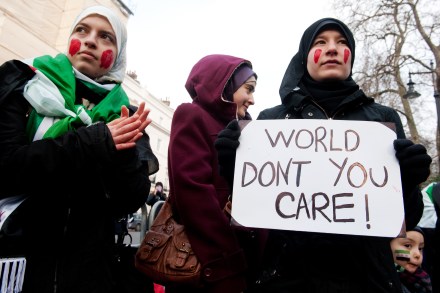
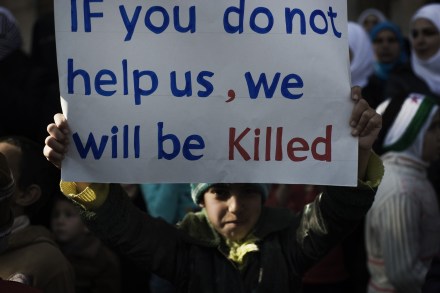
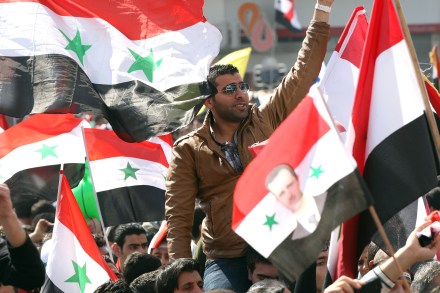
Things certainly seem to be coming to a head in Syria, with today’s news that Assad’s forces have launched a ground assault on Homs, forcing the rebels to withdraw, and that the UN Human Rights Council has passed a resolution condemning the brutality. John R. Bradley, writing for the Spectator last month, argued that this is not the ‘simple story of freedom fighters opposing tyranny’ that many believe it to be – that ‘the situation is clearly much more complex’. In this week’s magazine, out today, Rod Liddle further explores that complexity: What proportion of the Syrian population is fully in support of the continued uprising against the country’s authoritarian leader, Bashar al-Assad?
Lockerbie: Megrahi Publishes His Defence

From our UK edition

The Lockerbie case is back in the news with the publication of Megrahi: You Are My Jury by John Ashton, a member of Abdelbaset ali al-Megrahi's defence team. That Megrahi remains alive, if only just, two and a half years after he was released on compassionate grounds is, plainly, an embarassment and all the evidence required to demonstrate that Kenny Mackaskill's decision to release him on license was mistaken. It has been contradicted by events. Worse for Mr MacAskill, however, is Megrahi's suggestion that MacAskill advised him that his chances of being released on compassionate grounds would be enhanced if he dropped his appeal against his conviction for the bombing.

Making a call on Qatada

From our UK edition

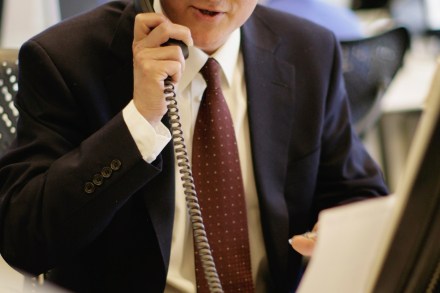
The Prime Minister, we are told, has been trying to reach the King of Jordan to see if some kind of arrangement can be made so that Abu Qatada can be deported legally and that no forms of torture-gained evidence will used against him in a Jordanian court. This seems like a sensible thing to do. But it is important that the government balances its counter-terrorism policy with its foreign policy.   Here is what I mean. Jordan is a friend of Britain, but the King is under tremendous pressure to reform. There are daily demonstrations against his rule and the protests are gathering pace. His reforms, meanwhile, have been limited and the country is running out of money. It is no longer unfeasible that Jordan could face what many other countries in the region has seen.

Brits sceptical of Syria intervention

From our UK edition

Britain’s response to Syria so far has been uncertain and cautious. A YouGov poll today suggests that the public is keen for this hands-off approach to continue. When presented several possible offences, the public responds with almost universal disapproval. A measly 9 per cent would support sending in British and allied troops to overthrow President al-Assad. Only 16 per cent would support providing arms to the rebels and 18 per cent support sending in troops to protect civilians. The only modicum of support is for the proposed no-fly zone. But, although a majority would agree with the zone, less than half believe it is necessary right now, with 26 per cent believing it may be useful in the future.

A Syrian Srebrenica?

From our UK edition

Every day things are getting worse in Syria. Today the Syrian regime started what looks like an all-out assault on the key city of Homs, reportedly killing at least 55 people. The attack took place as the UN Security Council prepares to vote on a draft resolution backing an Arab call for President Bashar al-Assad to give up power. The problem has been the lack of information about events on the ground. Though the Syrian government has failed to quell the uprising, it has succeeded in limiting access to information by the outside world. So a lot remains unknown, unreported or clouded in pro-regime propaganda. But speaking to people in Syria, some things appear clear. First, there is now a guerrilla war of popular resistance against the Syrian regime.

Libya still hasn’t found peace

From our UK edition

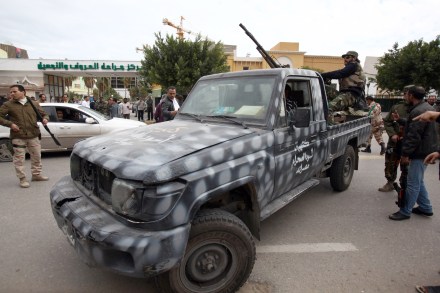
Guns blazing, Libya’s various militias are showing little sign of laying down their arms and giving authority to the Libyan state. Even Mustafa Abdul Jalil, chairman of the National Transitional Council, has said that Libya faces a risk of widespread conflict, after a gun battle between militias in one of Tripoli's busiest streets killed four fighters. Publicly, the militiamen are reluctant to lay down arms for fear of a rearguard pro-Gaddafi takeover. In reality, they like their newfound power and want to ensure that they swap their weapons for status and influence. How many of these groups exist is not clear — some estimate 100, with over 125,000 armed Libyans making up their numbers.

What didn’t happen in 2011

From our UK edition

In the run-up to every New Year, newspapers and the blogosphere are full of articles about what happened in the year just gone. 2011 was a particularly eventful year so there will be much to pick from. But what about the things that did not happen, though they were widely expected? Here are five things that did not take place — though, as the year unfolded, many people would have bet on their occurrence: 1) Algeria's revolution. As one North African dictator after another fell to pro-democracy protesters, everyone expected Algeria to be next. But it wasn't.

Woolf tucks into perfidious Albion

From our UK edition

Yesterday night's news that a senior FCO official lobbied Oxford University on behalf of Saif al-Islam Gaddafi adds more ordure to the already fetid story of Britain’s role in Colonel Gaddafi’s rehabilitation. The Woolf Inquiry into Saif’s dealings with British universities and businesses found that, 'It was made clear [to Oxford] … that the FCO would appreciate help in this case since Libya was opening up to the West again.'  Oxford resisted; but this episode has hardly covered Britain’s elites in glory: the civil service, BAE and august universities are all criticised in Woolf's report.

Paying for justice

From our UK edition

To British ministers, the role that the International Criminal Court played over Libya was key – it made clear that Colonel Gaddafi's actions were unacceptable and would be subject to international law. Tory MP Dominic Raab even wrote a piece in The Times about the need for Libyans to rely on the ICC in The Hague, rather than seek retribution and revenge against Gaddafi and his loyalists. And it wasn't only the British government. German Chancellor Angela Merkel stated that the Libyan leader Muammar Gaddafi should be tried by the ICC: 'Gaddafi should have a trial according to the law, something he never did with his opponents,' Merkel said when asked by the weekly Bild am Sonntag whether she was in favour of such a trial.

Now will we learn the truth about Saif’s British ties?

From our UK edition

Now that Saif Gaddafi has been captured, the race will be on to interview him from a prison cell and ask what his business was with the various figures of the British establishment with whom he was so close. CoffeeHousers will remember the 2009 party at the Rothschilds' manor in Corfu: Saif, Mandy and Nat Rothschild. A little later, Charles Moore revealed in The Spectator that the trio were later reunited in a shooting party at Lord Rothschild's Waddesdon Manor in Buckinghamshire. I spoke to Lord Mandelson a few weeks after the piece appeared, and thought CoffeeHousers may be interested in the transcript. The noble lord was outraged at Charles' piece – because it suggested he was also hanging out with Cherie Blair that night.

Saif Gaddafi captured — but what now?

From our UK edition

Remember when Saif Gaddafi was the Anointed One of those who wanted a freer, more liberal Libya? Now, he's at the mercy of militiamen in the city of Zintan, having been captured today. It leaves Abdullah al-Senussi, the former intelligence chief, as the most infamous member of the old regime still on the run. The details of the capture are still hazy, like so much else during Libya's revolution. What's striking is that, unlike his father, Saif Gaddafi appears to have been unharmed by the process. Reuters are sure they spoke with him earlier today (although the man wouldn't confirm his identity), and the only wounds he was carrying were, he claimed, sustained during a Nato air strike, ‘one month ago’.

Gingrich to the fore

From our UK edition

Yesterday saw three national polls and three different leaders in the race for the Republican presidential nomination. Politico's Battleground poll (conducted early last week) shows Herman Cain leading Mitt Romney by two points. CNN's latest (conducted over the weekend) has Romney narrowly leading Newt Gingrich, with Cain down in third. Most eye-catching of all is the PPP poll (also conducted over the weekend), which has Gingrich in first place, followed by Cain and then Romney in third. These polls do have one thing in common: they're good news for Newt Gingrich. Whether he's actually in the lead or not, he's certainly well ahead of where he was last month. He's up 13 points on his October showing according to PPP; or up 14 according to CNN.

American isolationism and its consequences

From our UK edition

I've spent the last couple of days in the United States, far away from the brouhaha in Europe. What has struck me most during meetings with US officials is how low down their list of priorities Europe — and indeed Britain — comes. This is an Asian Century, and the US means to focus inwards and eastwards but not elsewhere. As an official put it to me, "we see Britain moving away from Europe and being distant to us." There is even talk of closing down US European Command. This new focus will have a number of consequences. Take Libya, for instance. The UK and France could have fought the war, and won, without the US, but American involvement allowed casualties and collateral damage to be minimised.

Libya’s revolution, deflated

From our UK edition

Gaddafi was buried this morning, but Libya's problems remain firmly above ground. The news emerging from the country is mostly grim: a possible massacre by anti-Gaddafi fighters; the hint of complicity on the part of Libya's new leadership; Saif Gaddafi's continuing elusiveness, and so on. Revolution and civil war are never done cleanly, sure. But just because the current situation is unsurprising doesn't make it any less shocking. Unsurprising yet shocking. Much the same could be said of Mustafa Abdul-Jalil's declaration that Islamic Sharia law would be the "main source" of all legislation in Libya from now on. Unsurprising, because Libya is, on the whole, a conservative Muslim country.

Gaddafi’s death boosts support for Libya intervention

From our UK edition

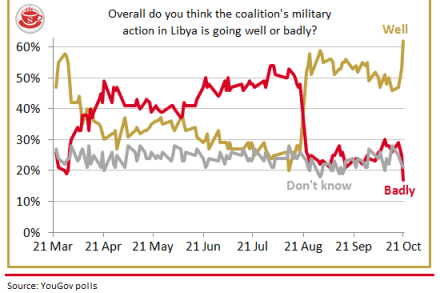
In August, I showed that the rebels' success in toppling Gaddafi's regime had boosted British support for the intervention in Libya – and David Cameron's handling of it. Unsurprisingly, this week's news appears to have done the same. Even though Gaddafi's death was not an explicit goal of the intervention, it seems to have been many people's definition of success. 62 per cent now say the military action is "going well", up sharply from 46 per cent last week: As a result, 45 per cent now support the decision to take military action, while only 31 per cent think it was wrong – the lowest opposition since the start of the conflict. And there can no be no doubt that Libya is seen as a personal success for David Cameron.

The End of a Delusion

From our UK edition

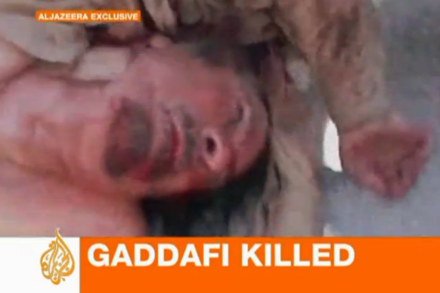
The sight of Colonel Muammar Gaddafi blood-stained and bewildered, pulled around by a crowd in the final moments of his life is not a sight that will cause much pity. For more than four decades he had none for those Libyans whom he repressed and killed — anymore than he had for the victims on Pan Am Flight 103, his other multiple acts of terrorism, or his pointless and bloody interventions across Africa. Yet there is something pitiful about it: perhaps most obviously because watching his end is to watch the end of a delusion. Even more than Saddam Hussein crawling out of a hole in the ground and saying that he wanted to negotiate, the sight of Gaddafi coming out of a soil-pipe armed with a golden gun seems the perfect example of reality catching up with the autocrat.

Right to reply: How we beat the Beeb

From our UK edition

A slight change to the normal rules of engagement for this latest post in our 'Right to reply' series. Whereas these posts normally take issue with what your Coffee House baristas have written, this one takes issue with the post by the BBC's Jon Williams that we put up yesterday. It's by Al Jazeera's Ben Rayner: In wars reputations of whole news organizations can be made or broken very quickly. And the spin on the result is almost as important as the reality. Undoubtedly the BBC took a fearful kicking in the press over its coverage of the fall of Tripoli in August. To the British papers, Sky's Alex Crawford had won the day at the expense of slow moving Auntie.

Right to reply: Why the BBC still matters across the world

From our UK edition

Reading Fraser’s post last night, you’d be forgiven for thinking the BBC is running up the white flag in terms of its global reporting. Yesterday — as Gaddafi was breathing his last in Sirte — Coffee House was praising Sky and Al Jazeera, and pouring scorn on the BBC’s “stifling bureaucracy”, accusing us of being “short sighted”, “slow-moving” and being constantly “bested” by others in terms foreign news. There’s only one problem with Fraser’s analysis: the facts don’t stand up to scrutiny. Timing is everything. Yesterday the BBC’s Gabriel Gatehouse was the only UK broadcaster in Sirte.

Beyond Gaddafi, America turns its attention to Pakistan

From our UK edition

It's hard to recall a more grisly complement of newspaper covers than those this morning. Only the FT refrains from showing either Gaddafi's stumbling last moments or his corpse, whereas the Sun runs with the headline, big and plain: "That's for Lockerbie". The insides of the papers are more uncertain. There are doubts about the details, such as what has happened to Gaddafi's infamous son Saif. And there are doubts about the general tide of events too. Several commentators, including Peter Oborne, make the point that the passing of Gaddafi is only the first phase in Libya's struggle towards democracy — and it is a struggle that might easily be forced off course by various factions, splinter groups and madmen.

Al Jazeera scores another victory in the information war

From our UK edition

Now that Gaddafi has been killed, which television station will the world turn to? I suspect that, right now, Al Jazeera will be on in No.10 and the White House, and indeed television sets across Asia and India. At a time when the BBC is retreating from global news, its Doha-based rival is expanding — and this has harsh implications. The Arab Spring demonstrated the importance of media to world affairs, and the Americans are mindful that they’re losing this battle. The America-style television news formula — celebrity newscasters and short packages rather thin on analysis — go down badly outside America. ‘We are in an information war and we are losing,’ Hillary Clinton warned the Senate foreign relations committee in March.