Letters

The Letters of Samuel Beckett: Volume II, 1941-56, edited by George Craig, Martha Dow Fehsenfeld, Dan Gunn and Lois More Overbeck

From our UK edition

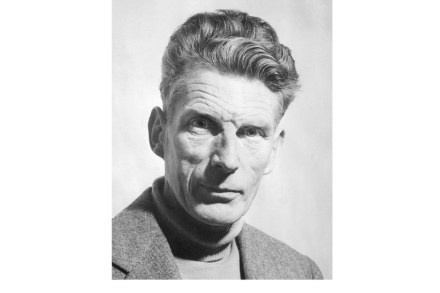
The die was miscast from the start, more’s the pity. As we reach the halfway point in this massy four-volume edition of the letters of Samuel Beckett, I cannot stifle a small sigh or whimper, of the type exhaled by one of those Beckett characters buried up to their necks. And there is no one to blame but the author of the letters. For it was Beckett himself who in his letter of 18 March, 1985, gave his blessing to Martha Fehsenfeld ‘to edit my correspondence in the sense agreed on, i.e. its reduction to those passages only having bearing on my work’. So the tussle began and continued long after the author’s death four years later.  What did ‘only having bearing on my work’ mean exactly?
Life & Letters | 30 July 2011

From our UK edition

There was a photograph the other day of a Hemingway lookalike competition in Key West, Florida. Bizarre? Perhaps not. It’s 50 years since he put the barrel of a shotgun in his mouth and blew his head off, but he remains the most famous and widely recognised American writer of the 20th century, indeed of all time. Sadly, however, the lookalikes all take after the bearded bust-up Papa of his last miserable years, not the handsome young author of the great short stories where every word does its work and there are never too many of them. That Hemingway created an American type — lean, rangy, debonair — last example, Gregory Peck as the journalist in Roman Holiday. There was a photograph the other day of a Hemingway lookalike competition in Key West, Florida.

Dark art

From our UK edition

Shadow Catchers is an effective title, with its magical and occult associations, and a nice echo of body snatchers into the bargain. Shadow Catchers is an effective title, with its magical and occult associations, and a nice echo of body snatchers into the bargain. The exhibition (sponsored by Barclays Wealth) it labels is less impressive: a group of five individuals who might be photographers or might be artists showing us their experiments with light-sensitive materials. Wandering round the more than usually subfusc exhibition space, I wondered whether this was not more properly a display for the Science or Natural History Museums.

Life & Letters: Memoirs as literature

From our UK edition

Laurence Sterne remarked rather a long time ago that they order these matters better in France, and happily this is still the case. Fifteen hundred teachers of literature recently protested about the choice of a set book for Terminale L du bac — the exam taken by 17-year-olds. Their concern is perhaps more political than literary. Nevertheless they denounced the choice of book as ‘a negation of our discipline’. ‘We are teachers of literature,’ they said; ‘is it our business to discuss a work of history?’ Laurence Sterne remarked rather a long time ago that they order these matters better in France, and happily this is still the case.

Bad enemy, worse lover

From our UK edition

Five years after his death, Saul Bellow’s literary reputation has yet to suffer the usual post-mortem slump, and publication of these lively letters should help sustain his standing. Five years after his death, Saul Bellow’s literary reputation has yet to suffer the usual post-mortem slump, and publication of these lively letters should help sustain his standing. It’s less likely to boost his reputation as a man. Bellow was never humble about his talents, and the surviving early letters show an intellectual precocity leavened by the vernacular of melting-pot Chicago. Yet initially he was reluctant to plumb home-grown strengths for his work.

Letters | 23 October 2010

From our UK edition

Dutch tensions Sir: Rod Liddle’s magnificent portrayal of Dutch politics is marred by one error (‘Orange alert’, 16 October). The anti-immigration and anti-Islam leader Geert Wilders is not ‘almost bizarrely Aryan’, as Liddle states. His grandmother was from a Jewish Indonesian family. His blond hair is peroxided. These facts, unlike many about Mr Wilders, are not in dispute. David Jones Amsterdam The philosophy of Stone Sir: I could have a little more respect for Oliver Stone’s views on cutting defence spending in the UK if he had the slightest idea what he was talking about (‘When Stone gets stick’, 16 October).

Two of a kind

From our UK edition

They were ‘soulmates’ according to people who knew both of them. They were ‘soulmates’ according to people who knew both of them. The word has a double-edged quality; it may suggest that they got on well together because they presented such a problem to everyone else. Both Philip Larkin and Monica Jones found it difficult to suffer fools gladly, and in this collection of letters (ranging from 1946-84) from Larkin to his long-term companion and lover, the mean-spirited and misanthropic are given full rein. Larkin met Jones in 1946, and they soon became lovers. (So much for sexual intercourse beginning in 1963). She was a flamboyant presence in the English Department of Leicester University, remaining a junior lecturer until her retirement in 1981.

Young man on the make

From our UK edition

We are not going to agree about Bruce Chatwin. The five books he published in his lifetime are, to some readers, magnificent works of art, setting out grand ideas about the human condition with reference to a closely observed local type — a Czech porcelain collector, Australian nomads, a displaced slave-king, taciturn British farmers and the communities of remotest Patagonia. In other eyes, he was an absurd pseud and show-off, whose work never extended much beyond a tremulous aesthete’s gush over exotic objects, half-digested history and anthropology. It is fair to say that the latter view has gain- ed ground since his death, and even his most passionate defenders would concede that his work was advanced, during his lifetime, by an unusually compelling personality.

The hell of working

From our UK edition

Joseph Conrad was 38, more than halfway through his life, when his first novel, Almayer’s Folly, was published in 1895. He died in 1924 with more than 30 books to his name. A good enough rate of production, you might think. An astonishing one actually, if you are to believe him. ‘Full 3 weeks’, he wrote to his friend Galsworthy in 1911, ‘— no consecutive ideas, no six consecutive words to be found anywhere in the world. I would prefer a red hot gridiron to that cold blankness.’ The gloom wasn’t new: ‘The sight of a pen and an inkwell fills me with anger and horror.’ Or again: I sit down for eight hours every day and sitting down is all.

E. M. Forster and Frank Kermode

From our UK edition

Any follower of literary blood sports should take a look at a review in the Weekly Standard, a conservative American magazine. You can find it on a site called Arts & Letters, which my son obligingly bookmarked for me. The present edition — at least I suppose it is the present one, not that it matters, since I understand that you can use the internet to summon articles from the vasty deep of time past — features the review, by Joseph Epstein of Sir Frank Kermode’s 2007 Clark Lectures devoted to E. M. Forster. Forster’s own book, Aspects of the Novel, had its origins in the same Cambridge lectures. Epstein has armed himself with a two- barrelled shotgun, one barrel for Kermode, the other for Forster, whom he admits to having admired in his youth.

Before she was a novelist

From our UK edition

‘It’s hard in letters quite to hit the mean between being earnest and sounding damn silly’ — as Iris Murdoch admits on page 205 of this book. ‘It’s hard in letters quite to hit the mean between being earnest and sounding damn silly’ — as Iris Murdoch admits on page 205 of this book. It is extraordinary to read these journals and letters written by Murdoch in her very early twenties. Her tone of voice, and the preoccupations, and the turns of phrase are exactly as they were when I, a shy teenager, first met her in her late forties. Even her handwriting — reproduced in the end papers — is the same as it was then.

Writing of, or from, yourself

From our UK edition

'All literature is, finally, autobiographical’, said Borges. ‘Every autobiography becomes an absorbing work of fiction’, responded H. L. Mencken, though not, you understand, directly. Certainly the fictional element in autobiography is evident; Trollope thought that nobody could ever tell the full truth about himself, and A. S. Byatt has said that ‘autobiographies tell more lies than all but the most self-indulgent fiction’. An exaggeration, perhaps, but one with a kernel of truth. Borges’s remark must, however, set any novelist pondering. In the most immediate sense it appears to be untrue. ‘What about invention?’ we may cry, ‘what about the imagination?

Was he anti-Semitic?

From our UK edition

Letters give us the life as lived — day-to-day, shapeless, haphazard, contingent, imperfect, authentic. Letters give us the life as lived — day-to-day, shapeless, haphazard, contingent, imperfect, authentic. That is their value. Life-writing, biography, is plotted, shaped by an argument and is summary, selective and often tendentious. There is a lovely moment in these letters when the shivering Eliot, trapped on the top of a French mountain, a long mule ride from civilisation, is writing to Richard Aldington on a defective typewriter. It sticks and repeats. ‘I’m writing there fore the r therefore more briefly than I intended and shall do when I get to Nice again and hie h ire hire a typewriter merde.’ Half of each letter is missing.

Delight and horror

From our UK edition

‘Everything that the lovingest of husbands can express to the best of wives, & love to the little ones, not forgetting the kicker in the dark,’ Jack Verney wrote to his pregnant wife in 1683. ‘Everything that the lovingest of husbands can express to the best of wives, & love to the little ones, not forgetting the kicker in the dark,’ Jack Verney wrote to his pregnant wife in 1683. I read this 326 years later with a pleasurable frisson. I don’t know why it is so charming to find that our ancestors felt as we do, but it is. In Louisa Lane Fox’s fascinating anthology, that thrill of recognition is found on nearly every page. Lane Fox has used letters, diaries and memoirs; nothing fictional.

Life & Letters | 7 November 2009

From our UK edition

Way back in 1984 when I was editing, rather incompetently, the New Edinburgh Review, I published a story by Raymond Carver. It was entitled ‘Vitamins’. I can’t remember how much I knew about Carver then, or even how the manuscript arrived on my desk. Probably it was sent by his agent, and was taken from a new collection, Cathedral which was to be published by Collins. It is a good story — I’ve just read it again — and less minimalist than some of the work by which he made his name. Which is very much to the point, for it seems that these stories owed a great deal to his editor, Gordon Lish, and that Carver himself was not entirely happy, to put it mildly, with Lish’s surgery which cut some stories by half, or even more than that.

A literary gypsy

From our UK edition

When Lavinia Greacen undertook her magisterial yet intimately sympathetic biography of James Gordon Farrell, she gained access to his diaries and many of his letters, especially love letters and letters to his literary agents, editors and publishers about his professional desires and requirements. In this supplementary volume, a selection of her prime sources is presented in their full extent, amounting to a warts-and-all self-portrait of the novelist. It might well serve as an inspiration or a warning. Even with his fecund talent, ardent ambition, sound education (Rossall and Brasenose), eagerness to work and sufficient charm for social survival (English father, Irish mother), writing novels for a living proved intellectually arduous, financially precarious and often desperately lonely.

Surprising literary ventures | 21 October 2009

From our UK edition

Love Letters of a Japanese begins: ‘These letters are real. Love Letters of a Japanese begins: ‘These letters are real. And like all real things they have a quality which no artificial counterpart can attain.’ They were pseudonymously published by Marie Stopes, the birth control reformer, under the editorship of ‘G. N. Mortlake’, and document a love affair between ‘Mertyl Meredith’ and ‘Kenrio Watanabe’. ‘G. N. Mortlake’ was an invention; Marie herself was ‘Mertyl’; and a married Japanese botanist, Kenjiro Fujii, was the model for ‘Kenrio’. Marie had had a disastrous love affair with him, and Love Letters of a Japanese, in edited form, are their billets-doux.

Surprising literary ventures | 23 September 2009

From our UK edition

Ermyntrude and Esmeralda was written in 1913 but not published until 1969, long after Lytton Strachey’s death. The delay was not surprising: the book consists of an exchange of letters between two naïve 17-year-old girls who are determined to find out where babies come from. Ermyntrude theorises that ‘it’s got something to do with those absurd little things that men have in statues hanging between their legs’, and reports to her eager correspondent that Once, when I was at Oxford, looking at the races with my cousin Tom, I heard quite a common woman say to another, ‘There, Sarah, doesn’t that make your pussy pout?’ And then I saw that one of the rowing men’s trousers were all split and those things were showing between his legs.

Life & Letters | 9 May 2009

From our UK edition

Amanda Craig recently rebuked her fellow novelists for evading the contemporary scene and setting their novels in the past. We should be more like the Victorians, she said, and have the courage to write about our own times. If the novel is to be relevant to readers, it should address today’s issues. Why, she asked, is Hilary Mantel publishing a novel about Henry VIII’s henchman, Thomas Cromwell, rather than . . . Well, I don’t recall if she actually suggested an alternative subject, but her point is clear. Writing historical novels is an evasion of the novelist’s duty. Of course Hilary Mantel has written novels set in the here and now, and very good ones.

Passionate friendships

From our UK edition

Few would look for what academics might call ‘a gay sub-text’ in the Waverley novels. Few would look for what academics might call ‘a gay sub-text’ in the Waverley novels. Nevertheless, writing of the relationship between the two young men who share most of the narrative in Redgauntlet, Professor David Hewitt, editor of the splendid Edinburgh Edition, declares ‘Alan and Darsie are in love with each other. There is absolutely no suggestion of their relationship being physical, but the love is overt.