Letters

Does the world need 17 volumes of Hemingway’s letters?

From our UK edition

‘In the years since 1961 Hemingway’s reputation as “the outstanding author since the death of Shakespeare” shrank to the extent that many critics, as well as some fellow writers, felt obliged to go on record that they, and the literary world at large had been bamboozled, somehow.’ So wrote Raymond Carver in the New York Times in 1981. My, how times have changed.

Darling Monster, edited by John Julius Norwich – review

From our UK edition

It must have been awful for Diana and Duff Cooper to be separated from their only child during the war, but we can be grateful for it because it’s a joy to read the correspondence it gave rise to. The letters in this book span the years 1939 to 1952 and take in the Blitz, Diana’s short spell as a farmer in Sussex, a trip to the Far East, when Duff was collecting intelligence on the likelihood of a Japanese invasion, the couple’s three years in the Paris embassy, and several more in their house at Chantilly, as well as a great number of journeys around Europe and North Africa. The most charming thing about the war letters is how grown-up they are. John Julius Norwich was sent to safety in America and hardly saw his parents for two years.

To ‘Flufftail’ from ‘Pinkpaws’: The Animals is only good for celebrity-spotting

From our UK edition

There is a fine old tradition of distinguished literary men addressing their loved ones by animal-world pet names. Evelyn Waugh saluted Laura Herbert, the woman who became his second wife, as ‘Whiskers’. Philip Larkin’s letters to his long-term girlfriend Monica Jones are full of Beatrix Potter-style references to the scrumptious carrots that his ‘darling bun’ will have unloaded on her plate at their next meeting should wicked Mr McGregor not get there first. Wanting to soften the blow of his sacking by the BBC Third Programme in the early 1950s, John Lehmann went off on holiday with an intimate known to posterity as ‘the faun’.

Dear Lumpy, by Roger Mortimer – review

From our UK edition

After the success of Dear Lupin, Roger Mortimer finds himself facing something not normally experienced by former Guards officers who have been dead for more than 20 years — namely Difficult Second Album Syndrome. Lupin, a collection of letters written by Mortimer to his extremely errant son Charles (‘Lupin’) took everyone by surprise when it became a big hit last year. Certainly its success astonished Charles himself. ‘It would not be an exaggeration to say that expectations for sales were not that high’, he writes here in his preface — hardly surprising as ‘I had barely read a book before, let alone compiled one.

Why is there such guff in the online comments below my articles?

From our UK edition

What’s to be done about the online comments sections in daily newspapers? These (for those estimable Spectator readers who have yet to succumb to tablets, iPhones and computer screens) are the spaces that the online versions of newspapers and magazines provide beneath the articles they publish, for readers to offer (or ‘post’) thoughts of their own. Typically there is no limit to the number of responses that can be made, and a generous limit to the length of each response. Contributors may make multiple incursions onto the site, and answer or comment on each other’s posts. Quite often a kind of conversation gets going. Contributors’ email addresses are available to the newspaper but not on the site. Some use real names, others post under pseudonyms.

Here and Now, by Paul Auster and J.M. Coetzee – review

From our UK edition

In love, there is always one who kisses and one who offers the cheek. So too in the luckless genre of letters artificially exchanged for the purposes of publication. There’s been a little spate of these lately, the most interesting and unbalanced having been Public Enemies, in which Michel Houellebecq brilliantly began the exchange by telling Bernard Henri-Levy that what they had in common was that they were both a bit contemptible, a bond from which BHL tried unsuccessfully to extract himself for the rest of their collaboration. Paul Auster and J.M. Coetzee had read each other’s work for years but only met for the first time in February 2008, when they were both in their sixties.

Letters | 21 March 2013

From our UK edition

Joining the club Sir: As Robert Hardman notes (Royal notebook, 16 March), not only is the C back in FCO but these days there is a waiting list of countries interested in joining, or being more closely associated with, the Commonwealth. I have a list of at least half a dozen, and even some strong signals from Dublin that they, too, are now thinking about joining the club. How can this be so when we were told so firmly by foreign policy experts in the past century that we should break our ties with the Commonwealth and that our future prosperity and destiny lay in Europe?

Letters | 14 March 2013

From our UK edition

Sir David must stand down Sir: Reading the reports of Sir David Nicholson’s evidence before the House of Commons Health Committee on 5 March 2013 (Leading article, 9 March), it seems to me inconceivable that he could remain in his post. We are informed by the Prime Minister that in the current circumstances the NHS is unable to do without him. But nobody is indispensable and in any case, to judge by Sir David’s recent performance, he is incompetent, a hopeless leader, has a very poor memory and is more interested in saving his skin than in the wellbeing of NHS patients.

Life & Letters: A PM’s summer reading

From our UK edition

One of the weaknesses of many political biographies is that they are so often all about politics. The authors either forget that politicians are people, and sometimes interesting people, or they assume that their private life is of neither interest nor importance. So the book becomes a record of what the politician did rather than a picture of what the man, or indeed woman, was. There are exceptions. One of the best of these is Roy Jenkins’s biography of H. H. Asquith. Jenkins of course covers Asquith’s public life in detail, acutely if at times rather indulgently.

‘A world dying of ugliness’

From our UK edition

Some writers’ lives are estimable, some enviable, some exemplary. And some send a shudder of gratitude down the spine that this life happened to somebody else. It isn’t necessarily about success or acclaim — most rational people would very much prefer to have had Rimbaud’s life rather than Somerset Maugham’s. But sometimes it is. In the ranks of Mephistophelean terror, there are few more frightening stories than the life of the Austrian novelist Joseph Roth. Everything went wrong for him, and it must have been simply appalling to have had to live within that head, with those thoughts. That he is also a great novelist merely adds to the horror that this collection of his letters conveys. He saw too clearly for his own sanity.

Life & Letters: The Creative Writing controversy

From our UK edition

It came as a bit of a shock to learn from Philip Hensher’s review of Body of Work: 40 Years of Creative Writing at UEA (31 December) that there are now nearly 100 institutions of higher education in Britain offering a degree in Creative Writing. I suppose for many it’s a merry-go-round. You get the degree and then you get a job teaching Creative Writing to other aspirants who get a degree and then a job teaching … and so it goes. This, after all, has been the way with art colleges for a long time. I sometimes think I must be one of the few surviving novelists who has neither studied nor taught Creative Writing.

The truest man of letters

From our UK edition

In 1969 an author in his early thirties published his first book. The Rise and Fall of the Man of Letters won the Duff Cooper prize, delighted the reading public, introduced them to the name of John Gross, and marked the beginning of what would be an illustrious and fascinating literary career. It ended with his death on 10 January 2011, a great sorrow for the many people who loved and admired John. A year ago, copious tributes were paid to this remarkable man, as writer, editor, critic, friend, which I wished I had joined in. He was the best-read man in the country, said Victoria Glendinning, or for Craig Brown, ‘the man who read everything’. His capacity for reading was indeed almost inhuman, and his memory frightening.

Friends across the sea

From our UK edition

On 12 February 1952 the novelist Anthony Powell received a letter from a bookseller in New York. Robert Vanderbilt Jr was the proprietor of a couple of Manhattan bookstores and a great admirer of Powell’s. He wrote to ask if he might himself publish a couple of the novelist’s out-of-print works. Powell was delighted. The two titles chosen were Venusberg and Agents and Patients, the covers of both to be designed by Powell’s old friend Osbert Lancaster. As their letters make clear, Powell and Vanderbilt quickly found they had much in common, and as Powell had worked in publishing before the war, he was able to engage very much on a level with Vanderbilt when discussing the more technical aspects of the process.

A gimlet eye

From our UK edition

We should be grateful to families which encourage the culture of writing letters, and equally vital, the keeping of them. Leopold Mozart, for instance, taught his son not only music but correspondence, and as a result we have 1,500 pages of letters which tell us everything we know of interest about the genius. His younger contemporary Jane Austen also came from a postman’s knock background. We have 164 of her letters, from January 1796, when she was 21, to the eve of her death in 1817. Some have been cut by the anxious family, and some suppressed altogether, but the remainder are pure gold. As in her novels, she never wasted a word. These are not exercises in epistolary elegance but crammed with personal news and comment.

A serenely contented writer

From our UK edition

Beaming Sir Pelham Grenville Wodehouse, KBE, D.Litt. (Oxon), Mark Twain medallist and co-founder of the Hollywood Cricket Club (1881-1975), personified a rare oxymoron: he was a serenely contented writer. Shortly before the Queen awarded him a knighthood and the Queen Mother, a devoted fan, wrote a letter congratulating him, Madame Tussaud’s sent an artist from London to the final Wodehouse home, in Remsenburg, Long Island, to measure him for waxwork portrayal, which, up to that time, he said, was ‘the supreme honour’. He wrote his first short story at the age of five (the first of more than 300) and at 93 took the half-completed manuscript of his 97th book, a Blandings Castle novel, to his hospital deathbed.

Life & Letters: Shakespeare’s women

From our UK edition

Gordon Bottomley, Georgian poet with an unpoetic name, wrote a play called King Lear’s Wife with which he hoped to inspire a poetic revival in the theatre. It might be interesting to see it revived — though most 19th- and 20th-century verse-dramas proved forgettable. Nevertheless, he surely happened on an interesting subject, though one which L. C. Knights, among others, would have deplored.  In a famous essay, ‘How Many Children Had Lady Macbeth?’, he poured scorn on the practice of treating Shakespearean characters as if they were real people with an anterior life beyond the play. Yet surely it is tempting to do so.

My Dear Hugh: Letters from Richard Cobb to Hugh Trevor-Roper and Others edited by Tim Heald

From our UK edition

Richard Cobb had many good friends, among them Hugh Trevor-Roper, who kept letters, and so made this selection possible. There must be many more letters, since the author was an inveterate correspondent at least from the 1930s. The wartime ones would be of greater historical interest than these, which are nearly all post-1967, many of them concerned with the essentially piddling subjects of university politics, pupils and personalities. Of course, these are foie gras and the sound of trumpets to persons connected with such things at Oxford and Cambridge, but the admirable publisher must be aiming at a larger audience than that, ignoring Cobb’s own repeated assertion that ‘nothing ever happens’ in Oxford. He was not your average don.

The Letters of Samuel Beckett: Volume II, 1941-56, edited by George Craig, Martha Dow Fehsenfeld, Dan Gunn and Lois More Overbeck

From our UK edition

The die was miscast from the start, more’s the pity. As we reach the halfway point in this massy four-volume edition of the letters of Samuel Beckett, I cannot stifle a small sigh or whimper, of the type exhaled by one of those Beckett characters buried up to their necks. And there is no one to blame but the author of the letters. For it was Beckett himself who in his letter of 18 March, 1985, gave his blessing to Martha Fehsenfeld ‘to edit my correspondence in the sense agreed on, i.e. its reduction to those passages only having bearing on my work’. So the tussle began and continued long after the author’s death four years later.  What did ‘only having bearing on my work’ mean exactly?

Life & Letters | 30 July 2011

From our UK edition

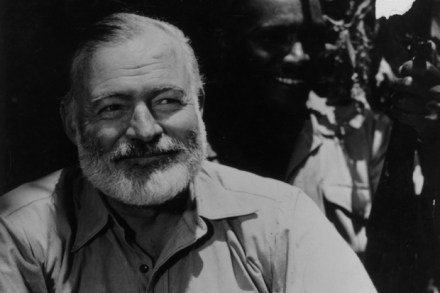
There was a photograph the other day of a Hemingway lookalike competition in Key West, Florida. Bizarre? Perhaps not. It’s 50 years since he put the barrel of a shotgun in his mouth and blew his head off, but he remains the most famous and widely recognised American writer of the 20th century, indeed of all time. Sadly, however, the lookalikes all take after the bearded bust-up Papa of his last miserable years, not the handsome young author of the great short stories where every word does its work and there are never too many of them. That Hemingway created an American type — lean, rangy, debonair — last example, Gregory Peck as the journalist in Roman Holiday. There was a photograph the other day of a Hemingway lookalike competition in Key West, Florida.

Dark art

From our UK edition

Shadow Catchers is an effective title, with its magical and occult associations, and a nice echo of body snatchers into the bargain. Shadow Catchers is an effective title, with its magical and occult associations, and a nice echo of body snatchers into the bargain. The exhibition (sponsored by Barclays Wealth) it labels is less impressive: a group of five individuals who might be photographers or might be artists showing us their experiments with light-sensitive materials. Wandering round the more than usually subfusc exhibition space, I wondered whether this was not more properly a display for the Science or Natural History Museums.