Labour party

The divisions laid bare

When The Speaker called a division, the Labour side roared a passionate No while the coalition benches delivered a rather muted Aye. I did not see a single Lib Dem open their mouth at this point. Instead, they sat on their benches looking emotionally exhausted. Even those Lib Dems who have been proved right in their warning about the party’s position on fees—notably, David Laws and Jeremy Browne—appeared downcast.   In the end, the government won but with a much reduced majority. 21 Lib Dems voted against the coalition, as did six Tories. Simon Hughes abstained despite Ed Miliband’s entreaties to come with him into the no lobby.   This

Miliband rises from his deathbed

At last Wednesday’s PMQs Cameron kicked Ed Miliband into touch with a debonair swagger. Today anger replaced disdain. The PM’s eye-popping rage is so palpable that some commentators take it for vulnerability or even a hint of self-doubt. Milband has Cameron rattled? Nothing of the sort. Cameron just can’t control himself.   Asked about the Coalition’s higher education policy, he heaped rancid abuse on the opposition leader from a lofty perch. He called him “an opportunist,”  who “posed about social mobility” and was guilty of “rank hypocrisy.” “He saw a big crowd in the Mall,” fumed Cameron, referring to the student protests, “and said, ‘I am their leader I must

Miliband’s jibes throw Cameron off course

After last week’s PMQs, Ed Miliband needed a clear win today—and he got one. Cameron, who had admittedly just flown back from Afghanistan, didn’t seem on top of the whole tuition fees debate and kept using lines that invited Labour to ridicule the Lib Dems. When Cameron tried to put Miliband down with the line, ‘he sounds like a student politician—and that’s all he’ll ever be’, Miliband shot back that “I was a student politician but I wasn’t hanging around with people who were throwing bread rolls and wrecking restaurants.” It was a good line and threw Cameron off for the final exchange.   The rest of the session was

PMQs live blog | 8 December 2010

VERDICT: Tuition fees, tuition fees, tuition fees. Ed Miliband used only one weapon from his armoury today – but it served him unexpectedly well. The Labour leader scraped a contest that, as usual, offered far more heat than light. His attacks were slightly more cutting, his one-liners that little bit more memorable, and it was all the more remarkable given his dreadful performance seven days ago. It wasn’t that Cameron performed badly. The PM rightly – and, at times, effectively – pointed out Labour’s hypocrisy on this issue. But it all seemed a little flat, as though he was reading from a script that had only just been handed to

Labour stumble into tomorrow’s tuition fee vote

Oh look, Alan Johnson has performed a hasty Reverse Cable. Only a few days ago, the Shadow Chancellor suggested that he didn’t believe a graduate tax – Ed Miliband’s chosen policy – could work. Yet, in a wilting Thunderer column (£) for the Times today, he now claims that “there is a very strong case for a graduate tax.” From unworkable to strong, in only four days. Sounds like a disclaimer for Ikea flatpack furniture, not a policy position. In a separate article, the Times characterises this as a minor victory for Ed Miliband – and so, in some respects, it is. He has managed to rein his Chancellor on

How far our schools have fallen

Comparing GCSE or A-Level results to previous years is a meaningless exercise. Leaving aside all the arguments about whether or not these exams are getting easier, it doesn’t much matter if children today are doing better academically than their peers a generation ago. What does matter is how they are doing in comparison to children in other countries, the people they’ll be competing with in the global marketplace.   Today’s PISA rankings, the OECD’s comparison of education standards, makes for depressing reading on this front. England has fallen from 7th in reading in 2000 to 25th today, from 8th to 27th in maths and 4th to 16th in science. Admittedly,

Bercow vs McLoughlin

Iain Dale has news of a remarkable exchange between the Speaker and the Chief Whip last night (see from 22:16:30 in the video above). The coalition were attempting to pass a motion limiting the debate on tuition fees to three hours. Labour was trying to prevent this.   The Labour front bench shouted ‘object’ at the wrong moment so Bercow, with a broad grin on his face, coached them through it. At which point, Patrick McLoughlin heckled, ‘give them an indication, won’t you?’ McLoughlin then goes to leave the Chamber. At which point, Bercow explodes, wagging his finger and ordering the Chief Whip to remain in the Chamber.   This

How the OBR measures up

There are only so many Labour interviews a blog can take, so I’ll skip over Yvette Cooper in the Guardian (sample: “I did think about standing, and Ed said he thought I should stand and if I wanted to stand he would not stand”). Instead, another catch-up on how the Office for Budget Responsibility’s growth forecasts are shaping up against those made by other institutions. Since I last did this, two new documents have been processed into the public domain: the OBR’s latest economic and fiscal outlook, of course, as well as the the Treasury’s round-up of long-term independent forecasts. So here’s how the panorama of forecasts looks now:

Brown struggles on beyond the crash

Today’s Guardian calls it his first interview since leaving office, although I think the Independent beat them to that one back in July. But, in any case, Gordon Brown’s chat with Larry Elliot is another staging post on his slow path back to public life. Here’s my quick summary: 1) Sniping from the moral high ground. A bit late now, but Brown is making a desperate scramble for the moral high ground. Not for him, he says, scurrilous memoirs that sift through the “arguments” of the past. No, he’s got far more important things on his mind than muck-raking and innuendo, like the future of financial regulation across the world.

Alan Johnson’s degree in making life difficult for Ed Miliband

There he goes again. Another Alan Johnson interview, another reiteration of his differences of opinion with his leader and another Tory press release claiming Ed Miliband’s writ doesn’t even run in his own shadow Cabinet. This time, Johnson has told Mary Riddell, “Well, I don’t think [a graduate tax] could [work]. Frankly, there’s a difference of view.” If this was not enough he continued to say, “I feel it’s going to be very difficult to make a graduate tax a workable proposition.” This must be so frustrating for Ed Miliband. First, it takes some of the heat off the Lib Dems who are all over the place this weekend on

Woolas loses his appeal

Phil Woolas has lost his appeal against the election court declaring his victory in Oldham East and Saddleworth. As I understand it, Woolas has not exhausted his legal options and could take the whole matter to judicial review. Word is that no decision will be made on a by-election until it is known whether or not Woolas will appeal.   Interestingly, Woolas was accompanied to court today by John Healey, the shadow Health minister. Healey is extremely popular with his Labour colleagues, he came second in the shadow Cabinet elections, and his decision to stand by Woolas today is a sign of where the emotional energy in the Parliamentary Labour

Laws on the formation of the coalition: Labour were simply too divided

David Laws has responded to Andrew Adonis’ partisan review (no link apparently) of 22 Days in May. Laws’ account of the formation of the coalition and its infancy in government. Laws denies Adonis’ charge that the Lib Dems had a ‘right-wing agenda’ and, to prove the point, drops a wonderful quotation from Peter Mandelson during a discussion on tax, saying: ‘Haven’t the rich suffered enough already.’ Rather, Laws’ argues that the coalition formed as it did because Labour were simply too divided to be credible. He writes: ‘Labour was too disorganised or divided even to table clear positions on tax, education spending, pensions or the deficit. And, on voting reform,

Uncharitable action

After CoffeeHouse raised a virtual eyebrow and a few questions about the behaviour of War on Want and the Jubilee Debt Campaign, Tory MP Matthew Hancock has written to the Charity Commission asking for an investigation into their status: “Quite apart from the issue over whether a charity should support an organisation that seeks to disrupt the operations of UK companies, I also believe that the charities’ support of UK Uncut clearly appears to breach Charity Commission guidance on political activity.” Let us see what Dame Suzie Leather, the Chairman of Charity Commission, thinks.

A grim turning point for Ed Miliband

Yesterday’s PMQs already feels like a turning point. It wasn’t so much the nature of David Cameron’s victory – comprehensive though it was – but rather the way  Labour MPs have reacted to Ed Miliband’s defeat. Whatever doubts some of them held privately about their leader have suddenly spilled out, mercilessly, across the snow. In his Daily Mail sketch, Quentin Letts describes Miliband’s excrutiating exit from the chamber yesterday; Guido and the Telegraph are carrying remarks from disgruntled Labour figures. The volume of hostile radio chatter has risen considerably over the past twenty-four hours. Of course, there are several caveats to be slapped across all this – not least that

What the statist left thinks of the liberal right

The Tories have the evil gene – that was the subtext to Ed Miliband’s jibes about the complacency of the children of Thatcher. Labour’s former General Secretary, Peter Watt, disagrees. In an important post for Labour Uncut, Watt observes: ‘But there is an arrogance at the heart of our politics that is going to make it difficult to really understand why we lost. It is an arrogance that says that we alone own morality and that we alone want the best for people. It says that our instincts and our motives alone are pure.  It’s an arrogance that belittles others’ fears and concerns as “isms” whilst raising ours as righteous.

Nothing Miliband says can rain on Mr Confident’s parade

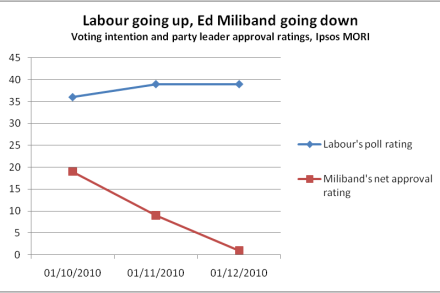
Back from Zurich, where he’s been helping FIFA determine the winner of the world’s greatest bribery festival, Cameron was in hearty form at PMQs today. He faced Ed Miliband who looks increasingly like the life and soul of the funeral. His party is riding high in the polls – but only when he’s away. As soon as he pops his head back around the door a groan of misery goes up and his rating collapses. Earlier this week the OBR gave an upbeat assessment of the economy so Ed sent his bad-news beavers to sift through it for signs of toxicity. They couldn’t find much. Jobless totals are to rise.

PMQs live blog | 1 December 2010

VERDICT: A freewheeling, swashbuckling sort of performance from Cameron today, that was encapsulated by a single line: “I’d rather be a Child of Thatcher than a Son of Brown”. Sure, that may not go down too well with lefty Lib Dems nor, indeed, many Scottish voters. But, in the context of PMQs, it was a rapier response to Ed Miliband’s sclerotic lines of questioning. Why the Labour leader chose to completely ignore today’s Mervyn King quotes, and sift unpersuasively through the footnotes of the OBR report, I’m not sure. In any case, the plan didn’t work at all. This was yet another PMQs which generated more heat than light, but

Poverty NGO or Labour stooge?

While I worked at DfiD, officials were very keen to disabuse me of my suspicion that some NGOs are in fact not focused on a politically-neutral campaign to end worldwide poverty but are instead extensions of the Labour movement. They may be staffed by Labour supporters, run by ex-Labour advisers or just be used to working with a Labour government; but they were not corporately aligned in any way. Or so I was told. And I was happy to believe it. But what is this? War on Want and the Jubilee Debt Campaign – two supposedly internationally-focused NGOs – are said to have joined forces with the protest organisation UK