Labour party

The money that didn’t swing the election

Before the election, the Tories used to regularly, and with a certain justification, complain about how the vast majority of money that Peter Mandelson’s department was dishing out to businesses via the Strategic Investment Fund went to those based in Labour constituencies. Not a single Tory-held seat benefitted from this £601.5 million of spending. Indeed, 84 percent of the constituencies that benefitted from this money were Labour at the time. But new research on the election result shows that this money doesn’t seem to have made voters much more loyal to Labour. In the 25 seats that benefitted from the fund the swing against Labour was 12 percent. This is

Lansley gives us a nudge

Andrew Lansley’s rhetoric is strident: ‘It’s time for politicians to stop telling people to make healthy choices. Rather than lecturing people about their habits we will give them the support they need… we will support leadership from within communities.’ One could be forgiven for thinking that the Health White Paper will inaugurate a completely new dawn. It doesn’t. Many of Lansley’s initiatives are resuscitated Labour policies: taxes on alcohol and tobacco and incentivising healthy living through choice are tried and tested formulas that have had limited past success in every field bar raising revenue. Lansley’s White Paper is not a testament of radicalism, but it is quietly revolutionary nonetheless. Of

Osborne airs the Tories’ election message

George Osborne’s autumn statement previewed what I suspect will be the coalition, or at least the Conservatives, re-election message. ‘This government has taken Britain out of the financial danger zone and set our economy on the path to recovery.’   Today’s OBR forecast was a boon for the Chancellor. It suggests that there won’t be a double-dip recession, as his critics suggested there would be. The improved economic numbers allowed him to come to the House and declare that the deficit reduction ‘plan is working’, and that already the coalition has saved the country £19 billion in debt interest. Alan Johnson was his usual self in response. He attacked the

Setting the scene for Osborne’s speech

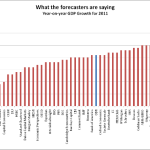
George Osborne will make a brief statement to the house this afternoon, responding to the Office for Budget Responsibility’s revised growth forecasts. Reuters reports: ‘As expected, the Office for Budget Responsibility raised its 2010 growth forecast to 1.8 percent from its 1.2 percent June forecast to factor in a surprisingly strong performance in the middle of the year.’ The upgrade fuels Osborne’s positive narrative: the coalition pulled Britain from the abyss and international confidence in Britain’s economy is growing. These forecasts vindicate the government’s ‘cut with care’ strategy. Concrete savings are now being made and they enable the Chancellor to announce that public sector net borrowing will fall. Reuters again:

Some early statistical vindication for IDS

The Observer has news that will warm the government’s hearts. Ernst and Young have conducted a report that suggests 100,000 public sector jobs will be saved thanks to the savings made by welfare reform. The report’s other finding, a crucial one, is that the Treasury will be raking in £11bn by 2014-15. So then, a statistical vindication for IDS’ reforms, the economic side of them at least. It also gives the government some defensive hardware ahead of tomorrow’s Chancellor’s autumn statement. Not that it really needs it. On the back of Britain’s strong economic performance in the third quarter, the Office for Budget Responsibility is expected to raise its 2010

Too clever by half, Miliband pitches for the squeezed middle with the vacuous promise of change

Ed Miliband has made an inauspicious start to his second political relaunch of the week. The Sun has dubbed him Buzz Lightweight, after he adopted the Pixar-inspired catchphrase ‘Beyond New Labour’ to describe his vision for the party. Miliband’s media presence is already wooden; migrating to plastic is hardly a promotion. Miliband and his elders have arrived at Labour’s national policy forum. In so far as it’s possible to determine what he stands for, Miliband is not aiming for the middle ground of British politics, as David Cameron and Tony Blair did. But he is courting the ‘squeezed middle’ with the promise of change. So far, that promise is more vacuous than profound

The Big Squeeze

The media pack is often blind to an impending political car-crash.  For instance, very few in Westminster, or the media, noticed the scrapping of the 10p tax band until the screech of twisting steel turned heads. The same is happening now in relation to living standards. The media and political establishment are yet to wake up to the fact that working families in Britain are about to become poorer (though hat-tip to Allister Heath for being quick off the mark on this front). The gathering wisdom is that, with the recession now behind us, household budgets will start to recover.  We have just published a new report – Squeezed Britain 

Solutions to the Mili-woe

Ed Miliband’s day today rather sums up his problems. His morning media round has all been seen through a negative prism. Nick Robinson mocks the new leader’s attempt to talk about the squeezed middle by calling it the squeezed muddle. While Ed Miliband’s declaration that he is a socialist, something he has said many times before, is not being treated as a refreshing dose of intellectual honesty but as evidence that he’s just too left-wing. A lot of Ed Miliabnd’s problems come from the fact that the media is in hunting mode. The media, as a rule, don’t like being surprised and Ed Miliband’s victory was not what it expected.

Ed Miliband: “Yes, I am a socialist”

Ed Miliband was doing the interview rounds today, and CoffeeHouses may be interested in the below – an edited version of his exchange with Nicky Campbell on Five Live. NC: Is the problem union power?  MPs and the constituencies clearly voted for your brother, Alan Johnson’s favourite candidate.  He was a clear winner in those two parts of the party, and many people say union influence has to be limited.  Now this is a real test of your guts, isn’t it?  Is it the right thing to do? EM: I see it a different way, Nicky, to be honest.  I see that politics as a whole, in every party, is

Tory and Labour grandees unite against AV

The NOtoAV campaign has unveiled its patrons. It’s an impressive list. Margaret Beckett is the President, supported by Blunkett, Falconer, Prescott, Reid and Emily Thornberry on one side and Ken Clarke, Micheal Gove, William Hague, Steve Norris and Baroness Warsi on the other. The squeeze is on. The YEStoAV campaign has Labour supporters, but they aren’t quite so august. Iain Martin reckons that the YES team are faced with a cross-party opposition that can get these diverse big beasts working together. Iain calls it a pincer movement on the Lib Dems. The strategy is to characterise electoral reform as aan exclusively sectional interest: Clegg’s fixation. With his singular brand of native wit, John

The Big Society is a threat to Labour

If you think there really is a big idea behind the Big Society, then you agree with the unlikely pairing of Jon Cruddas (Lab, Dagenham) and Jesse Norman (Con, Hereford). The latter’s new book, The Big Society: The Anatomy of the New Politics, attempts the seemingly impossible task of providing a grand philosophical narrative to underscore David Cameron’s often amorphous rhetoric. Cruddas and Norman debated at the Institute of Economic Affairs last night, alongside the IEA’s Professor Philip Booth and Dr Steve Davies. The ninety minute discussion did more to expose the philosophical fault lines in modern British politics than any public event I’ve attended since the General Election. Jesse

Five things the student unions didn’t protest against in the last 13 years…

1)    That Labour cut the number of schools each year. 2)    That pupils were shepherded into ever-larger schools. 3)    That, although the budget trebled, class sizes hardly moved. 4)    That the attainment gap between private and public schools grew to become the largest of any country except Brazil (Source: OECD ) 5)    And all at a time when the supposed funding per pupil was soaring… Moral: cash doesn’t help schools. Reform does.  

Gove starts the revolution

The Spectator has been a long-term fan of Michael Gove – indeed, we named him the single best reason to vote Tory at the last election. His ‘free school’ reforms are laudable and the emphasis on improving standards is imperative. Under the previous government, Britain slid down the international rankings of educational attainment. A tide of politically correct initiatives robbed teachers of their classrooms and discipline suffered. The post code lottery under which state education operates sentences the poorest and most vulnerable in society to rot in under-funded sink schools. Reform is both a moral crusade and a necessity if Britain is to continuing punching above its weight in the

Time for the real Ed Miliband to speak up

There is talk of Ed Miliband’s ‘New Generation’, but no indication of what it stands for. It has no clear views on the economy, student finance, defence and electoral reform. Despite his party’s lead in the polls, Ed Miliband is an inert political entity (and it did not help him that the party peaked in his absence). Tim Montgomerie has rightly diagnosed a leadership vacuum. Miliband is timid before a parliamentary party that did not select him, and is struggling to acclimatise to a political discourse that the coalition government is moving beyond the terse liturgy of left and right. So far, Miliband’s banal default tactic has been to seek

Miliband should re-examine Cameron’s playbook for the real lessons

Ed Miliband has come roaring back from his paternity leave, keen to silence the growing chorus of criticism that he is not in control of his party and has let the Coalition determine the agenda.     To do so, he has come out in favour of a permanent top rate of income tax at 50 percent, but is otherwise taking a leaf out of the Cameron playbook – by establishing a number of policy reviews. But he might want to take another look at Cameron’s experience. Reviews are a great tactical ploy – they show a willingness to “think big”, allow a leader to reach out to a range party

From The Annals of the Gord

This snippet from Anthony Seldon and Guy Lodge’s latest book merits repeating: ‘As Barack Obama waited in a cavernous building in London, he suddenly noticed Gordon Brown stomping towards him down a corridor, with a flurry of aides in his wake. Unfortunately — probably because he has a glass eye as the result of a rugby injury — the Prime Minister didn’t see the President. To the surprise of Obama and his entourage, the British premier was doing a passable impression of an erupting volcano. He was clearly furious about something his aides had or hadn’t done. It was hardly the behaviour anyone would expect of a G20 summit host,

Labour’s terror u-turn doesn’t lessen its authoritarianism

It is a day for about turns. First, the Pope has taken a historic decision to approve the use of condoms to fight AIDS; second, Labour has vowed to change its position on terror legislation and law and order. The party feels its record in government has damaged its reputation as a guarantor of liberty. Generation Ed wants to make another break from the past. Ed Balls has masterminded a cunning sleight of hand. The proposal is nowhere near as dramatic as headlines suggest. Labour will support the government’s proposed reduction of detention periods from 28 days to 14, provided the police and security services are not impeded by the change. Balls

Miliband’s New Generation draws the line under donor peers

Patronage remains a strong statement of leadership, and an indication of a leader’s competence. As James noted yesterday, Ed Miliband chose the occasion to play one of his few picture cards: Maurice Glassman’s accession into red ermine is a major PR coup for Labour in the battle to be ‘progressive’ and community-focused. But Miliband’s list is also noteworthy for those it excluded. The Times has the details (£): ‘He decided against handing seats in the House of Lords to Nigel Doughty and Sir Ronald Cohen — who have given more than £6 million to the party since 2005 — as well as Jon Mendelsohn, Labour’s fundraising chief. All three had

Full list of peerages

Number 10 has published the full list of new peerages. There are 27 new Conservative peers, including Sir Patrick Cormack, Richard Spring, Julian Fellowes, Howard Flight, Michael Grade and Patience Wheatcroft. The Lib Dems and the Labour party have acquired15 and 10 respectively. General Dannatt is also to be ennobled, but will sit on the crossbenches, confirming his break-up from the Tory machine. Expect his strident voice to be a constant feature of the debate growing from the troubled strategic defence review.