Labour party

Has Labour finally found its campaign message?

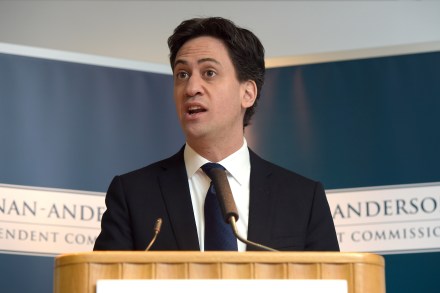
As well as keeping the tax avoidance row going for as long as possible (something that is worrying Tories, who think their party needs to find a way of moving the conversation on from a toxic issue as quickly as possible), Ed Miliband also unveiled a potential new campaign message at his speech today. He talked about ‘a better plan for working people, a better plan for Britain’. The 79-page document that launched alongside it was entitled ‘Better Plan for Britain’s Prosperity’.

Seven times Labour has previously launched a plan for the economy

The Labour vs. Conservative battle of economic plans is heating up. Ed Miliband is launching a 79-page Better Plan for Britain’s Prosperity today, which appears to be his latest alternative on the Conservatives’ robotic chants of a ‘long-term economic plan’ for ‘hardworking families’. But this isn’t the first time they have launched their plan for the economy. Here are seven previous occasions where Labour has made a fuss about some new plans, pledges or promises about the economy: 1. December 2014 – five election pledges. At the end of last year, Miliband announced that Labour would go into the election with five election pledges that constituted ‘a long-term plan to make the country work for working people again’.

Will Labour’s efforts to paint the Conservatives as a party of the rich backfire?

Quite naturally, the latest foray by Labour into pointing fingers at Tory tax avoiders has led to two scraps, firstly about Labour’s own donors and their tax affairs (as James predicted on Thursday) and secondly about whether or not paying your builder in cash is illegal. The last time the second row blew about Westminster, it was after Tory minister and tax personality of the year David Gauke made some rather clumsy comments about paying your cleaner. Chuka Umunna had a rather tough section of his Today programme interview in which he was repeatedly asked whether Labour would hand back money donated to it by someone who turned out to have been involved in aggressive tax avoidance.

The danger for Miliband in his tax triumph

Last week was Labour’s best of the campaign so far and the Tories’ worst. The row over tax avoidance and Lord Fink’s comments reinforced the damaging perception that the Tories are the party of the rich. It also raised Labour morale, frontbenchers who used to be pessimistic about the party’s electoral prospects are now bullish. But there is a danger that this tactical victory could turn into a strategic defeat. For Miliband by denouncing tax avoidance—which is legal—and setting himself up as a moral arbiter on the issue, has made his tax affairs and those of his shadow Cabinet, MPs and donors a legitimate subject of public interest. They no longer just have to be legal and fully declared, they also have to pass the higher Miliband bar.

Will Labour rule out a deal with the SNP?

Who ends up governing Britain after the election may well be determined by what happens in the Scottish seats. If the SNP take a slew of seats from Labour, it becomes far more likely that the Tories will be the largest party nationally. Add to that the fact that Cameron is the incumbent Prime Minister and he would, in these circumstances, probably be able to put together a deal that sees him carry on as Prime Minister. Labour is acutely aware of this and is busy warning Scots ‘Vote SNP, Get Tory.’ But in this anti-politics era, these squeeze messages don’t work as well as they used to—as the Tories are finding out with their ‘Vote Ukip, Get Miliband’ warnings.

Three reasons why Labour probably (just about) ‘won’ this week

Ed Miliband’s party has ended up having a reasonably good week, even though it’s been a pretty tough battle. Today’s front pages have not been good at all, something the party leader’s supporters are obviously disappointed by, but given the story about a comparison between the row about Lord Fink’s tax affairs and the hacking of Milly Dowler’s phone was made by an aide, not Miliband, and then reported in a way that was initially misinterpreted, the focus of the row is not Miliband himself. The line about Miliband's own tax affairs was inevitable, too. But it depends whether anyone can find anything to continue the story.

Immigration, not money, will improve Scotland’s most deprived schools

I suppose we should be thankful that Nicola Sturgeon has acknowledged there’s a problem with Scotland’s public education system, even if she’s hit upon the wrong solution. Earlier this week, the First Minister announced that the Scottish -government would be trying out its version of ‘the London challenge’, a programme carried out by the last government, to address the chronic underachievement of Scotland’s most deprived children. In the past, the SNP has deflected criticisms of its education record by pointing out that Scottish 15-year-olds did marginally better than their English counterparts in the 2012 Pisa tests. But the difference between the two groups is minuscule and both have declined dramatically since Pisa first started testing in 2000.

PinkVanGate: Harriet Harman denies telling Karen Danczuk to join Girls Aloud

Yesterday Harriet Harman claimed that Labour's pink ‘Woman to Woman’ van is not patronising after a public backlash saw the feminine choice of colour ridiculed online. Now the deputy leader faces further backlash, after Karen Danczuk accused Harman of patronising her when they first met. The Labour councillor and wife of Simon Danczuk claims that Harman told her she was too pretty to be in politics and instead suggested she join the pop band Girls Aloud. When I first met Harriet Harman she said I was far too pretty to be interested in politics & should be in Girls Aloud. KD — Cllr Karen Danczuk (@KarenDanczuk) February 11, 2015 Harman has now come out to deny that she ever said such a thing.

Miliband: I stand by what I said about Lord Fink

Ed Miliband has now repeated what he said about Lord Fink in the Commons. At the end of his speech, he said: ‘Yesterday Conservative donor Lord Fink challenged me to stand by what I said in the House of Commons, that he was engaged in tax avoidance activities. I do. And believe it or not, now today he confirms it as well as he has just said, and I quote, I didn’t object to his use of the word tax avoidance, because you’re right, tax avoidance, everyone does it. ‘Now David Cameron must explain why he appointed a treasurer of the Conservative party who boasts about engaging in tax avoidance and thinks that it’s something everyone does. Friends, this is the big choice facing our country.

Miliband appears to win tax battle as Lord Fink backs off legal threat

So it looks as though that Ed Miliband has won his battle with Lord Fink. The Tory peer has given an interview to the Evening Standard in which he says he did use ‘vanilla’ tax avoidance measures. He told the newspaper: ‘The expression tax avoidance is so wide that everyone does tax avoidance at some level.’ Fink then says he doesn’t want to sue Miliband for saying that he ‘did ordinary tax avoidance’, but that he ‘took exception to’ the suggestion that he was dodgy and that he had questions to answer. This means that Miliband can quite easily repeat the specific comment he made about Fink in the Commons yesterday, which was this: ‘Let us talk about the difference between the Prime Minister and me.

Peter Oborne: Ed Miliband is the most accomplished opposition leader since the war

[audioplayer src="http://traffic.libsyn.com/spectator/TheViewFrom22_12_Feb_2015_v4.mp3" title="Peter Oborne and Dan Hodges discuss Ed Miliband" startat=1343] In this week’s Spectator podcast, we put a Labour and a Tory supporter next to each other to debate the virtues of Ed Miliband. The difference being that Peter Oborne is a passionate defender of the leader, and Dan Hodges his most vocal critic. Peter explains to Sebastian Payne that while he is a conservative journalist, his job is to tell the truth, and put political prejudices to one side, which leads him to conclude that Ed Miliband is a man of incredible accomplishment and bravery, whose efficacy is demonstrated by the ferocity of the press backlash against him.

Podcast: why modern love is rubbish and is Ed Miliband an honourable opposition leader?

In the age of Tinder and online dating, is modern love rubbish? On this week’s View from 22 podcast, Melissa Kite, Cosmo Landesman and Camilla Swift discuss this week’s Spectator cover feature on why romance is being killed off by digital dating. Is it more brutal or reflective of real life to ruthlessly chase someone on their looks alone through apps and websites? Is it a tragedy that young romantics are missing out on the art of courtship? James Forsyth and David Skelton also discuss the Tories’ gamble to woo working class voters ahead of the election.

Lord Cashman inherits his late partner Paul Cottingham’s estate

After Paul Cottingham passed away last year following a battle with cancer, Ed Miliband led the tributes for the long-term partner of Lord Cashman. Miliband, who described the pair as the 'Posh and Becks of the Labour Party', said that he felt deeply privileged to have known Cottingham, who was a human rights activist. Now Mr S can disclose that Cottingham left an estate worth £75,000, according to figures released by the probate office in London. As there was no will, Cottingham's civil partner Lord Cashmam will inherit his estate under the rules of intestacy.

Even the people who make political adverts aren’t sure they work

It is a common prejudice about modern politics that it is all focus groups and spin, all public relations and advertising. The rather heartening conclusion from Sam Delaney’s history of advertising in politics is that this is a calumny on the political trade. Delaney has spoken to everyone involved in political advertising since the phenomenon began in earnest with Wilson in 1964 and can hardly find a soul who is certain that advertising does anything more than varnish good ideas. Maurice Saatchi, for example, credited Margaret Thatcher’s proposals, rather than his talent for a pithy slogan, for her electoral victories. Chris Powell, a leading figure in Labour’s Shadow Communications Agency, also doubts whether advertising can really change popular opinion.

David Cameron is lucky he faces Ed Miliband, not Nicola Sturgeon

In some respects David Cameron has been a lucky politician. Lucky that his predecessors had failed so completely that his initial brand of so-called modernisation seemed a punt worth taking. Lucky that he faced Gordon Brown, not Tony Blair. Lucky that he could pivot from 'sharing the proceeds of growth' to 'we're all in it together' without too many people noticing (or caring too much). Lucky, above all, that he now faces Ed Miliband. Because however you dress it up, this has not been a happy government. In economic terms - the defining issue of the age - his party has missed many of its most important targets. Functionally-speaking, George Osborne's record in office has followed Alistair Darling's 2010 plans more than it resembles Osborne's own projections from five years ago.

Miliband to repeat allegations against Lord Fink in public

So Ed Miliband really is going to pick one of the bigger battles of his leadership. After Lord Fink demanded that the Labour leader withdraw what he said about the peer at PMQs or to repeat it outside the House of Commons, I've spoken to a Labour source who says: 'These are very serious allegations in the Guardian about Lord Fink, including his complex arrangement to minimise tax. He still has not justified the reason why he's made these arrangements. He should do so. 'David Cameron must explain whether he is happy to have appointed Lord Fink as a treasurer. Then it will be up to the public to judge.' Miliband is going to repeat his allegations outside the Chamber, as soon as he is given the opportunity to do so.

Ed Miliband is being pushed to the left by the SNP

At last, the picture is becoming clearer. We now have a better idea of what the SNP will demand in return for its support to put Ed Miliband in Downing Street. Nicola Sturgeon didn’t use the term ‘red line issue’ but this was the clear message underlying both the broadcast interviews she made this morning and her keynote speech at UCL. We have known for some time that the SNP leadership does not favour a formal coalition with Labour. Rather, it would look for a ‘confidence and supply’ deal, backing Labour’s Budgets and opposing no confidence motions and expecting concessions in return. And now there appear to be two ‘red lines’ - concessions which the SNP would expect from Labour.

Lord Fink confronts Miliband over ‘defamatory’ comments at PMQs

Lord Fink has confronted Ed Miliband over his allegation at Prime Minister's Questions that the peer was engaged in 'tax avoidance'. In a letter, Fink says Miliband should repeat the allegation outside the House of Commons, or withdraw it. You can read the full text of the letter below. Miliband's question did seem to go further than the Guardian article published before PMQs that named Fink. The article said: 'One of the Conservative party’s recent treasurers, Lord Fink, formerly Stanley Fink, is revealed as having made the most of a four-year posting to Switzerland while working at hedge fund the Man Group.