Keir starmer

Prince of Darkness sacked (again)

22 min listen

Another week, another departure. Conservative MP Neil O'Brien – who serves in the shadow cabinet as minister for policy renewal and development – was granted an urgent question in Parliament this morning, to question the government about Peter Mandelson. Then the news broke that Lord Mandelson had been sacked by Keir Starmer following further disclosures about his relationship with Jeffrey Epstein. Neil joins Tim Shipman and James Heale to discuss the latest developments and also the questions that still remain: what did they know about Mandelson's relationship with Epstein; if they didn't know, why didn't they know; and will the government be forced to release their vetting files on Mandelson's apppointment?

Starmer’s survival depends on going against his instincts

Athelstan has long faded from public imagination, despite being the king who, in 927 ad, first united England. But thanks to a campaign by historians such as Tom Holland, David Woodman and Michael Wood, the 1,100th anniversary of his coronation last week was celebrated with a memorial service, a new biography and the naming of a train in his honour. Athelstan’s kingdom fragmented after his death, but its brief unification reminds us of the deep history of England and its constitutional order. What followed from Athelstan was the rule of law, parliamentary sovereignty, Magna Carta and the Bill of Rights: principles that have survived for centuries and inspired imitation across the world. That our constitution is uncodified, and therefore evolutionary, makes it perhaps more impressive.

Britain’s war on free speech is worse than you think

From our US edition

Where do you strike the balance between expression and security? It is a question Americans don’t need to ask. Our Constitution is plain and unambiguous about our fundamental rights to say what we want, write what we like, to gather in protest and – sweet relief – to mock our government.  Not everyone is so lucky. Not even our friends. “It doesn’t give me any great joy to be sitting in America and describing the really awful, authoritarian situation that we have now sunk into,” Britain’s Nigel Farage told the House Judiciary Committee yesterday afternoon, as he detailed the speech crackdown being carried out in the UK. “At what point did we become North Korea?

free

The red reshuffle overshadows Reform

14 min listen

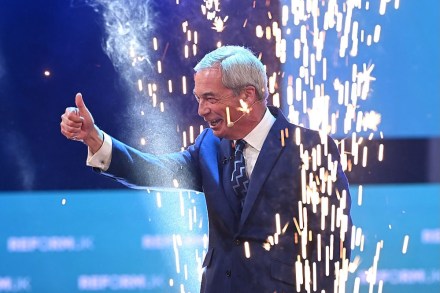
Lucy Dunn catches up with Tim Shipman at Reform's party conference, taking place in Birmingham, to get his reaction to Labour's reshuffle. The reshuffle took place following Angela Rayner's resignation from government. Tim argues that it's clear the reshuffle centred around getting Shabana Mahmood into the Home Office, where she can tackle some of the biggest issues for Labour – small boats and asylum hotels. They also round up the goings on at Reform including leader Nigel Farage's speech, who claimed Labour's reshuffle proved an election could be sooner than we think... Produced by Patrick Gibbons and Megan McElroy.

Can Rayner survive tax row?

16 min listen

24 hours after Angela Rayner admitted underpaying tax, the pressure remains on the deputy prime minister as Westminster now waits the outcome of the probe by the Prime Minister’s standards adviser. The Spectator’s political editor Tim Shipman and the Sunday Times’s Whitehall editor Gabriel Pogrund join Patrick Gibbons to discuss whether Rayner can retain her briefs. As Gabriel points out, regardless of the outcome of the ethics probe, Rayner was seen as Labour’s ‘sleaze-buster in chief’. So how damaging is this to ‘brand Ang’? Produced by Patrick Gibbons.

PMQs: Rayner defended as Badenoch flops

17 min listen

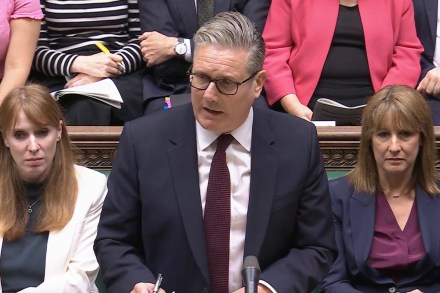
Keir Starmer and Kemi Badenoch faced off in the first Prime Minister’s Questions following summer recess. With the date of the Budget announced that morning, the economy was expected to dominate – which it did, to the surprise of most MPs, who expected Badenoch to attack over the Angela Rayner tax row. The deputy prime minister had admitted that morning she underpaid stamp duty on her flat in Hove. The leader of the opposition did question Starmer on it initially, but as political editor Tim Shipman says she more than missed an open goal. Tim joins Isabel Hardman and Lucy Dunn to discuss how damaging the row is for Rayner – and how damaging PMQs was for Badenoch. Produced by Patrick Gibbons.

Labour’s transfer deadline day

17 min listen

The summer transfer window comes to a close today but, as Parliament also returns from summer recess today, the only team Keir Starmer is focused on is his own in Number Ten. The Prime Minister has decided to reshuffle his advisers, including bringing in Darren Jones MP to Number Ten from the Treasury. Political editor Tim Shipman and James Kirkup, a partner at Apella Advisors and senior fellow at the Social Market Foundation, join economics editor Michael Simmons to go through the moves. Will yet another change in advisers boost Labour's fortunes? Or are they doomed to relegation? Produced by Patrick Gibbons and Natasha Feroze.

The left’s fightback against Labour has begun

If there is a hallmark of Keir Starmer’s leadership, it is a willingness to bash the left. For five years, he has repeatedly sided with his moderate factions to make Labour electable. Corbynites have been purged from parliament and the party machine. Principles and policies have been changed to meet the electorate’s approval. Last summer’s election result appeared to vindicate the Prime Minister’s strategy. But with Starmer’s authority crumbling, the British left is aiming to reassert itself and wreak its revenge from outside, rather than inside, the Labour party. ‘This Labour government is here to appease Reform. We are here to defeat Reform’ Three groups pose a threat to Starmer. The first is the new ‘Your Party’, led by Jeremy Corbyn and Zarah Sultana.

J.D. Vance: proconsul to Britain?

From our US edition

Vice President J.D. Vance’s family vacation in Britain was disrupted by protesters who insisted that he was not welcome in the country. In the Cotswolds, an area northwest of Oxford and the British equivalent of Martha’s Vineyard, ultraliberal white protesters huddled together on August 12 to make their meager numbers look large for the cameras, wielding signs bearing such slogans as “End Genocide!” and “Stop Fascists!” One participant quoted by the Guardian explained: “I’m most worried about his environmental policies. They risk eliminating the whole of humanity, all the creatures on the Earth.

Vance Britain

Who still supports Keir Starmer?

Successful political leaders hold in their minds some idea of what Mrs Thatcher called ‘Our People’. In this context, I do not mean the whole population of the country they seek to lead, or the core of the party they belong to. I mean that group of people with whose aspirations they most wish to identify. In making that identification, they combine direct self-interest – getting their floating vote – with a wider view about who are most important for the nation’s future prosperity and good order. In the Thatcher era, such people were the famous C2s, first-generation home-buyers, millions who could expect not only to earn but also to own. In Tony Blair’s time, the group was not so different, but a bit softer, as one expects when growth has seemed secure for many years.

Britain’s foreign secretary faces fine for fishing without a license

From our US edition

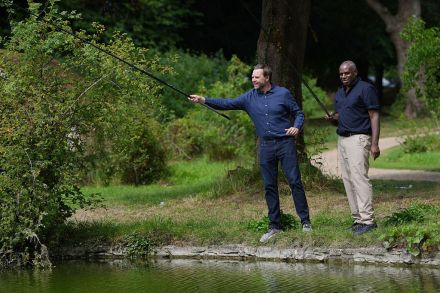
What people on the other side of the pond call "Brand Britain" has taken something of a knock in recent years – especially in the United States, which the British often still view as an errant son. With unnerving speed Britain's reputation has collapsed stateside, especially among the political right, from the country of Brideshead Revisited to a grotty Airstrip One. The symbol of the new Britain in the eyes of many Americans are the ubiquitous licenses (or, in the argot of a London copper, "loicenses") that citizens seem to need for everything – including, most notoriously, owning a TV. Now even the Foreign Secretary has been caught without a loicense. On Friday David Lammy went fishing with the now-Vice President J.D.

Lammy Vance

A global MAGA crusade against web regulation?

From our US edition

“Censorship is not how we do things in Western civilization”. So said Congressman Scott Fitzgerald (R-WI) of the United Kingdom’s new Online Safety Act (OSA). Its effects on free expression are “dangerous and needs to be addressed,” possibly by means of an international “united front”. The Congressman was fresh from meetings with British and Irish lawmakers and US tech firms, held as part of a House Judiciary Committee fact-finding mission to investigate the impact of the OSA and the European Union’s new Digital Marketing Act on American businesses. The main event was a one-on-one between Committee chair Jim Jordan (R-OH) and Peter Kyle, the United Kingdom’s Secretary of State for Science, Innovation and Technology.

Online Safety Act

Varun Chandra: the most important adviser you’ve never heard of

The porousness of the Establishment, and its reluctance to advertise its activities, are illustrated by the career of Varun Chandra. At the age of 40, he sits as business adviser at the right hand of the Prime Minister, accompanied him to the meeting on Monday with Donald Trump at Turnberry, and is credited with playing an invaluable role in the recent trade talks in Washington. Before the general election, he used his innumerable high-level contacts to persuade business that Labour would be a better bet than the Conservatives. About himself he has preserved an almost immaculate discretion. He has no Wikipedia entry and is not in Who’s Who.

Make Trump Britain’s prime minister

When I was a young man, the claim that Britain was in danger of becoming the 51st state was a political slur mainly thrown about by the left, particularly those who objected to the presence of US military bases. But there was some anti-American sentiment on the right, too – Enoch Powell, for instance, had a dislike of America’s hostility to the Empire that dated back to his service in the second world war. I’m even guilty of some anti--American prejudice myself and wrote a memoir in which I tried to convey that my failure to take Manhattan in the mid-1990s was because I wasn’t willing to sell my soul to Mammon. Well, I take it all back.

The UK censorship files: Jim Jordan’s crusade against Britain

From our US edition

The British Empire may be gone, but there is one area where the UK has not lost its global ambitions: online censorship. The latest vehicle is the Online Safety Act (OSA), a behemoth internet regulation law whose vast provisions are steadily coming into force – and increasingly drawing the ire of the Trump administration as it starts to impact US tech firms.  Under the OSA, “Britain has the power to shut down any platform” that breaks its content regulation rules, boasts secretary of state for technology Peter Kyle. The latest stage of its implementation began last week with new mandatory age-verification measures for social media platforms.  The Act is already curtailing what can be read online in the UK.

Free speech

What does Trump really want in Gaza?

From our US edition

UK Prime Minister Keir Starmer, French President Emmanuel Macron and the rest of Europe’s leaders are clear about what they want to see in Gaza: an immediate ceasefire, the release of the 50 remaining hostages in Hamas’s grasp, an acceleration of aid supplies and an end to a nearly two-year war that has turned the coastal enclave into a real-life version of Dante’s Inferno. Macron went one step further several days ago, announcing that France will recognize an independent Palestinian state at next month’s UN General Assembly meetings in New York. Starmer, under pressure from Labour backbenchers, is moving in a similar, albeit more conditional, direction.

Trumpism rules the world

From our US edition

Whatever loopiness there is in Donald Trump’s personality is a loopiness born of isolation. For ten years the history of the world has revolved around him, not he around it. The events of last November have left Trump as, for all intents and purposes, the only remaining historical actor – especially after Xi Jinping’s retreat into obscurantism since the pandemic.

Trump Starmer

Can anything stop Reform?

A close associate of Nigel Farage received phone calls from three civil servants in the past week, asking how they might help Reform UK prepare for government. Officially, mandarins won’t begin talks with the opposition until six months before a general election, which might be nearly four years away. And Reform currently has just four MPs. But behind the scenes, the source reveals: ‘I’m personally getting middle-ranking civil servants in various departments asking if they can help – people who actually understand how to get things done. They don’t want to lose their jobs, but they want to tell us what’s going on.’ MPs may have departed Westminster for recess, but that also marks the firing of a starting gun on a highly consequential political summer.

The pointlessness of ‘smashing the gangs’

‘Smash the gangs’ is the fascinating slogan that Keir Starmer’s government has settled on for tackling illegal migration. What is the government going to do to stop the hundreds – sometimes thousands – of people sailing across the Channel and coming into England each day? ‘We will smash the gangs,’ they say. The slogan is interesting for reasons beyond the tough-guy rhetoric. For it suggests, of course, that it is people-smuggling gangs that are the main problem. Perhaps our government sees them as being like press gangs back in the day, roaming around northern France, waylaying passing migrants and forcing them on to rubber dinghies to begin a new life in Britain.

Where did ‘husband’ come from?

‘Am I housebound?’ asked my husband as I was discussing with him the complicated history of the name for his role in life. ‘No, darling,’ I said. ‘You’re the one in the house who just is or lives there.’ Only later did I tell him that the word bond, behind the -band of husband, sank in worth with the years, following the same path as boor, churl and peasant. Whereas I as a housewife enjoy a comparatively transparent label, any husband’s title is obscure. It is simply a house-bond, but the first element of husband, hus-, no longer seems like house, and the -bond element is often mistaken for a form of bond, a separate word to do with binding.