Italy

Words to live by from Saint John Henry Newman

From our UK edition

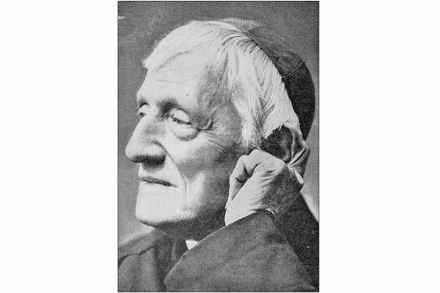
On 13 October, John Henry Newman, a distinguished and distinctive Englishman, was officially declared a Saint. A well-known saying of his is: ‘To live is to change; to be perfect is to change often.’ How did that work in his life and, to a lesser extent, how has it worked in mine? In 1833, Newman was desperate to get back to England from a trip to Italy, including to Rome, for which he acquired a deep dislike. He had his plans ready, among them a determination to lead the Church of England in a profound renewal. But he fell ill and then, heading for Marseilles, his ship was becalmed in the Strait of Bonifacio, between Corsica and Sardinia. His frustration deepened. But then a change.

Why Tuscany always beats Provence for me

From our UK edition

A family of peacocks is sunning itself in our villa garden. They all look extraordinarily happy and composed, especially the baby one, for whom (like us, come to think of it) this is a whole new experience. But then, the 150 hens wandering in and out of their coops painted like beach huts don’t look exactly overburdened themselves; nor do the sheep, pigs and cows in their 220 acres of lush Tuscan terrain near the Merse river about 45 minutes southwest of Siena.

Venice needs Venexit

From our UK edition

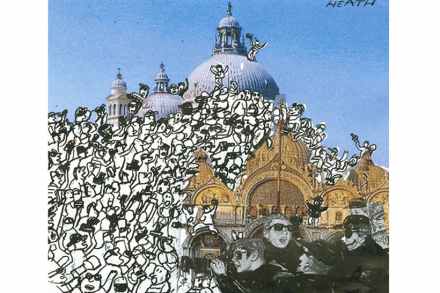
Some of Venice’s problems are well known: the challenge of conserving her famous buildings, the dangers of poorly managed mass tourism — not to mention the fact that the city might well simply drown, a threat made all the more obvious by last week’s floods, the worst in 50 years. Since 1987 billions have been spent on the Mose project, a still unfinished and controversial system of underwater dams intended to protect the city from flooding. The authorities have repeatedly shifted the completion date: 1995, 2012, 2016 and now 2021. Venetians suspect these delays were just attempts to hide serious faults. They view the most recent floods as a clear sign of a major dysfunction in the way the city is politically managed.

Should I return to the land of my Italian ancestors?

From our UK edition

When I was growing up, my Italian grandfather was my favourite person. He taught me to play a mean game of draughts. He told me stories about his childhood in a remote mountain village in Abruzzo. I couldn’t hear often enough about how he got the deep scar across the bridge of his nose. He was standing as a little boy behind his father who had a pair of shears slung over his back and they fell and sliced his face. He told me they had to stick the adhesive strip of an envelope over the cut. My mother told him to be quiet every time he gave me the lurid details but I loved it. The builder boyfriend and I have been thinking a lot about our heritage. Like many Brexit voters, we find the charge of ‘little Englander’ ironic.

Will Italy’s new coalition last?

From our UK edition

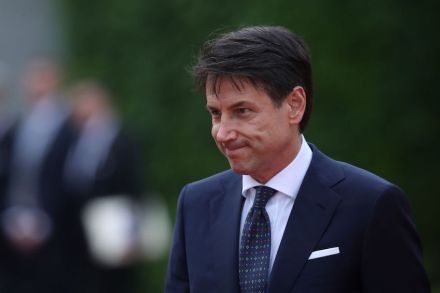
Italian politics is like a game of musical chairs. One government resigns or collapses, another takes its place, until that government is either rendered irrelevant a year later or voted out during the next election. Italy has had 68 governments in the last 74 years and 10 prime ministers in the last 20. Italians will get another prime minister sworn in relatively soon, and the new one is the same as the old. Guissspe Conte, a quiet law professor only 15 months ago, will stay on as Italy’s premier after surviving an attempt by his hardline interior minister Matteo Salvini to force an early election.

Will Italy’s warring politicians succeed in shutting Salvini out of power?

From our UK edition

What now looks like a distinct possibility in Italy after today's resignation of Italian prime minister Giuseppe Conte is a reminder of a golden rule of modern politics: the liberal left will sleep with any enemy however repulsive to stop right-wing populism. Matteo Salvini, who is by far Italy's most popular politician, perhaps forgot this rule when he pulled the plug on the coalition government of his radical-right League party and the alt-left Five Star Movement by tabling a no-confidence vote in Giuseppe Conte, which prompted his resignation. Either that or he just could not face another day in a coalition government which was unable to agree anything and which was damaging and not helping Italy. Whatever.

The secret of Il Capitano’s success

From our UK edition

Last summer, when Italy became the first major European country to get a populist government, Steve Bannon was cock-a-hoop. The former White House chief strategist had spent much of his time in Europe last year aiding and abetting populists. He called Italy ‘the centre of the political universe right now’. He was full of praise for what he described as the altruism of the alt-left Five Star movement led by Luigi Di Maio and the radical right Lega led by Matteo Salvini. The two populist parties had buried their differences for the sake of the nation, Bannon believed, as they formed a coalition government. But for all his excitement, this anti-establishment honeymoon couldn’t last.

Matteo Salvini prepares for his big gamble

From our UK edition

Italians have had ten prime ministers in the last 20 years. They may soon have another. Matteo Salvini, the interior minister, deputy prime minister, and leader of the League, is ready to pull the plug on a coalition government increasingly pitted against itself. The League and its coalition ally, the Five Star Movement or 5SM, are less ideological brothers-in-arms than sibling rivals forced to live under the same roof. Salvini and Five Star Leader Luigi Di Maio are two strong personalities who were never completely aligned to begin with – Salvini having represented Italy’s industrial north, Di Maio coming onto the national scene as the leader of a grassroots party with significant support in the agricultural south.

Low life | 18 July 2019

From our UK edition

The train standing at platform 1A had no air-conditioning and the heat was stupefying. Latecomers pressing into the carriage reacted to it as to a slap in the face. Those with nothing better to hand fanned themselves with their tickets. The lady seated opposite me mistook my theatrical languor for conviviality. ‘I’ve been in Florence for a week and I’ve never been so hot in my life,’ she said. ‘But I’ve had such a wonderful time in school here learning Italian. Such a beautiful language. You sort of roll it around in your mouth as if you are tasting something delicious, like olive oil or something. And I made such good progress! I’m sure that if I’d done another week I would be fluent almost.

Low life | 11 July 2019

From our UK edition

The hotel manager had arranged for me to borrow an Alfa Romeo Spider Duetto two-seater convertible (1982) for the afternoon. And now, after lunch, here it was, as promised, parked on the forecourt. ‘You’re familiar with left-hand drive cars I take it, Mr Clarke?’ she said, a touch apprehensively I thought. ‘I’ve had a Spider,’ I said. ‘Similar to this, but a later, fuel-injected model.’ A true statement — although I was as confounded by it as she was. She handed me the key and a map with a suggested scenic route marked in Biro. I climbed in, fired the thing up, and with a cheery wave, 10,000 exploratory revs and a pip on the horn I set off through the village.

A chance encounter with a butterfly-catching Nazi

In the winter of 1943, Eric Newby, captured in 1942 on a commando raid on Sicily, escaped from an Italian prisoner of war camp. Love and War in the Apennines, his memoir of life on the run among the peasant farmers of the Apennine Mountains, is that rarest of combinations, a military classic and a love story. Patrick French’s tribute to Newby’s memoir can be read here. In this excerpt, Newby describes an unlikely encounter in a mountain pasture. As I climbed, the trees began to thin out and at last I came to a place where there was nothing but juniper growing.

butterfly naxi apennines

Love and War in the Apennines

An escaped British prisoner-of-war is sleeping in a grassy hollow by the edge of a cliff. He wakes to find a German soldier standing over him, wearing summer battledress, a pistol at his hip. Realizing he has been caught, he says his name and adds, ‘I’m a lieutenant in the infantry, or rather I was until I was put in the bag.’In the bag – captured. It is one of the many phrases of the time that add to the resonance of Love and War in the Apennines (1971), a vivid memoir of Eric Newby’s capture, escape and recapture in Italy’s mountainous terrain during the later years of World War Two. The man standing over him will not, though, take him away.

apennines

The triumph of Matteo Salvini

Since becoming leader six years ago Matteo Salvini — Il Capitano as they call him — has transformed the radical-right Lega from small regional separatist party into the largest party in Italy. After last week’s European elections, the Lega is now also the second largest national party in the European Parliament. Its 28 seats place it level with Angela Merkel’s CDU, and just behind the 29 seats of Nigel Farage’s Brexit party. The European Parliament election results confirm Salvini as the undisputed leader of Europe’s populists. Their insurrection is determined to unseat the EU ancien régime. Its latest champion, French president Emmanuel Macron, is ever less convincing and popular in France and elsewhere in Europe.

matteo salvini

Salvini’s common touch

From our UK edition

While Britain continues to try to struggle its way out of the EU, perhaps it is wise to consider what is happening inside the bloc itself, not just in Paris where the fumes from burning cars fill the apartments and approval ratings for Emmanuel Macron continue to slide as he engages in a national listening exercise (which actually consists of him delivering Chávez-length lectures to the French public). But over the border in Italy, where the tone of the era is being set. Being both interior minister and deputy prime minister is a tremendous position for Matteo Salvini to be in.

Italians

From our UK edition

For a few years before coming to Italy, I lived in Paris and I cannot tell you the life-enhancing difference I felt as I crossed the frontier from France into Italy in my metallic burgundy Honda Prelude. On arrival at the Italian motorway toll that stifling summer of 1998, I discovered I had no money and that the sun had melted my bank card which I had left on the dashboard. The charming young woman on the toll-gate simply gave me a form to fill in and waved me through with a smile. Isn’t this how we should run the world? I remember once being stopped by two Italian police patrol cars in the dead of night when well over the limit. Instead of them breathalysing me, we started to have a discussion about the Mussolini biography I had written.

Italy shows that left-wing populism doesn’t work

From our UK edition

To judge from what is going on in Italy, the only major European country where populists are in power, right-wing populism works but left-wing populism does not. The senior partner in Italy's populist coalition government – the alt-left Five Star Movement – is haemorrhaging support, while the popularity of the junior partner – the radical-right League – soars ever higher. In regional elections in Sardinia last Sunday, Five Star got just 11 per cent of the vote compared to the 42 per cent it got on the island at Italy's general election in March 2018. The League's candidate, by contrast, at the head of a right-wing coalition, won with 47 per cent. This catastrophic result for Five Star comes two weeks after a similar rout in regional elections in Abruzzo.

Europe’s culture clash

From our UK edition

Two weeks ago Luigi Di Maio, Italy’s vice-premier and Labour Minister and the top politician of the Five Star Movement (M5S), appointed a new commissioner for the UN cultural organisation Unesco. He chose the dog--whistling, bum-slapping sex--comedy actor Lino Banfi, star of How to Seduce Your Teacher, Policewoman on the Porno Squad and other films. The M5S was launched online by the 1980s comedian Beppe Grillo. It is run on the basis of a private computer operating system called Rousseau. Most Italians look at the M5S as either a breath of fresh air, a necessary gesture of defiance, or a ridiculous episode that will pass. But you need a sense of humour for that. French President Emmanuel Macron has lately shown himself unable to take the Italian government in his stride.

What Macron’s spat with Italy is really about

From our UK edition

Who needs the Comédie-Française when there is Emmanuel Macron in the Élysée? France's recall last week of its ambassador from Italy for consultation was pure theatre on the part of the president. And it was a decision more for the benefit of his domestic audience than for the coalition government in Rome. In a statement explaining why Christian Masset had been ordered home, the foreign office said that for several months France has been subjected to outrageous statements that have created a 'serious situation which is raising questions about the Italian government’s intentions towards France.' France blamed the recall on Luigi Di Maio, the Italian deputy prime minster, who flew to Paris last week to meet members of the Yellow Vest protest movement.

How Italy’s populists stepped up their war with Macron

From our UK edition

The war of words between the governments of Italy and France escalated last week, after Italy’s deputy Prime Ministers, Luigi Di Maio and Matteo Salvini, gave their support for the gilets jaunes movement against French President Emmanuel Macron. The two sides have repeatedly come to blows over all manner of issues, from immigration to economics, via a whirlwind of thinly veiled insults. But the latest move marks a changing dynamic between the two sides; a once confident and resplendent President Macron now finds himself on the back foot, whilst the Italian leadership, emboldened, have begun to assert themselves across Europe, even to the point of inserting themselves into the affairs of other countries.

Matteo Salvini is doing Brussels a favour with his harsh migration policy

From our UK edition

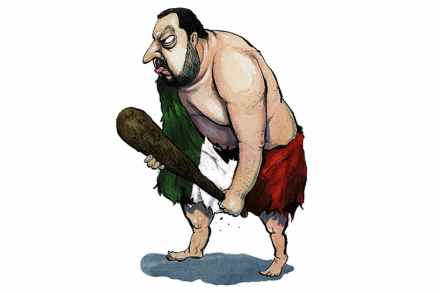
Matteo Salvini, Italy’s deputy prime minister and interior minister, is one of the most controversial politicians in Europe. The 45-year old chief of the League party exudes a down-to-earth demeanour with his common-man social media posts, in which he shares pictures of himself eating Barilla pasta and Nutella. To his many opponents, Salvini is a thick-headed, semi-fascist ideologue who wants to turn back the clock and return Europe to a dangerous form of nationalism. But to his supporters, in and out of Italy, he is a straight-talking, no-nonsense defender of his country's sovereignty against the northern elites in Berlin and Brussels.