Iran

Trump’s foreign policy isn’t working

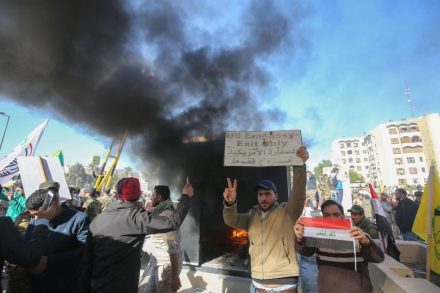
An end to endless wars? Get real. America’s foreign policy since the end of the Cold War is a never-ceasing tragedy. One front improves, another worsens. On Sunday, it emerged that the Taliban council had agreed a ceasefire in Afghanistan, a development that could at last end America’s longest war, its 18-year military engagement in the graveyard of empires. Maybe President Donald Trump really could make good on his promise to end America’s hopeless and destructive foreign entanglements. At the same time, however, Iraq has fallen into greater chaos again — because America can’t stop meddling. George W. Bush’s other great disaster continues. The failure cycle whirs.

baghdad iraq foreign policy

The alliance between America and Saudi Arabia is over

From our UK edition

The oil-for-security alliance between the US and Saudi Arabia, forged in 1945 when Franklin D. Roosevelt met King Abdul Aziz aboard a US Navy destroyer, is now over. Just look at the American reaction to the attack by Iran on Saudi oil facilities. Secretary of State Mike Pompeo duly called it an ‘act of war’; the Wall Street Journal told us the attack was ‘the big one’. But then nothing: President Donald Trump merely shrugged and declared the US energy independent. ‘We don’t need Middle Eastern Oil & Gas,’ he said. Industry experts warned that such an assessment was premature; but oil prices stabilised and the sound of war drums faded. We are witnessing the beginning of a new geopolitics in the Middle East.

The negotiator or Bolton Lite? Reading Robert C. O’Brien

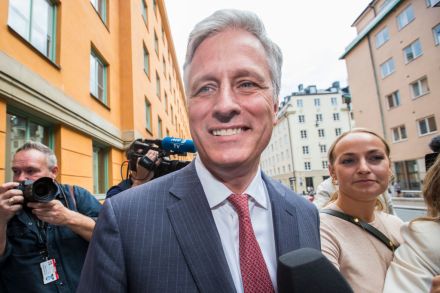
President Trump proudly unveiled a new national security adviser on Wednesday who looks the part: Robert C. O’Brien, the State Department’s special presidential envoy for hostage affairs. A tanned Californian, with a successful law career based in Los Angeles, O’Brien has spent time in mid-level State Department roles when not making his living in international arbitration. He is a comparatively unknown figure and so the question hangs in the air: is Trump’s new NSA a sober diplomat, 'Bolton Lite', or something else? O’Brien was not an immediate public contender for the job. But DC insider speculation proved fruitless. Purported favorites like belligerent ambassador Ric Grenell, realist Ret. Col.

Robert C. O’Brien

Robert C. O’Brien, Trump’s good soldier

With the appointment of Robert C. O’Brien to serve as national security adviser, Donald Trump will once more disappoint his America First backers. They were hoping that Ret. Col. Douglas Macgregor would get the nod. Instead, Trump has gone with a Republican establishment figure who views China as the biggest threat to American national security. As always, Trump was bullish on his new hire: 'I have worked long & hard with Robert. He will do a great job!' As Trump national security adviser number 4, O’Brien is expected to bring some calm to the roiling waters of the NSC, where its heads have repeatedly capsized, whether it's Michael Flynn, H.R. McMaster, or John Bolton.

robert c. o’brien

Emmanuel Macron could be the big loser from the Saudi drone attack

From our UK edition

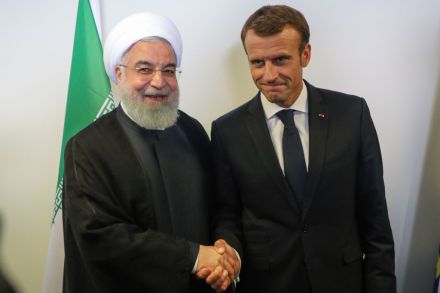
Saudis woke up last Saturday to find the crown jewel of their oil industry in smoke. The attack on the al-Abqaiq oil processing facility, allegedly conducted by cruise missiles and launched from a staging area inside Iran, resulted in the sharpest single-day increase in crude prices since the 1991 Gulf War. Saudi Arabia’s largest oil installation, however, wasn’t the only thing that went up in smoke last weekend. The volley of missiles screeching into Saudi airspace may have also ruined French president Emmanuel Macron’s attempt to deescalate tensions in the Persian Gulf and save the 2015 Iran nuclear deal from a slow and agonising death.

Letters: There is more to village life than shutters, benches and paint

From our UK edition

Shambles at sea Sir: On 19 July Iranian Republican Guard forces captured the UK flagged tanker Stena Impero, as described by former defence secretary Penny Mordaunt in her Spectator Diary (3 August). It was a national humiliation and it needn’t have happened. As was made clear at the House of Commons Defence Committee hearing on 9 September, warnings were being given about possible Iranian actions as early as mid-June. The UK naval presence in the area comprised only one frigate, HMS Montrose, and more ships were needed to protect UK shipping. The HCDC was surprised to discover from Mordaunt that she had been trying to stimulate a response, but had her requests for a Cobra meeting refused on at least five occasions.

What Britain can learn from Iran about sovereignty

From our UK edition

‘Great Minds discuss ideas; average minds discuss events; small minds discuss people.’ (Eleanor Roosevelt) The essay which follows is about ideas, not people, for people – now more than ever – no matter what office they may hold, have far less agency than they imagine. It is ideas that change the world. Accordingly, the discussion below is not meant to constitute advice to any particular individual and should not be construed as such. The fact that a crisis in our diplomatic relations with Iran should have synchronised with a school chum’s appointment as Prime Minister is happenstance.

America’s cyberspace challenge

America is at war in cyberspace and is losing badly. The US has some of the world’s most advanced cyber weapons, but no political will or a coherent national strategy. As a result, America’s enemies see a fatal weakness, and are exploiting it every day. In July, the Senate Intelligence Committee reported that Russia hacked into the electoral systems of all 50 US states. The committee did not find that the Russians directly interfered with the voting, but is clear that they have developed that capability. 'While the Committee does not know with confidence what Moscow’s intentions were, Russia may have been probing vulnerabilities in voting systems to exploit later,’ the report said.

cyberspace

Persia’s lessons for the PM

From our UK edition

Stanley Johnson suggests his son, the PM, will easily deal with Iran because he is well acquainted with Persian history and knows all about kings such as Darius and Xerxes. But talking ancient history with Ayatollahs could have its problems. Here, for example, is what Herodotus (d. c. 425 bc) had to say about Darius. Distantly related to the royal family, he served loyally under King Cambyses, at whose death in 522 bc a usurper took power. Darius plotted with six others to dethrone him, suggesting they should lie their way into the palace and kill him: ‘Where a lie must be told, tell it. Those who lie and those who tell the truth all have a similar objective, to gain advantage: same end, different means.

Diary – 1 August 2019

From our UK edition

I begin the week in Bamako, Mali, with a crackly telephone call to Commodore Dean Bassett, UK Maritime Component Commander in the Gulf. He informs me that HMS Montrose and the Maritime Trade Operation has seen 30 ships safely through the Strait of Hormuz. These ships had been given 24 hours’ notice for their transit. Another, Stena Impero, had not made it through. Montrose was given only 60 minutes notice for her transit. Despite increasing to flank speed, she was 20 minutes too late and steamed into the Iranian Revolutionary Guard. The anger and disappointment is evident in the Commodore’s voice as he professionally delivers his report. I thank him and his team for their efforts.

Portrait of the week | 25 July 2019

From our UK edition

Home Boris Johnson became Prime Minister after being elected the leader of the Conservative party by its members, with 92,153 votes to Jeremy Hunt’s 46,656 and a turnout of 87.4 per cent. Philip Hammond got his resignation as chancellor of the exchequer in before he could be sacked, as did David Gauke as justice secretary and Sir Alan Duncan as a Foreign Office minister. Plots were afoot to undermine Mr Johnson’s promise to leave the European Union by 31 October, with or without an agreement. David Frost, a former chief executive of the Scotch Whisky Association, was appointed to the job of liaising with the EU over Brexit, relinquished by the civil servant Oliver Robbins.

Diplomacy by deference

From our UK edition

Iran’s seizure of a British-owned oil tanker transiting the Persian Gulf has let loose a fresh round of media war chatter. Yet should another Persian Gulf War actually occur, who would benefit? Not America, that’s for sure. The central theme of present-day US policy regarding Iran is deference. Nominally, US policy is made in Washington. Substantively, it is framed in Riyadh and Jerusalem, with the interests of the United States figuring only minimally in determining the result. I am not suggesting that President Donald Trump supinely complies with secret marching orders from Saudi Crown Prince Mohammad bin Salman and Israeli Prime Minister Benjamin Netanyahu.

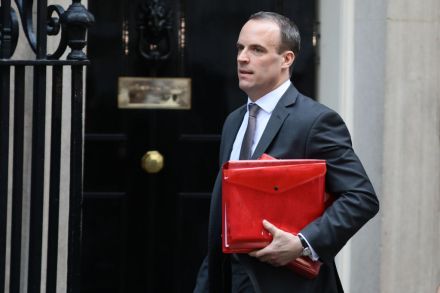
Dominic Raab has to handle a stand-off with Iran and his own civil servants

From our UK edition

It's not an easy time to become Foreign Secretary, as Dominic Raab is about to find out. There is, of course, the crisis in relations with Iran, which threatens to escalate further in the coming days. Raab is taking over shortly after Jeremy Hunt announced a European-led mission to protect shipping in the Gulf, which may not necessarily accord with Boris Johnson's own foreign policy instincts. One of the reasons that the Iranian Revolutionary Guard was able to seize the British-flagged tanker was that Britain had turned down the US's suggestion of co-operation to protect boats, for fear of appearing too cosy with Donald Trump. Johnson has no such qualms about working with the US President, something Freddy highlighted in his recent Spectator cover piece.

Alan Duncan’s resignation just adds to the chaos in the Foreign Office

From our UK edition

Sir Alan Duncan's resignation will only leave a hole in the Foreign Office for a couple of days before the new prime minister replaces him. But he's not the only missing minister in that department: Mark Field is suspended while the incident at Mansion House is investigated. Duncan had been covering some of Field's responsibilities over the past few weeks, and now he is off too, just as the crisis in relations with Iran deepens. Jeremy Hunt, meanwhile, has been busy conducting a leadership campaign, all of which gives the Foreign Office, normally the most composed and regal part of Whitehall, a slightly chaotic, neglected feel.

On Iran and oil tankers

From our UK edition

I’m glad the Foreign Secretary thinks it ‘unacceptable’ of Iran to have seized a British-flagged oil tanker in the Straits of Hormuz. But wouldn’t it have been a decent idea to give any British-flagged ships sailing through that tiny strait a naval escort? The risk was always there, ever since we seized an Iranian tanker at Gibraltar. Was the possibility of escorting tankers considered by the government?

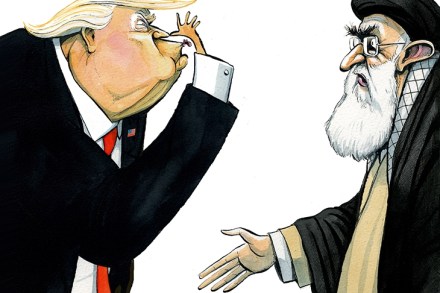
Can Trump break the cycle of mistrust with Iran?

Might Donald Trump going to visit Tehran and crack a deal with Iran? It might seem improbable. But then again, there isn’t much with Trump that doesn’t. This is the fellow who ended up at the border with North Korea, playing kissy-face with Kim Jong-un after having breathed voluminous amounts of fire and fury. When I raised this question of a fresh Trump volte-face yesterday in New York at the ambassador’s palatial residence on Fifth Avenue with Iran’s foreign minister Javad Zarif in an interview for the National Interest, he thus didn’t bat an eye. 'There are prudent ways out,' of his current situation, he indicated. Indeed there are. Iran is floating the idea of beefed-up inspections in return for a permanent lifting of sanctions.

iran

Ignoring Iran

From our UK edition

Crises in the Gulf and Conservative leadership elections come around with unnerving regularity. It is not unknown for both to coincide — that happened in 1990, when Margaret Thatcher was overthrown in the lead-up to the first Gulf War. On that occasion, drama on the domestic front did not smother Britain’s response to the international crisis — unlike now. It is bizarre to have a US president threatening to ‘obliterate’ Iran while our Foreign Secretary hardly bothers to respond, preferring to pose with fish and chips and Irn Bru on the campaign trail.

Pompeo summons up fresh Iran sanctions from the Gulf

'First, I think it’s really important to understand that the Iranians are sowing disinformation,' Mike Pompeo told reporters Sunday en route to the Kingdom of Saudi Arabia and the United Arab Emirates  ('two great allies in the challenge that Iran presents.')'You’ll see too,' the secretary of state continued, 'that our campaign that began when President Trump took office will continue. On Monday, there’ll be a significant set of new sanctions.' Sure enough, this afternoon Trump announced intensified sanctions on Iran’s Supreme Leader.With that, the secretary was off, jetting from Joint Base Andrews to Riyadh and Abu Dhabi.

iran sanctions
donald trump iran

Trump is trapped in an Iran cul-de-sac

Donald Trump says he’s open to talks with Iran. He says that his policy of avoiding war is 'common sense.' And he says that he is upping sanctions on the regime today (which Russia is condemning as 'illegal').Iran’s response? Rear Adm. Hossein Khanzadi announced on Monday that Tehran can mete out a 'crushing response … and the enemy knows it.'Here are the fruits of Trump’s Iran policy. Far from undermining the regime, Trump has strengthened and emboldened it. Tehran is on a roll. It has shot down an American drone and interfered with shipping the Persian Gulf with no real consequences.

bad wars

After 30 years of bad wars, who thinks one with Iran will be good?

Don’t believe the hawks who tell you they don’t want a war with Iran. Instead, ask them if they’d go to war to stop Iran from getting nuclear weapons, or if they’d prefer war to peace if peace meant the mullahs’ regime could cling to power. War is a means to an end, and the hawks believe the ends of regime change and nuclear nonproliferation justify war, if it comes to that. Peace too is only a means to an end, and war is what happens when the means of peace are deemed insufficient.President Trump has a cooler head than most of his critics when it comes to nuclear weapons, as he’s proved so far with his North Korea policy. And North Korea actually has the bomb, which Iran is some distance from possessing.