Iran

Is President Rouhani’s Iran serious?

Is Iran serious? That is the question everybody has been asking for the last 24 hours since the new Iranian President went to the UN in New York and gave an interview to CNN. A colossal outbreak of wilful optimism has followed from policy makers, ex-policy makers and media. This has been based largely on the fact that an Iranian President may have just acknowledged that the Holocaust of European Jewry occurred. Well huzzah. For what it’s worth, President Rouhani didn’t quite say that. In the CNN interview he said that it was the job of historians to look at such things. And to the extent that he acknowledged that a

Extremists and the mainstream: the case of Comrade Newman

The Chippenham Labour Party has decided that its candidate to contest the 2015 general election will be one Andy Newman. As the anti-totalitarian blogs Howie’s Corner and Harry’s Place have already argued he is almost certain to be the worst politician to stand for a mainstream party. An innocent observer, who believes the British Left’s protestations that it is for workers’ rights and against sexism, racism and homophobia, could go further wonder how such a man could get close to the Labour Party – let alone close enough to run on a Labour ticket. Newman manages the laughably named “Socialist Unity” website: laughable, not just because it engages in vicious

George Galloway blames Israel for the use of chemical weapons in Syria

Say this for George Galloway: every time you think he cannot sink any lower he finds new ways to surprise you. His latest contribution to Press TV, Iran’s propaganda station, speaks for itself. Parody is pointless. Given his history and his paymasters, we would expect him to defend the Assad regime in Syria. Even so, under-estimating his ability to sniff out the true villains is never sensible. Here’s his “analysis” of the use of chemical weapons in Syria: “If there’s been any use of nerve gas it’s the rebels that used it. […] If there has been a use of chemical weapons it was al-Qaeda who used chemical weapons. Who

As an Anglican ex-bishop, I can tell you: Iran's new president could be our best hope for peace

The installation of Hassan Rouhani as President of Iran next month heralds a new chapter for the country. It is clear that he was elected not only because it was felt — both at the highest levels and by the people — that he was best placed to negotiate with the West on Iran’s nuclear programme but also because he was the candidate most likely to appeal to reform-hungry Iranians. Rouhani is a protégé of the former president Muhammed Khatami, with whom I have had the chance to work. When he was President, I spent a whole day with him meeting political, civil society and religious leaders. Visiting him in

The EU fails to ban Hezbollah

As though the sunny weather and the royal baby were not enough, here comes yet more good news. The European Union has finally banned the military wing of Hezbollah. This is something I have argued for often, including here, here, and here. After recent trials of Hezbollah operatives and Hezbollah operations – including the Bulgaria bombing – on European soil the decision did seem inevitable. Yet there is a cloud on the silver lining – which is that the EU, in somewhat characteristic fashion, has only managed to do a partly good thing. While they have banned the ‘military wing’ of Hezbollah they continue to allow the ‘political’ wing to fundraise and

China: the Middle East’s new power broker

It’s exactly ten years since Iranian dissidents first blew the cover of a secret uranium-enrichment facility under a mountain at Natanz, in a bleak stretch of desert near Isfahan. Ever since, relations between Israel and Iran have headed inexorably towards war. Israeli leaders have insisted that they are ready to launch a military strike — unilaterally if necessary — against Iran if the uranium enrichment continues. Iranian leaders, liberals and hardliners alike, have been equally adamant that the centrifuges will continue to spin. For Israeli hawks like prime minister Benjamin Netanyahu, the question has been not whether to strike Iran, but when. But in the past few weeks, the diplomatic

Just Give War A Chance: Obama's Realpolitik Approach to the Syrian Civil War.

Boris Johnson makes a strong case in today’s Telegraph that even if the west wanted to intervene in the Syrian civil war the point at which is was plausible to do so has long since passed. The benefits of intervention no longer outweigh the risks. Meanwhile, Paul Goodman reiterates that there’s no obvious British national interest in intervening. It is difficult to disagree with either analysis. Across the Atlantic, meanwhile, Andrew Sullivan is appalled by the Obama administration’s decision to offer a modest quantity of modest weaponry to the Syrian opposition. This isn’t just unwise; it’s close to insane, he suggests. Don’t be fooled into thinking this will shorten the conflict or save lives,

Review: Stir yourself — I am Nasrine is far from an Earnestly Grim Wrist Slitter

I Am Nasrine is one of those small, low-budget films showing somewhere awkward on a day and time that probably aren’t ideal but you can’t expect everything in life to be handed to you on a plate, and it’s worth the effort, if you can stir yourself sufficiently. (Can you? Most people I asked said you couldn’t, but I believe in you, as I always have.) Its writer-director, Tina Gharavi, who is Iranian-born but is now a lecturer in Digital Media at Newcastle University, was nominated for a Bafta for most outstanding debut, and although it is one of those films about the immigration experience, and a young woman who

Norman Lamont’s diary: Green shoots, George Osborne and Mark Carney

I was surprised to be told, by the editor of this magazine, that next week will mark the 20th anniversary of my standing down as Chancellor. The anniversary had entirely passed me by. I was asked this week why, if the economy was turning, George Osborne didn’t announce that he had spotted ‘green shoots’, as I observed in 1991. Although my remark, much rubbished at the time, turned out to be surprisingly prescient, I think Osborne is right to be cautious. Economic statistics are revised so often, trying to steer the economy as Chancellor is, as Harold Macmillan observed, like trying to catch a train using last year’s timetable. The

In response to Peter Oborne on nuclear Iran

I am pleased that Peter Oborne concedes that his co-author David Morrison was ‘foolish’ and ‘clumsy’ in his statements. Perhaps Morrison was indeed attempting ‘to be as accurate as he could about what he understood to be the facts’. But that is a statement about the understanding of Mr Oborne’s co-author, not a statement about the facts. I still cannot see how anybody who accepts that President Ahmadinejad is a Holocaust denier could have said what Mr Oborne’s co-author said last week. To recap, over at the Telegraph last week David Morrison said: ‘I have never come across a statement from Ahmadinejad saying that the Holocaust didn’t happen. He’s said

If there was ever a time to intervene in Syria, it has passed

It is more than ten years since I first sat down with members of the Syrian opposition. Back then they included real moderates, but even these didn’t predict a bloodless transition. ‘We will have to unite the country against the Alawites,’ I remember one saying, referring to the minority from which the Assad dynasty comes. ‘Kill them?’ I asked nervously. ‘Or chase them into the mountains,’ he replied. Now, more than two years into the Syrian civil war, there may still be some Alawites but, as Paul Wood points out opposite, there are hardly any moderates. What good opposition elements there were have been killed, have fallen away or otherwise

Peter Oborne should stop apologising for Mahmoud Ahmadinejad

There was an extraordinary meeting of the Juche Ideas Study Group (England) in London last week, held to commemorate the 81st anniversary of the foundation of the Korean People’s Army. For various domestic reasons I was unable to be present, but I think it went off quite well. Sandwiches, tea and coffee were served after the various speeches. Juche is the political ideology of North Korea, emphasising a steely self-reliance in the face of Yankee and Jap imperialist aggression. The meeting was taken by a chap called Dermot Hudson, who may or may not have recited the poem he wrote a while back about Kim Il Sung, the founder of

Memo to Iran’s apologists: President Ahmadinejad has denied the Holocaust

Has President Ahmadinejad ever denied the Holocaust? David Morrison, co-author with Peter Oborne of a new apologia on the Iranian ‘government’, appears to think that he has not. In a bizarre and disgraceful interview with the Telegraph, alongside his co-author, Morrison recites the main claim of their book – which is that the Iranian regime is not pursuing nuclear weapons. Oborne’s Telegraph colleague Con Coughlin too kindly skewers that claim as ‘delusional’. But even more alarming than that conspiracy theory of theirs is Morrison’s claim (uncorrected by Oborne, the Telegraph’s chief political commentator) that he has ‘never come across a statement from President Ahmadinejad saying that the Holocaust didn’t happen’.

At last. Some right thinking on Iran

At last some leadership on Iran. And from the Conservative benches. After last week’s appalling Jack Straw piece in the Telegraph, the Conservative MP James Morris has a brilliant and blistering response in the same paper. ‘It is vital that we continue to pressure the Iranian regime through tough and sustained sanctions – and leave the possibility of a military option firmly on the table. The Iranian regime must be under no illusions about our determination and resolve in preventing them from achieving their objective of developing a nuclear weapons capability. Those of us who understand the grave danger a nuclear Iran would pose – and there are many –

Little Britain

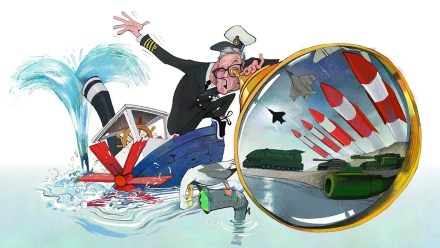
The foreign news pages read increasingly like some terrible satire on western military decline. Two years ago French and British forces, with the help of the US Navy, managed to help Libyan rebels topple Colonel Gaddafi. This year, the French needed British support to go to war against some tribesmen in Mali. It was a successful operation, but the ‘Timbuktu Freed’ headline rather summed up the extent of European military power today. The French have only two drone aircraft (the Americans have hundreds) and had to drop concrete bombs on Tripoli when they ran low on real ones. As the foreign policy rhetoric of our media and political leadership grows,

Jack Straw's parting gift

Jack Straw cropped up in the Telegraph yesterday claiming that even if Iran does acquire nuclear weapons it wouldn’t be worth going to war over. This, it will be remembered, is the same man who as Foreign Secretary argued for full-scale military intervention in Iraq to disarm that country of Weapons of Mass Destruction which it turned out not to have. Happily, putting Straw’s advice to the test, this morning’s Telegraph contains information about Iran’s ‘Plan B’ effort to gain nuclear weaponry right under the nose of the international inspections professionals. So it looks like Jack Straw’s best advice may yet work out. And what a legacy that would leave.

What Iran wants in Syria

The Washington Post has an important story about how the Iranian regime is preparing for post-Assad Syria. The paper reports that American and Middle Eastern governments believe that Tehran is backing a 50,000 strong militia in the hope of keeping Assad in power and, if that’s not possible, defending its interests in the aftermath of his downfall. Iran’s ultimate aim, the paper suggests, is the establishment of a client state on the coast. This would enable it to continue funneling weapons to Hezbollah in Lebanon allowing it to maintain its influence in Lebanese politics and to carry on supporting terrorist attacks against Israel. If the Assad regime does fall, it

Breakfast with the Supreme Leader

I have a piece in the Wall Street Journal (Europe) this morning: ‘Take Iran At Its Word’ can be found online here. The piece asks what is required to stop the Mullahs getting nuclear weaponry. And it relates a strange breakfast experience with the Supreme Leader, Ayatollah Khameini.

Simin Daneshvar, Persia’s first female novelist and hope for Iran's future

There is a Persian proverb which states that ‘books are a man’s best friend.’ Persian literature from the kings of antiquity to the last Shah of the Peacock Throne has, for the most part, been dominated by its proverbial male companion. When presented with today’s Islamic Republic, an unfamiliar Western reader can easily believe that a female literary voice cannot possibly exist underneath the seemingly anonymising chador, the Islamic female dress most closely associated with Iran. Instead, all that would appear to emanate from Iran is a male voice: Ahmadinejad defending arms programs; the Mullahs dictating morality; Khomeini, father of the nation, ever-present from beyond the grave, still influencing the

Operation Pillar of Defence leads Israel to strategic failure

Last night’s ceasefire is a strategic failure for Israel. While the end of military action must be welcomed, it is hard to see what Netanyahu has achieved beyond the killing of Ahmed Jabari. Despite a week of tit-for-tat missile fire, Israel secured none of its strategic objectives. In fact, in many cases it actually strengthened Hamas and diminished Israel’s security. Here’s some of the ways in which Israel has been weakened by Operation Pillar of Defence: 1) Hamas was able to break the psychological barrier of attacking Tel Aviv. No one has fired missiles at the city since 1991 when Saddam Hussein tried to undermine coalition forces in Operation Desert Storm.