Greece

The Greeks haven’t exactly got negotiations off to a good start

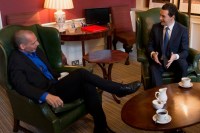
Eurozone leaders are holding a summit later today to discuss the Greeks' proposal for dealing with their debt that was to be put before the Eurogroup this afternoon. But that summit might be a tad short. The Greeks haven’t turned up with any new ideas. They have instead made an oral presentation, and may table a paper tomorrow. If this is true, then it hardly gets the new negotiations off to a good start. It had looked yesterday as though Syriza was keen to give it another shot by removing Yanis Varoufakis as finance minister at the behest of the Eurogroup, but on his first full day in the job, Euclid Tsakalotos looked isolated.

Merkel strikes an uncompromising tone as the ECB tightens the squeeze on the Greek banks

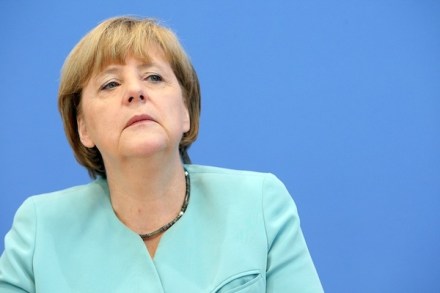
François Hollande and Angela Merkel have both given brief statements to the media ahead of their dinner this evening. Hollande was keen to stress that the door remained open to Greece for negotiations and struck a generally more emollient tone. Merkel, though, did not sound so emollient. She claimed that the deal that the Greeks rejected was ‘quite a generous one’. Meanwhile, the European Central Bank—the key actors in this drama—have kept the emergency lending assistance they are offering the Greek banks at the same level. This means that the Greek banks will not be able to re-open. The ECB has also said that it will ‘adjust the haircuts on collateral accepted by the Bank of Greece for ELA.

Cheer up! The Greek crisis shows you were right all along

I don't know whether the joy on the right was worse than the preening on the left last night but as the result of the Greek referendum swept across social media I found myself thinking that any result so cheerfully welcomed by Marine Le Pen, Nigel Farage, Jeremy Corbyn and Sinn Fein can't be thought altogether cheerful. Of course you needn't judge a cause by its followers but when a cause is followed and endorsed by such a collection of rogues, crooks and cranks it's wise to begin to wonder about it. All this glee seemed especially shabby since, really, it didn't really seem to be about Greece at all.

Greece has chosen to inflict heavy economic damage on itself

The Greek referendum will change nothing. Greek voters already expressed their great dissatisfaction with the bailout packages when they elected Syriza to power in January. The proposition they were asked to vote about now does not exist – and the referendum was just a sham. The bailout agreement that Greece and its creditors battled over for the past half-year is a dead parrot; it has ceased to exist.And yet the referendum result may change everything.It has made it close to impossible for euro governments to aid Greece with more money.

Greek finance minister Yanis Varoufakis resigns

If Greece had voted ‘Yes’ to the austerity package proposed by its creditors, then there would have been a round of resignations at the top of Syriza. But this morning, even though the party is celebrating a ‘No’ vote, its finance minister Yanis Varoufakis has resigned. Writing on his blog, he explains that in order for the country to get a good deal that it can accept, he needs to let someone else take over: ‘Soon after the announcement of the referendum results, I was made aware of a certain preference by some Eurogroup participants, and assorted ‘partners’, for my… ‘absence’ from its meetings; an idea that the Prime Minister judged to be potentially helpful to him in reaching an agreement.

Greece says No, will Germany now try and kick it out of the Euro?

Greece has voted No in the referendum and resoundingly so. With more than 90 percent of the votes counted, No is leading 61% to 39%. The result is a massive humiliation for Eurozone leaders who have spent the last few days telling the Greeks to vote Yes and warning them that this was really a referendum on whether the country should stay in the single currency or not. Tonight, Syriza have been making clear that the Greek government intends to remain within the Euro. However, the German government is making clear that it is not interested in further negotiations with Athens or a new bailout deal.

Alexis Tsipras asked if people were happy. The answer was always going to be ‘no’

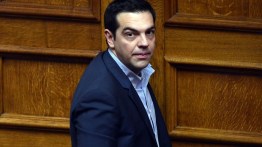
Greek Prime Minister Alexis Tsipras has just done something unthinkable. He has won the Greek referendum. And make no mistake, it was him that won it. It was his decision to call a referendum just over a week ago and send the EU into a panic. The last Prime Minister to try that was George Papandreou in 2011 before he was forced to backtrack rapidly. He resigned shortly after. But winning the referendum isn’t what is so astounding – opinion polls were neck and neck throughout last week and once voting closed at 7pm Greek time it became almost immediately apparent that the No side would win.

German rhetoric suggests that they are preparing to try and kick Greece out of the Euro

Greece has voted No, and resoundingly so. But the reaction from Berlin tonight does not suggest that Germany is prepared to have any further negotiations with the Syriza government. The vice chancellor, and head of the SPD, Sigmar Gabriel has declared that "With the rejection of the eurozone's rules of the game, which has been expressed in this majority 'no' vote, negotiations on further multibillion euro programs are scarcely conceivable." Given that the SDP is more doveish than the CDU and the CSU on the Greek question, this sounds like Germany has given up on trying to strike a deal and now wants Greece to leave the Euro. Indeed, one influential CSU politician has already publicly suggested that Greece might be better off outside the Euro.

Greek voters say Oxi, what will the Eurozone do now?

With half the votes counted, the No side in the Greek referendum is leading by 61% to 39%. With this lead for No at this stage in the count, it seems certain that it has won. The question now is how the Eurozone will react to this result. Before the vote, the Eurozone powers made clear that they wanted Greece to vote Yes. The Germans, French and Italians all repeatedly warned the Greeks that this was effectively a vote on whether to stay in the Euro or Not. Jean-Claude Juncker even hinted that this was a referendum on whether Greece should stay in the EU or not. So, what will they do now that the Greek electorate has so spectacularly rejected their advice? Well, the person everyone will be watching now is Mario Draghi, the president of the European Central Bank.

Globalists v localists: the new reality of 21st century politics

Tonight it looks like the Oxi's have it, and Greece's fraught relationship with the Franks has reached a new phase, with possible Grexit coming; that's assuming the exit polls are correct and that this whole torturous episode doesn't continue. Whether Grexit takes place or not, though, the whole episode has fundamentally damaged the European Union by undermining the very idea it was built on - solidarity. If you ever get Irish people on the subject of the Great Famine, the essential point they always make is that had the potato blight hit Yorkshire, no one would have starved because London would have come to its aid. Yorkshire is the example used, because it's far away enough  from London but the people are regarded as being the same. The people of Ireland were not, clearly.

Polls suggest narrow ‘No’ vote in Greek referendum

If the final result in the Greek referendum is as close as the polls (not exit polls, so treat with caution) below suggest, then as well as the trauma and drama of Grexit, the country will have to cope with deep divisions. The same would be the case if there is a narrow win for ‘Yes’. In either case, that just over half of the country voted one way, and just a few fewer people went the other way naturally means there will be a lot of voters who are bitterly disappointed. Whatever the result, the future for Greece is going to be difficult and many people will suffer a great deal. For those suffering who voted for the losing side, it will be easy to blame their opponents for causing their misery, and for a narrative about betrayal to spring up.

‘No’ side confident as polls close in Greek referendum

The polls have just closed in the Greek referendum, and the ‘No’ side seems, currently, to be rather more confident of a victory. The Guardian reports a briefing from the EU Commission that those in favour of rejecting the anti-austerity deal from Greece’s creditors could be 8-10 points ahead, while others claim ‘No’ had a late surge. Syriza members have also been talking about what would happen in the event of a ‘No’ vote, with Yanis Varoufakis saying Greece could do a deal with its lenders in 24 hours. If the country has voted 'No', then Grexit is expected, unless the country stays suspended in negotiations for longer.

Which way will Greece vote?

This time tomorrow, we’ll have had the first projections from the Greek referendum. We will have an idea as to whether the country has said Oxi or Nai. At the moment, the polls make the referendum too close to call. Whatever the result, there’ll be no quick deal between Greece and its creditors. But if the Greeks vote Oxi, then the country could be forced out of the Euro by the ECB cutting off assistance to its banks. If that were to happen, then the Eurozone would have to move to integrate very quickly to prevent Portugal, Italy, Spain and even France being pushed towards the Euro exit the next time there’s a fiscal crisis. This would almost certainly require a new EU treaty, which would provide Cameron with quite an opportunity.

Does the EU want the Greeks to vote for Golden Dawn?

If Greece does vote Yes, and Mr Tsipras has to go, who is left to run the country? The voters have tried all the main parties, only to find them broken by the demands of the eurozone. The only category left is the extreme right, so there would be a sort of desperate logic in electing the repulsive Golden Dawn party. Otherwise, there really doesn’t seem any point in having any more votes at all. Greek citizens — or rather subjects — might as well invite the satraps of the troika formally to take up the reins of power, sit back, and see how they manage. If they do not like what happens next, they can reserve the right to riot. It will be like being under the Ottomans all over again. This is an extract from Charles Moore's Notes. You can read the full article here.

Is Cameron ready for his European opportunity?

Could Greek voters back austerity measures to keep their country in the eurozone this weekend? Today’s papers cover a poll by GPO which put ‘Yes’ on 47.1 per cent and No on 43.2 per cent. This result would see resignations at the top of Syriza, but effectively no Grexit.

Solon vs Jean-Claude Juncker

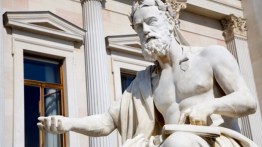
The combination of terror and outrage with which Brussels has greeted Greek Prime Minister Tsipras’s referendum tells us everything we ever needed to know about the EU, i.e. stuff the people — what have they to do with us? The farmer-hero Dikaiopolis in Aristophanes’ comedy Acharnians (425 BC) felt much as modern Greeks must do when the Athenian Assembly refused to do anything about the war against Sparta. All the executives cared about was getting the best seats, he complains: ‘For peace, they don’t give a toss. Oh Athens, Athens, what are you coming to?… I’m longing for peace. All I want is to get back to my little village — ah, my village!

Barometer | 2 July 2015

Bank job Should we buy shares in companies which print banknotes in expectation of one getting to print millions of drachma notes? — In May, according to the ECB, there were a total of 17.6bn euro notes in circulation. Given that Greece accounts for approximately 2.5% of the GDP of the eurozone, 441m of these were Greek, and might need replacing with drachma notes in the event the country leaves the euro. — However, there is already a good business in printing replacement euro notes. In May, 2.76bn notes were taken out of circulation and 2.88bn new ones were put into circulation.

High life | 2 July 2015

Tempus sure fugit, and how. Twenty years ago, on Saturday 1 July 1995, monarchs from around the world descended on London for the wedding of Greek Crown Prince Pavlos to Marie-Chantal, daughter of the duty-free magnate Bob Miller. I remember it well, especially the hangover. Never have I seen so many royals under one roof. The Greeks had treated King Constantine, father of the groom, very badly, managing to convince the press, and in turn the people, that the first man to resist the military takeover and stage a countercoup against the colonels was in fact one of them. Leave it to the Hellenes to say black is white and vice versa. I’ll come back to the Greeks a bit later, but first the royal wedding.