Government

Paranoia rather than camaraderie

Another one for the Brown as Nixon folder, courtesy of Rachel Sylvester's column today: "'It’s about style of government,' says one senior figure due to give evidence [to the Iraq Inquiry]. 'Blair would have a war Cabinet, but a small caucus would meet beforehand. The civil servants were frustrated. Gordon is just as bad. He gives lots of time to Peter Mandelson and Shriti Vadera and ignores the officials. There’s a darker side to the Brown machine — he’s more suspicious. It’s cliquiness driven by paranoia rather than camaraderie, but it has the same result.

If you want to restore Cabinet government, you have to reduce the size of the Cabinet

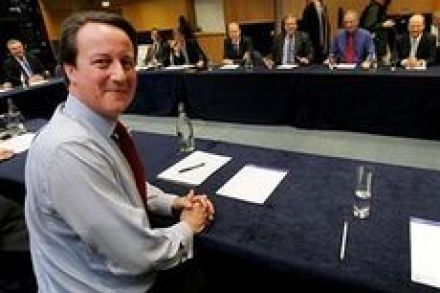
In the politics column this week, I write about how the Tories plan to hand over many of the traditional policy making powers of the Cabinet to a seven man policy board. The Cameroons are going to do this partly because it is a model that has worked well for them in oppoistion and that they are comfortable with but also because the Cabinet is just too large for effective, detailed discussions about policy. The shadow Cabinet currently has 34 members in it. In government, this number will have to drop by at least ten. But still, a 24 person group is, probably, too large to foster constructive and detailed debate. However, if the Cabinet was smaller, then it would be easier to restore it to its traditional role without sacrificing effectiveness.

Byrne draws a dividing line over decentralisation

Good work by the Guardian, who have got their hands on leaked sections of a government report into downscaling Whitehall.  At first glance, it all looks kinda promising.  There are provisions to reduce the cost of senior civil servants, to cut the numbers of quangos, and to make it more difficult to establish new quangos.  Surely, these are measures which will be necessary to fix our broken public finances. But it's the headline idea which could give you cause for concern: namely, that the government "wants a review" into relocating around 200,000 civil servants and other public sector workers away from London and the South-East.  It's meant to strengthen localism and reduce costs - which is nice, if it works.

A debased database

As with much police work, the questions surrounding a DNA database come down to one thing: striking a balance between civil protection and civil liberties.  Going off a new report by the Human Genetics Commission, reported on the cover of today's Times, the government are getting that balance seriously wrong: "Jonathan Montgomery, commission chairman, said that 'function creep' over the years had transformed a database of offenders into one of suspects. Almost one million innocent people are now on the DNA database... ...Professor Montgomery said there was some evidence that people were arrested to retain the DNA information even though they might not have been arrested in other circumstance.

A fine line between love and hatred for Peter Mandelson

So far as Downing Street is concerned, this morning's Sunday Times cover is a presentational nightmare. It reports that Peter Mandelson is calling on Brown to make him Foreign Secretary – a move which would create all kinds of internal difficulties for the PM. Sounds a little bizarre to me: we all know that Mandelson would, in theory, like the role which was once occupied by his grandfather, but would he really want it under such controversial circumstances and for what would likely be only six months? Perhaps not. But, true or no', it still feeds into the idea that the government is divided and self-obsessed. It's also the kind of story which could loosen Mandelson's grip on the government. Over the past year he's enjoyed a remarkable renaissance within the Labour Party.

David Cameron’s Immodest Belief in Government

David Cameron's response to the Queen's Speech was, of course, dictated by both convention and political nit-picking. Nonetheless, I agree with Sunder Katwala that it's rum to see a Conservative leader complaining that the government isn't proposing enough legislation. A useful reminder that whatever else they may be, Dave's Conservatives do not take an especially modest or reatrained view of government. On the contrary: if there is a problem there must be a bill and damn the consequences. So Cameron, correctly, identified Labour's approach as believing that "The answer to every problem is more big government and spending" at the same time as he demanded that the government do more, not less on a range of issues.

Nothing to see here

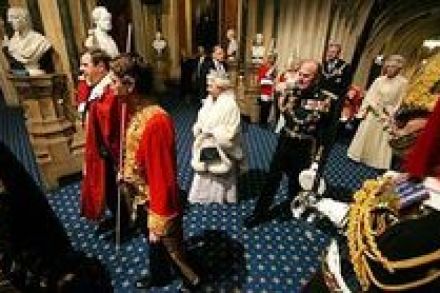
Blink and you missed it.  After seven minutes, the Queen had rattled through the Government's legislative agenda for the next few months.  It was all pretty much as expected – although it’s worth noting the “council of financial stability,” made up of the Treasury, the Bank of England and FSA, chaired by the Chancellor, and which was first mooted back in July.  The question is whether any of this will connect with the public.  I rather doubt it. We’ll put footage on Coffee House as soon as it’s available.

Balls dumps Brown into another lose-lose situation

Things never seem to go smoothly for Gordon.  On a day when the Telegraph carries details of his Whitehall savings programme, the FT has news that one of his closest allies, Ed Balls, is calling for relatively hefty spending increases elsewhere.  Apparently, Balls has asked the Treasury to grant his department – the Department for Children, Schools and Families – real-terms spending increases of 1.4 percent until 2014.  That's an extra £2.6 billion in total – and goes beyond previous Labour commitments to "protect" schools spending. It's a brassy move by Balls and one which is sure to aggravate his colleagues.

Can Clarke serve in a Cameron government?

Despite his pronounced Europhile views, a Politics Home insider poll suggests that Clarke can remain in the Shadow Cabinet and join a prospective Euro-sceptic Cameron government. As Clarke is signed up to the Cameron plan, I doubt that Europe is necessarily the problem. Concern arises from Clarke's apparent unwillingness to fulfil the duties of his brief. One think tank supremo is quoted by Pol Home saying: “No. It isn’t just Europe, it’s his non-fondness to work hard, master a brief, do the hard slog. He likes being on television, but there’s more to being a Secretary of State than that, and plenty of current non-frontbenchers who would work.” This objection relates to Clarke’s age as well, but is age necessarily a problem?

Brown’s spelling mistakes prove how badly run Downing Street is

The row over Gordon Brown’s spelling mistakes in a letter to the mother of a soldier who had been killed in Afghanistan shows how badly run Brown’s Downing Street is. It is well known in Westminster that Brown’s handwriting is poor because of his bad eyesight. There is little that can be done about that and it is rather unfair to criticise him for that. But someone in Brown’s office should be checking all his letters to the families of the fallen to check that all the names in them are spelt correctly. Because this basic fail-safe mechanism is not in place there is now a family whose grief has been compounded and a political situation that is damaging the Prime Minister; this is the kind of story that sticks in peoples’ minds.

Scorching the earth

Tim Montgomerie is right; Peter Oborne is at his best in the Mail today – a mix of relevant history and sharp analysis of current affairs. Like Callaghan and Major before him, Gordon Brown faces electoral defeat. Brown’s predicament is deep – consistently loathed by the electorate and the target of unhatched coups and constant intrigue. How does a prime minister defend a hopeless position? Does he govern in the best interests of the country, his party, or himself? Oborne remarks about the magnanimity of Callaghan and Major and notes that Brown has not followed their example. ‘The truth is that Gordon Brown is now governing Britain purely for partisan or even personal advantage rather than in the national interest.

Nanny knows best

Does Professor David Nutt's dismissal concern the impossibility of relaxing drugs legislation, or the relationship between experts and ministers? David Nutt was sacked because he spoke the unspeakable and criticised the government for failing to acknowledge the self-evident scientific truth that horse-riding, especially after quaffing sherry, is more dangerous than taking ecstasy and dancing maniacally in a night club. As Bruce Anderson notes in today’s Independent, it is impossible to have a rational debate about drugs. The politics of narcotics always trumps evidence.

Efficiency savings are no match for budget cuts

Jack Straw has abandoned what he described as “simply unacceptable” efficiency saving recommendations. This is self-evidently the correct action, as the proposals would have endangered the processes of our democracy for a negligible saving. Everyone, even the Prime Minister, though grudgingly on his part, recognises the need for cuts. Efficiency savings are part of this process - £5bn a year is wasted by the NHS on middle management alone. However, there is a danger that Civil Servants will make counter-productive and paltry efficiency savings in an attempt to ward off substantial budget cuts.

The Tories prime their shake-up of the civil service

One of the quickest wins that the next government could achieve is to change the power and accountability arrangements of Whitehall.  At the moment, there's a convoluted system in place where its difficult to apportion blame when a government department screws up.  Sure, a minister may take the media flak if, say, a department loses a data disk.  But the people in charge of the day-to-day running of a department tend to escape any substantive judgement on their performance.  As James Kirkup points out in the Telegraph today, "no permanent secretary has been formally dismissed for more than 70 years."  That's hardly a set-up to incite much more than complacency and atrophy.

An untrumpeted change

John Rentoul rightly flags up the story in this morning’s FT that about 100,000 NHS patients have gone private and had the state pick up the tab, the private hospitals have had to agree to do the work at the NHS price. For those of us who would like to see the NHS move towards a model where the state pays for healthcare but it is provided by a whole panoply of providers, this is an encouraging step. This kind of consumer-focused reform is hard to reverse. The story, as John notes, hasn’t got as much coverage as it should. John blames this on the press’s lack of interest in policy stories. But it is also the case that the Brown government, which is currently slowing down if not reversing Blair’s NHS reforms, hasn’t chosen to trumpet this story.

The Neather clarification

Plenty of CoffeeHousers are mentioning the Andrew Neather revelations in various comment sections.  If you haven't seen them yourself, the story is that Neather, a former government adviser, wrote a comment piece claiming that New Labour's immigration policy was "intended - even if this wasn't its main purpose - to rub the Right's nose in diversity and render their arguments out of date."  Many reports since have taken this as confirmation that Labour's policy was exclusively politically-motivated.    In which case, it's worth highlighting Neather's latest column for the Evening Standard, in which he claims his comments have been exaggerated and misinterpreted.

Back pain, the unions and social-networking

So how do you explain the postal strike when it makes little-to-no business sense whatsoever?  That's the question which Danny Finkelstein sets about tackling in his superb column today.  I won't set out his full answer here - you should read the full article for that - but suffice to say that it involves back pain in East Germany and the latest research into social-networking.  Overall, it makes a very persuasive case, and one which has clear implications for policymakers.  As Danny concludes: "If the Royal Mail dispute were about individual postal workers and their economic interest, it would be easy enough to solve. It could be ended in a conciliatory way with most people better off. Unfortunately things aren’t that simple.

Scotland the Brave

Everyone knows that Martin Luther King had a dream. It featured eloquent, high-minded ambitions about little white girls and little black girls playing together in harmony. Alex Salmond has dreams too. In an utterance that should have resulted in immediate committal, he compared Kenny MacAskill to Mahatma Gandhi, and then, with the rhetorical panache of a Scottish Judge Jeffries, told the SNP conference that he wanted to see “Westminster dangling from a Scottish rope”. As visions of the future go, capital punishment is not as appealing as Dr Luther King’s evocation of Christian brotherhood; but, in the event of a hung parliament, Salmond’s dream might be realised.

The Cameron project is more intellectually interesting than we appreciate

David Brooks is the most influential American newspaper columnist and his column today is a paean of praise for George Osborne. He praises Osborne for offering not just pain but a “different economic vision — different from Labour and different from the Thatcherism that was designed to meet the problems of the 1980s.” He goes on to argue that Cameron and Osborne’s responsibility agenda is something that the Republicans should copy. This isn’t the first time that Brooks, who Tim Montgomerie identified as a guru for Cameron back in 2007, has applauded the Tories.