Gordon brown

Supplementary notes on Osborne’s progressive speech

Earlier, I wrote that Osborne's speech today seemed to be a significant moment for Project Cameron.  Having attended the Demos event a few hours ago, I still think that's the case.  Sure, there wasn't anything particularly new in it - and the delivery didn't quite zing - but its central point that Brown's approach to the public finances is regressive, while spending cuts and the right reforms could deliver better services for all, is a necessary refinement of the Tory message.  Come election time, Brown is going to deploy all kinds of attacks on the "nasty Tories" and their "cuts in frontline services", so it's important for Cameron & Co. that they counter this in advance.

Now the Tories foresee a “zero percent rise” of a different sort

When Brown comes to weigh up his prime ministerial legacy, maybe he'll be satisfied that - if nothing else - he seems to have enshrined the idea of a "zero percent rise" in political discourse.  Here's a passage from the Times article today on how the Tories plan to freeze the pay of local government workers:       "Conservative town hall employers told The Times that 'a zero rise' for workers next year would be the 'maximum' that Tory councils would support." More seriously, the Times article indicates a toughening of the Tories' stance towards the unions, and perhaps even over public spending cuts more generally (although Andrew Lansley does rather undermine that point).

Is Brown starting to accept defeat?

The FT report on how Labour MPs aren't putting themselves forward to be parliamentary private secretaries - or "ministerial bag-carriers", as they're known around Westminster - says a lot about the party's confidence in Gordon Brown.  After all, as one source tells the newspaper: "Why would you bother if you know that there is no chance of becoming a minister in the next government?" But it's this snippet from the FT's analysis which could be more noteworthy: "One Downing Street insider said the prime minister was more relaxed because he now realised that he was certain to lose the next election and was powerless to defy political gravity." Sure, another insider goes on to deny the same in the following sentence.

Why Mandelson isn’t deputy PM

As the country prepares for Peter Mandelson’s week in charge, The Mail on Sunday reports that the Cabinet Secretary, Sir Gus O’Donnell, put the kybosh on him acquiring the title of Deputy Prime Minister. O’Donnell may well have said that it was inappropriate for a peer to be deputy PM but I would have thought that Harriet Harman would also have objected. As the elected deputy leader of the Labour party, I can’t imagine she would have taken kindly to somebody else grabbing the title of deputy PM which Brown had conspicuously failed to offer her. Given all of Brown’s women trouble at the time of the mid-plot reshuffle, I doubt that he could have risked angering Harman.

Confusion reigns

On Wednesday, the Downing Street press office confirmed with us that there was a timetable for ministers to stand-in for Gordon Brown. They said that Harriet Harman was in the job this week and last and that Lord Mandelson would begin “next week”. Today it’s emerged that Harman’s stint has ended prematurely, and that she’s been replaced by Mandelson – though he’s yet to return from Corfu. The Dark Lord is influential, but can even he run the government from the Med? We thought we’d check what was going and put in another call to Downing Street. This time they had a different story: we were told that there was no timetable; that there never had been a timetable.

What Dougie didn’t say

The New Statesman’s interview with Douglas Alexander is making waves for Alexander’s admission that he was briefed against by Brown’s inner circle following the election that never was. The treatment of Alexander, a man who had been a Brown loyalist for his entire political career and was only following instructions, was particularly brutal. But what strikes me about the interview is how Alexander, who is still Labour’s general election coordinator, did not produce a single positive domestic policy argument for re-electing Labour that the New Statesman thought was worth printing. Indeed, when the interview turns to British politics, all we hear from Alexander is negative slogans about the Tories: they are “untested” and “outside the mainstream.

How close we came to Chancellor Balls

Sue Cameron’s Notebook in the FT is one of the best guides there is to the mood in Whitehall. The main focus of her column today is the discontent among the Mandarins about the fact that huge cuts will have to be made but they are getting no guidance from their current ministers as to where and how this is to be done. But the bit which stood out to me was how advanced Ed Balls plans for moving to the Treasury were. Cameron reports that: "Some in Whitehall have still not recovered from the reshuffle drama when schools secretary Ed Balls had his hopes of becoming chancellor dashed. 'It was Shakespearean,' says one onlooker. 'Ed had his finger on the crown. He’d even cleared his diary and said goodbye to his civil servants. He knew he was moving – then he didn’t.

PMQs live blog | 15 July 2009

Stay tuned for live coverage of PMQs from 1200. 1202: And we're off.  John Maples asks Brown to clarify our objectives in Afghanistan.  Brown says that "since 2001, our main objective has been to stop terrorism". 1204: In response to a question from Anne Begg, Brown says he is "committed to increasing the diversity of Pariament". 1205: Cameron now.  He asks whether to maintain support for the Afghanistan mission, we've got to "make more visible progress".  Brown repeats his point about "tackling terrorism," and that the mission also aims to bring "social and economic development" in the country.  He adds that the Government will review "equipment and resources" after the Afghan elections.

A mutual decision?

There is an interesting little story tucked away in today’s Daily Mirror, the government might only sell off Northern Rock and Bradford and Bingley on condition that they are turned into mutually-owned societies. Jason Beattie reports that the idea of turning them back into building societies is being backed by John McFall, the chairman of the Treasury Select Committee, and 29 other Co-Operative party Labour MPs. I suspect that if Northern Rock and Bradford and Bingley are de-nationalised this side of the election, something that I suspect Brown would like to do, the price will be the key determinant.

AnotherĀ goat goes

News is breaking that the Health Minister Lord Darzi is leaving the government. By my count, that means Lord West is the ony one of Gordon's goats still in post.

Defending his own premiership

The Times's story of how Bob Ainsworth came to be Defence Secretary is equal parts extraordinary and disheartening.  Here are the key passages: "Mr Ainsworth’s predecessor, John Hutton, had indicated to Mr Brown in mid-May that he was thinking of leaving the Government. Mr Hutton, recently remarried, had a compelling family reason for wanting to step down. But Mr Brown, preoccupied with the elections and the possibility of a leadership challenge, appears to have spent little time thinking about the vacancy. It wasn’t until around noon the day after the polls that he began to focus on who should oversee Britain’s military and its engagement in Afghanistan.

What Labour women think of Gordon

For those of you who missed it, Radio Four has just broadcast a piece about what the women who worked with think Gordon Brown think of him. Not a lot, it seems. Here are some of the quotes: Jane Kennedy "Well I think that the Labour Party is expecting us to do better. The Parliamentary Labour Party were told in the first meeting after the election in June we were promised that there was going to be a change.  We haven't seen that change yet, we haven't even really seen the kind of clarity and willingness to listen to what the voters are telling us about policy.

A framework for shelving tax cuts

So, the News of the World claims that the Tories are planning to shelve some of their tax-cutting proposals - including the inheritance tax cut and tax breaks for married couples - to help combat the fiscal crisis.  Guido suspects that the news came direct from the Blackberry of Andy Coulson, but the Tories have told Tim Montgomerie to "treat the story with a ton of salt". Either way, I do - like Tim - have some sympathy for the idea that commitments will have to be sidelined to overcome Brown's debt mountain.  The longer those terrible deficits remain, the more future generations will be burdened by the Dear Leader's fiscal sabotage, and the more likely that potential investors will turn away from the UK.

Smith’s claims call Brown’s political judgement into question

Ok, let's get the hard, grim facts out of the way first: Jacqui Smith was an ineffective Home Secretary whose expense claims were dubious, to say the least, and who rightly lost her job in government.  But - having said that - it's hard not to feel slightly sorry for her as she discusses the embarrassment caused by her husband's porn rentals in an interview with the Guardian today.  The whole piece is a remarkably candid exchange: she also discusses how she "did wrong" with her expenses, and how she'd "definitely" be voted out "if the general election was tomorrow".  But this passage struck me more than any other:      "[Smith] insists she wasn't forced out - that Brown asked her to stay when she first said she wanted out.

Brown’s legacy of inequality, poverty and joblessness

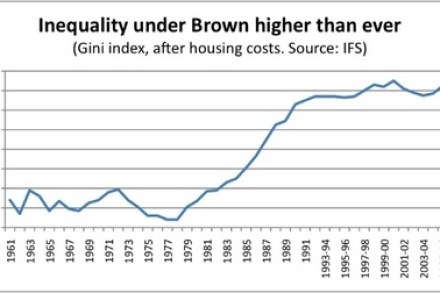
We all know Labour has failed to run an efficient economy or public services, but what’s little discussed is its failure to achieve even its own goals. Had Brown bankrupted the country but, say, made the poorest much better off, then Labour members might not be facing such an existential crisis. As it stands they won three victories, trebled health spending, redistributed some £1.5 trillion – and will end up with a society even more ‘unequal’ than it ever was under Thatcher. I look at this in my column today, and thought I’d share a few of the points with CoffeeHousers. First, equality. This (rather than making the poor better off) is the great leftist goal – and it can be nominally achieved by hurting the rich.

Whom do you trust more?

So, a ComRes poll for the Daily Politics has Cameron leading Brown on the issue of which party leader would be more honest about spending cuts. It echoes a poll that we conducted a few days ago; the results of which we figured we’d share with CoffeeHousers, before our work experience at the Speccie comes to an end. Basically, we hit the streets of London (avoiding Westminster and all the party hacks), and asked around 350 people: “Who do you trust more, Gordon Brown or David Cameron?” Sure, it may not be as scientific as a YouGov or ComRes poll, but the results are still striking. Cameron polled a comfortable 62.5 percent, while Brown only managed a lacklustre 37.5 percent. A massive victory for Dave, then? Well, yes – in one respect.

The extent of Johnson’s loyalty?

Kevin Maguire's Commons Confidential column in the latest New Statesman contains this intriguing little snippet: "Home Secretary Alan Johnson was a picture of innocence during the plot to oust Brown and replace him with a former postie with the initials A J. Not so his entourage. It has come to the attention of No 10 that one of his team offered a job in Downing Street to a hackette." After his article for the Indy earlier this week - and his fizzy performance in Manchester yesterday (covered by John Rentoul as part of his AJ4PM series) - you suspect Johnson is being a little more active than the Dear Leader would like.

Could you stick with Gordon for 3 more years?

Brace yourselves.  According to some great research by David Herdson at Political Betting, Gordon Brown could refrain from holding a general election until 2013.  The loopholes by which he could manage it are a bit arcane and convoluted – so I’d suggest you read Herdson’s post in full – but this snippet gives the idea: “The only statutory requirement to move writs for a general election is under the Meeting of Parliament Act 1694, which allows no less than three years between the dissolution and the writs being issued. In other words, technically, the election doesn’t have to be held until June 2013.

When the cat’s away…

Hm.  Seems like Alan Johnson has chosen the day that Gordon's away in Italy to write another comment piece on voting reform.  Like his article for the Times a few months ago, it pushes the AV+ version of proportional representation.  And, like his Times article, it goes out of its way to mention Brown ("I work for a leader who accepts the need for ... renewal"), but it still comes across as an attempt to grab the leadership limelight.  After all, why should the Home Secretary be reiterating points he's made before about voing reform?  Why isn't he leaving this attention-grabbing stuff for his leader who "accepts the need for renewal"?  And why now?