Gordon brown

Brown’s speech: live blog | 29 September 2009

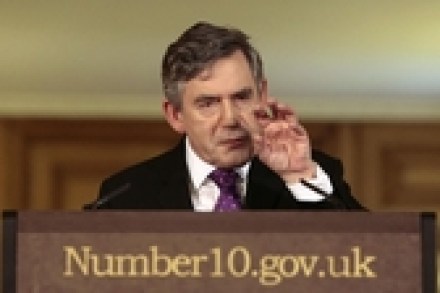
1404, PH: We'll be live-blogging Brown's conference speech from 1415 onwards.  In the meantime, CoffeeHousers, your thoughts on how our PM will kick things off.  Last year, of course, he got Sarah Brown to introduce him.  Will he repeat the trick this year?  Or will he get someone else?  Mandelson, perhaps?  Or someone off X-Factor?  Or will it be nothing flash, just Gordon?  Your predictions, please... 1405, PH: Brother Massie is also live-blogging the speech here. 1410, PH: Oh, and you can watch the speech here. 1416, PH: So what will Brown actually say?  Well, his announcements on anti-social behaviour and childcare have been heavily trailed.

Brown’s uncertainty over a TV debate exemplifies his moribund premiership

So what's the story with Brown and the leaders' TV debate?  There were reports, weeks ago, that the PM was going to use his speech today to, ahem, "challenge" his opposite numbers to a debate, but then Sky intervened and Downing Street fell silent.  Last we heard, Brown was veering towards a debate, but was still uncertain about the timing of it all. Now, this morning's FT reports that Brown "spent hours on Monday night agonising" over whether to mention a televised debate in his speech today.  Nick Robinson has followed that up by saying that the relevant passage has been removed from the speech.  If Brown does finally accept a debate, Robinson writes, then he may attach a set of demands which will slow the whole process down.

Brown is either fleet-footed or indecisive – he cannot be both

Gordon Brown delivers the most important speech of his life this afternoon. Whether that speech can even check the march of the seemingly inevitable is doubtful, but his best chance is to express an alternative strain of personality from the severe and serious man the electorate plainly dislike. Jim Naughtie and Neil Kinnock debated the alleged disparity between Gordon Brown in public and Gordon Brown in private. Kinnock repeated the line that, behind closed doors, Brown is a barrel of laughs, a near dilettante, and he sang the usual ‘if you could see him through my eyes’ chorus.

Labour want Blair to hit the campaign trail

Tom Watson has told the Times that Tony Blair should hit the campaign trail "if he fancies it". There have been rumours that both Blairs will campaign at the next election, but this is the first time, to my knowledge, that a Brownite has publicly implored the former PM to return to the fold, and perhaps it's a measure of the Brown camp's increasing desperation that they are prepared to bury the hatchet. I've no doubt that Blair will answer the call, he would have done so had no call come. His input will be valued by a party that grew accustomed to victory under his leadership, even if he only inspires false self-confidence. But, after 12 years of government and the catastrophic Brown premiership, I doubt whether even Blair can avert the inevitable.

Why Say it if You Won’t Act?

The only conversation I have had so far at Labour Party conference is about why everyone realises that Gordon Brown would do his comrades a great service by standing down but no one can find a way of getting him to do the right thing. The general feeling is that the Labour Party has the right answers to the economic crisis (this is the least you'd expect), but failing to get the message across. It is right that the British electorate should face a choice between two different strategies for tackling the economic crisis. But the arguments need to be made with equal force. Alistair Darling is emerging as an impressive purveyor of hard truths. His comments to the Observer at the weekend about Labour "losing the will to live" will hang over conference.

Brown’s new dividing line ignores that banks are our route to salvation

Gordon Brown and Alistair Darling will launch their umpteenth fight back today by talking tough on banks and bonuses. They hope to prove the Conservatives are interested solely in “helping their rich friends”. The Times has the details: ‘The Chancellor will tell the party conference in Brighton that legislation to be introduced in the next few weeks will scrap automatic year-after-year bonuses and stop executives getting payouts unless they can prove they are deserved. Bonuses will be deferred over a period so that they can be clawed back if they are not warranted by long-term performance.’ This is not a dividing line.

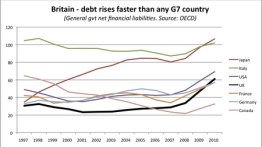
Either debt goes up, or goes down. It really is that simple.

Last night, I appeared on an hour-long phone in on Five Live listening in amazement as Angela Smith and Barry Gardiner defended Brown. You’d be amazed the lines the Labour MPs are being sent out with: that the shallow media is personality-based, but real people know that Brown did a great job on the economy. Seriously. That Brown’s fiscal decisions have somehow saved us all – rather than bankrupted us all. They are suggesting that the idea of 9% Labour cuts was a Treasury speculation, when it is a hard plan contained in the Budget.

Was Marr right to ask Brown that question?

Andrew Marr asking Gordon Brown if he was on anti-depressants was a real surprise. When I first heard that Marr had put this question to Brown, I thought there was a possibility that Labour aides had let it be known that the Prime Minister would like the chance to shoot down these rumours. But Brown’s reaction, suggests he wasn’t expecting the question. One can see why Marr asked the question: if Brown was on anti-depressants that could affect his judgement then the public has a right to know. It wasn’t in the public interest, as Andrew Marr seemed to acknowledge in his interview with George Osborne, that the BBC sat on the story of Charles Kennedy’s drinking. Also, one can argue that once the rumour is out there it needs to be dealt with.

Labour’s latest dividing line

Today’s papers give us an idea of what Labour’s new dividing line with the Tories is going to be. Labour will find money for eye-catching but not too costly initiatives such as the cancer pledge that the papers have reported on this morning. These pledges will be financed by taking money from the less sexy parts of departmental budgets. Labour will then ask, as Pete noted Ed Balls doing today, how the Tories can match this spending when they are committed to paying down the deficit faster than the government and to reversing several of Labour’s tax rises.

A Bargain Ringside Seat to History

Apparently the Labour Party is selling tickets to sit behind Gordon Brown during his leader's speech for a bargain £130 a pop. At the same time they are struggling to fill the seats for their gala fundraising dinner in Brighton. Things are getting desperate. Already, last year in Manchester, the exhibitors' hall was dominated by Labour associated organisations and unions. The corporate world abandoned the party long ago. The interviews in this morning's papers show a new change in the political weather. Ed Balls continues his charm offensive and even borrows the rhetoric of Peter Mandelson's "fighter not a quitter" speech as a rallying call for the party. (I'm not sure it's a great idea to evoke the image of that toe-curling moment though).

Ben Bradshaw’s advice for Brown

It's the question that won't go away for Gordon Brown: should he - will he -  take part in a televised leaders' debate?  On this weekend's Straight Talk, Andrew Neil takes the opportunity to quiz Ben Bradshaw about his views on the matter.  Here's how the Culture Secretary responds: "I don’t think [Brown]’s got anything to lose by doing that ....  My advice to him would say, I think you’ve got the arguments, you’ve made the right decisions, you could demolish that guy." Like Mandelson's interventions before now, Bradshaw's advice will slightly raise the pressure on Brown to take part in a debate.  But the first half of it also chimes with what a lot of Labour folk are saying around Westminster.

Brown ignores the small issues which precede the “big choices”

James has already highlighted the New Statesman's interview with Gordon Brown, but it's worth flagging up this passage as well: "Again and again, throughout our interview, Brown refers to the next election as being about 'big choices', not the small issues, which he says the Conservatives would prefer. 'What was the latest thing? The cost of food in the House of Commons?' he asks, referring to David Cameron's recent gimmicky pledge to cut public spending by reducing subsidies on MPs' food. This theme of 'big choices', say Brown's aides, is one he is likely to pursue in his conference speech and beyond." To my mind, this exemplifies one of the main reasons why Brown will struggle to be trusted on the issue of the public finances.

Eureka!

Brown's pursuit of Obama through the UN canteen has finally paid dividends: PoliticsHome is reporting that Barack Obama will hold bilateral talks with Gordon Brown later today. After yesterday's negative headlines, Obama was always going to make a gesture that indicated how much he valued Brown; but from the Prime Minister's point of view, the damage has already been done.

Dereliction of duty

The Ministry of Defence is the subject of two very damaging stories this morning. First, there are twice as many former service personnel in prison than there were six years ago. And second, Major General Andrew Mackay, a former commanding officer in Helmand, who masterminded the recapture of Musa Qala, has resigned his commission. Mackay is understood to have been dismayed at the direction of the war and army restructuring. The Independent has the details: ‘Mackay was disillusioned with what he considered to be a failure to carry out adequate reconstruction and development in Helmand. He had said privately that British soldiers risking their lives in the conflict had been let down by the Government in carrying out the vital tasks necessary to win over the local population.

A number that shows what a drag on Labour’s prospects Brown is

The news that Max Clifford is now involved in publicising the story of Baroness Scotland and the illegal cleaner is another blow to an already bruised Labour party. One of the last things that it needs is the beginning of its conference being overshadowed by a story that combines the two toxic issues of political hypocrisy and immigration violations.

Can things get any worse for Brown?

Yesterday was bad enough, but today’s turning into an utter catastrophe for Brown. First, it emerged that the Tories enjoy a 4 point lead in Labour’s traditional northern strongholds, then Baroness Vadera leaves the government to work for the G20, and now another former GOAT, Lord Malloch Brown, tells the World at One that Brown was too “desperate” in his pursuit of a meeting with President Obama. Malloch Brown said: “I don’t know whether they were frantic or not, they shouldn’t have been frankly so desperate.” When handpicked former ministers make such statements it's clear that the writing’s been on the wall for so long it’s started to fade.

Is Vadera about to resign?

If, as the Westminster rumour mill suggests, business minister Baroness Shriti Vadera is about to resign from the Government, it is a far greater blow to the beleaguered prime minister than the loss of a PPS no one's ever heard of over the Baroness Scotland affair, the potential loss of Lady Scotland herself, or even the refusal of Barack Obama to grant him a private audience ahead of the G20 summit. Vadera has been one of Brown's most loyal sidekicks for more than a decade, and unlike anyone else who fits that description, she is the very opposite of a spin doctor or political hack.

The Tories lead in the north

Financial Times research has revealed that Labour has lost its traditional northern strongholds under Gordon Brown. Here are the details: ‘The Tories have built a narrow four-point lead in the north, eradicating the 19-point Labour lead in the region that underpinned Tony Blair’s last general election victory, the research shows. The 11.5 percentage point swing from Labour to the Tories in the north since the May 2005 poll is the largest for any region of Britain. The FT analysis suggests Mr Cameron has yet to win over fully pivotal “Middle England” voters. He has built a convincing lead among the well-off AB upper and upper-middle socio-economic groups.