Gordon brown

Brown’s strange position of strength

I've said it before, but it's worth repeating: the email exchanges between Danny Finkelstein and Philip Collins over at Comment Central are one of neatest features in the political blogosphere - always worth a read.  They've got a new one up today, discussing how Brown should go about handling the Legg letters.  Does he force Labour MPs to cough up, and risk drawing their anger?  Or does he fold and allow them to fight Legg, to maintain some degree of their support?

Brown told to repay £12,415.10 of expenses

Here's the statement from the office of the PM, courtesy of Sky's Cheryl Smith: Mr Brown received a letter from Sir Thomas Legg this afternoon. Sir Thomas Legg has issued his provisional conclusions to MPs, asking for further information where necessary before concluding in December. Mr Brown has always supported this process and will cooperate fully and make the necessary repayment. Mr Brown's expenses have always been cleared by the House Authorities as entirely consistent with the rules. He has not claimed the maximum level of expenses. The Review says its findings "carry no implication about the conduct or motives of the MPs concerned".

Is this the death of another anti-Brown plot?

An eagle-eyed spot by Hopi Sen, who has posted on Barry Sheerman's comments in the Huddersfield Examiner today.  If you remember, Sheerman was mooted as a key component in an anti-Brown plot, whereby he'd stand as chair of the Parliamentary Labour Party on a Get Gordon Out platform. Votes for Sheerman, it was thought, would be votes against Brown - and increase the pressure on the PM to stand down.  But in the Huddersfield Examiner, Sheerman suggests that, while he will stand for the PLP position, he won't do so as part of a coup: "...Mr Sheerman denied this was part of a move to topple Gordon Brown. He said “If colleagues ask me to stand I will consider it.

Selling assets at rock bottom prices – sound familiar?

So what to make of Gordon Brown's plan to sell off an expected £16bn-worth of assets?  Like Charlie Elphicke over at CentreRight, I have my qualms. As he puts it, Brown has form when it comes to selling national assets at rock-bottom prices. And, in the immediate aftermath of the credit crunch and a recession, the prices he gets for our stake in Urenco, say, or the Dartford crossing, are likely to be rock bottom.   Besides, there's an unmistakeable whiff of political opportunism about this plan. You can imagine the posturing now: "We're selling off assets we can spare to protect jobs and frontline services, unlike those dastardly Tories..." yada, yada, yada.

The politics of growth

One strange side-effect of the car crash that was the Liberal Democrat conference is that no one dares say the word “cuts” anymore. Since Nick Clegg promised “savage cuts” – alarming his base in the process – we’re back to the normal euphemism of “efficiencies”. This, like so much in life, will have Gordon Brown hopping mad. He didn’t want to say “cuts” in the first place, and the whole farrago will prove (in his head) that he should stop taking advice from people outside his coterie.   The next stage in the debate is to focus on growth. As James revealed in his political column for the current edition of the magazine, the Tory plan to do this is an aggressive cut in corporation tax.

John Rentoul Calls it Right on Brown and Cameron

As he says himself in this week's column in the Independent on Sunday, John Rentoul showed "slavish admiration for a former Prime Minister". Such is his grief for Tony Blair that he can't bear to utter his name.  I did wonder whether John would seamlessly shift his admiration from Blair to Cameron, but he has remained loyal to his former idol's New Labour project. Even when I disagree with him (and possibly especially when I disagree with him) John Rentoul remains one of the most incisive political columnists writing today, even though he has lost his access to the highest levels of power.  At risk of falling into slavish admiration myself, I have to say John's column today is spot on about the post-conference political scene.

Brown’s double hit

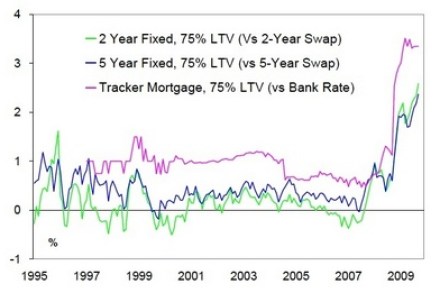
What is the true price of Gordon Brown’s economic incompetence and inept bank regulation? The soaring national debt is one. And if you own a mortgage, you’ll find that you’re paying another. The gulf between the Bank of England base rate and the average mortgage rate is now at a huge high – as banks rip off their customers, trying to fill the hole in their balance sheets. This is an under-discussed topic. The “action we have taken” (a phrase Brown uses to try to lay claim to the Bank of England’s base rate reduction) would have a far greater effect on the economy if the UK banking system was not (still) so badly broken. The below graph, from Citi, shows spreads (ie, gap between base rate and retail rate) on key UK mortgages from 1995.

Dannatt may be overstating his case, but the government is being disingenuous

General Sir Richard Dannatt issues a vociferous condemnation of the government’s commitment to British efforts in Afghanistan in the print edition of today’s Sun. Dannatt asserts that Gordon Brown vetoed increasing the British deployment by 2,000 troops, against the advice of military chiefs. He told the paper: “The military advice has been for an uplift since the beginning of 2009. If the military says we need more troops and we can supply them, then frankly they should take that advice and deploy up to the level we recommend. “If it means finding more resources and putting more energy in, let’s do it. If you’re going to conduct an operation, you’re doing it for one reason – to succeed.

The politics of hope are dead. Cameron has everything to gain by being realistic

Publicly at least, Labour MPs are jubilant that Gordon Brown has agreed to appear, in principle, in a televised election debate. They give the responses to the creed first spun by Blair: that Brown is an arch-realist and heavyweight who will undo the vacuous Tories in debate. Certainly, Mr Brown is blessed with talents. As proud wives like to do, Brown’s listed his the other day – intelligence, hard work, dutifulness, diligence and patriotism. All laudable attributes, but even from environs of the cosy Labour conference, Mrs Brown did not dare suggest that her husband was in any way a realist. Brown’s, and Labour’s, messy divorce from political reality was finalised this week when they launched a limp counter-attack based solely on crass anti-Tory slurs.

Brown agrees in principle to TV election debate

Despite trying to turn Adam Boulton to stone on Tuesday night, Gordon Brown has agreed in principle to appearing on the Sky election debate. It's long been suspected that he would agree to participate, today merely confirms the rumour. If the debate goes ahead, it would represent a huge change in British electoral procedure. Mr Brown deserves credit for contributing to that change. Why he did not choose to announce this positive move, illustrating that he's prepared to take the fight to Cameron and Clegg, in his conference speech defies belief and speaks volumes about his political courage and instincts.

Memo to Brown: compromise can be a good thing sometimes

Iain Martin writes a typically insightful post on Labour's conference capitulation.  His central point is that Brown & Co. are following a misguided "no compromise" strategy: "These difficulties with the media are part of a wider problem with the so-called 'fight-back' strategy being used by Gordon Brown. It is based on an analysis which is highly unlikely to convince any voter to change his or her mind. In short, it runs like this: 'We have looked at the many opinion polls which tell us the vast majority of you think we’re untrustworthy and have messed up monumentally. But we think you’re wrong. We’re actually brilliant, and we’re going to keep telling you so, in a very aggressive fashion.' Who is going to be wooed by that?

Brown claims it’s 1945 all over again

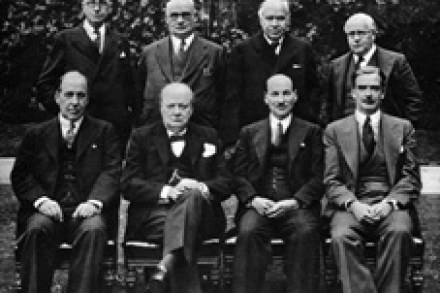
So we've heard before that Brown is "obsessed" with Winston Churchill and, in his mind, wants to avoid the wartime leader's fate as a Prime Minister who guided Britian through a crisis only to be answered with a thumping in the polls. In which case, it's rather odd that Brown should write this in the campaign document that he's releasing today:   "This is the stark choice facing the British people at the next election. The choice will be as stark as 1945." So who's Brown meant to be?  Churchill or Attlee?  Or some alternate universe Churchill who won the 1945 election?

Getting shirty with the media won’t do Labour any favours

The news that the Sun was endorsing the Tories deflated the mood of conference last night. And Labour hang-overs can not have been improved by Brown’s performance on Sky today, which Pete referenced earlier. The Prime Minister was clearly irritated by Adam Boulton’s line of questioning, using the phrase ‘let me finish’ more than any other.  But watching it you couldn’t help wondering if this was a preview of the election campaign: a defensive Brown railing against the media. Andrew Marr asking that question and The Sun endorsing the Tories have bated Labour into running against the media. But there are two fundamental flaws with this strategy.  First, Labour does not have an alternative way of getting its message out.

On this morning’s evidence, Brown’s fightback is already over

If you still haven't made up your mind about whether Brown's speech yesterday will do anything for Labour's chances, then just dash through his interviews with the broadcast media.  Two topics stand out – the Sun's decision to back the Tories, and whether Brown will get involved in a televised debate – and there's little substantive discussion of the agenda that Brown set out in his speech yesterday. Now, you could, like Alastair Campbell, say that this is because the media is hell-bent on portraying Brown in a negative light.  But I'd argue that, aside from some crowd-pleasing passages for the Labour faithful, his speech yesterday was remarkably thin.  Any boost it may have provided is already deflating – and rapidly.

Did you know? Gordon Brown’s been talking about strong global regulation for years

Well, that’s what he claims anyway. Brown’s extended interview on the Today programme was an exercise in deflecting blame (and the Sun coming out for Cameron) – ‘none of this would have happened if people had listened to me because, you see, I saw it all coming’ was his refrain. This exchange with Jim Naughtie was particularly telling: “JN: Let me take you back to ‘markets without morality’, which was in your speech and you’ve repeated it now. When did you decide that bankers were being greedy and excessive in their demands? GB: Well Jim, you know, I’ve always been of the view that we needed a better global financial supervisory system.

Why now, Gordon?

Considering the dire situation in which Gordon Brown finds himself, yesterday's speech was really rather good. It gives the party faithful something to cling on to as they begin the grim task of campaigning for a Labour victory in 2010. The obvious question for me after hearing it, though, was "why now?" How can the Prime Minister credibly offer a message of change two years into his premiership? Think back to 2007 and the first flush of the Brownite dawn. His initial offer to the British people was constitutional reform. I know he was already beginning to be persuaded of the arguments for the alternative vote system at this point. The people around him were happy to talk about it. Why didn't he go for it then? And abolition of the hereditary peers: why wait?

The Sun shines on David Cameron

The Sun's Whitehall Editor, David Wooding, has just tweeted that the newspaper will officially back the Conservatives at the next election.  Given the paper's recent editorial stance, it's hardly surprising news.  But it will still delight Team Cameron, and is a blow for Brown in the aftermath of his conference speech.  I expect we'll hear more about it shortly. UPDATE: The relevant Sun story is here, although it's still only showing the opening paragraph.

Brown’s watch words to defeat

Comment Central’s Alice Fishburn has collated Brown’s buzzwords. It’s revealing that derivatives of ‘choice’ and ‘change’ were used 38 times, whereas the words ‘honest’ and ‘responsibility’ were uttered twice and four times respectively. Given that the public have turned against the government’s running of the economy, Brown was unwise to concentrate on Tory-bashing rather than attempt to emphasise his honesty and sense of responsibility, but perhaps he’s given up on that front. Initially, his Goethe-inspired avowal to dream big and change the world again had me grasping for the gin; but this speech was for the hall first and the voters second, which isn't enough to avoid defeat.

Good enough for Labour

For Brown this was a doddle. He couldn’t fluff it. Expectations have sunk so low that all he had to do today was show up, try not to look too knackered, spout a few revivalist platitudes and make sure he didn’t fall over. The rebellion has stalled, the plotters are paralysed. Those who criticise won’t lead, while those who would lead won’t criticise. Mandy, like a protection racketeer within the cabinet, has enriched himself in the currency of ‘loyalty’ (which in these circumstances means a reluctance to coerce others to be disloyal), and yesterday he couldn’t contain his delight at the scale of his new-found wealth. And so Mr Brown, Mandy’s proudest protégé, appeared at 2 pm today on the Brighton seafront.

What was in Brown’s speech for those turning away from Labour?

Much like Peter Mandelson's address yesterday, Gordon Brown's speech was designed for the Labour Party members inside the conference hall.  It was effectively book-ended by two crowd-pleasing rat-a-tat lists: the first, a rundown of Labour "achievements" which received massive cheers; and the second, a disingenuous account of Tory measures "for the privileged few", designed to draw hisses and boos from the audience.  All very pantomine.  And all very fun, I'm sure, for the party faithful. But what about those voters who are turning away from Labour in their droves?  What was there for them?