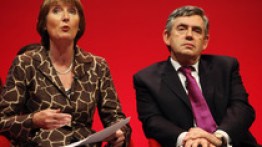
Gordon brown

What happened the last time Gove played Cameron’s opponent in debate prep

One of the surprises of the Tory leadership campaign in 2005 was how David Davis bested David Cameron in the TV debate between the two men. Those involved in Cameron’s preparations for that debate blame Cameron’s poor performance on how Michael Gove knocked Cameron’s confidence in the run up to it. Gove was Davis in debate prep and played Davis as a ferociously clever, Oxford Union-style debater and kept leaving Cameron tied in knots. So it is interesting that the Cameron camp have again chosen Gove to play the role of Cameron’s opponent in the run up to a TV debate. This time Gove will, of course, be playing the part of Gordon Brown. These debates are going to fascinate the press.

Those split stories just won’t go away…

A hefty one-two punch in the continuing "Have Gordon and Peter fallen out?" story, this morning.  The Telegraph has quotes suggesting that Mandelson is "upset" and feels "disposed of" by Brown.  And Sue Cameron of the FT details a specific rift between the pair, ending with the observation: "I hear Lord M is not happy, telling friends that he does not have the influence he was promised."  For his part, Mandelson has since dismissed the reports as "complete tosh". Problem is, for Downing Street, the truth of the stories is almost immaterial.  After a relatively stable few months, Brown is once again mired in rumour and speculation concerning his own leadership.  Indeed, the Telegraph reports a potential Miliband challenge on the back of its Mandelson story.

Will this be the game-changer that Brown needs?

So there we have it.  There will be televised election debates between the three main party leaders during the next election campaign, after all.  The first will be on ITV, then there'll be one each on Sky and the BBC.  Talk about good TV for political anoraks. Like Tim Montgomerie and Mike Smithson, I suspect that Gordon Brown and Nick Clegg will be happiest with the news.  Both of them, particularly Brown, need potential game-changing events like this to make some progress in the polls.   As for Cameron, he'd probably be better off not giving his opponents a chance to make inroads into the Tories' poll lead.  But he could hardly have resisted live debates in the current political climate.

I blame Bono for the Copenhagen failure

So who or what is to blame for the failure of the Copenhagen gathering to achieve what most people hoped for? Polly Toynbee says that the nature of politics is to blame. Personally I blame U2’s Bono. I don’t blame him for the failure of world leaders to agree a legally-binding agreement, of course. But I do blame him for the unrealistic expectations that were raised in the run-up to the meeting. Issue-based campaigning, of which the climate change movement is the latest example, came into its own with the debt-relief campaign of Jubilee 2000, which the Irish singer spearheaded.

Slightly surprising stat of the day

According to a YouGov poll in tomorrow's People (reported by the paper's political editor, Nigel Nelson, on Twitter): "1% more people would rather have G.Brown than D.Cameron round for Christmas dinner." There's better news elsewhere in the poll for the Tories: the gap between them and Labour is back in double digits.  It's the Tories on 40 percent, Labour on 28, and the Lib Dems on 18.

Cutting the deficit sooner won’t risk the recovery

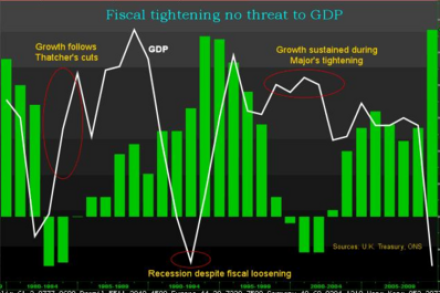
Would cutting spending “risk the recovery?” This claim is, literally, Gordon Brown’s re-election manifesto. He is hoping that the Tories haven’t learned to use numbers as weapons – so any economic message he has will not be effectively countered. In fact, his claim is very easily exposed as being bogus by a simple look at recent British economic history. Bloomberg’s Chart of the Day shows that economic growth in the past two recessions (white line) was not at all threatened by fiscal tightening (green graph). Even Goldman Sachs – which is acquiring a reputation as the Labour Party’s house broker – is conceding the central point.

A parting shot

I need a new radio for Christmas. Whilst listening to Dr. Sir Liam Donaldson tell the Today programme that parents should not offer their fifteen year old offspring alcohol, my pocket-radio had an altercation with a wall. The soon to be retiring chief medical officer said: “The more they get a taste for it, the more likely they are to be heavy drinking adults or binge drinkers later in childhood.” This latest soothsaying counts among Sir Liam’s other alcohol-related triumphs; he also gave us the inscrutable phenomenon of “passive drinking” - I don’t know about you but this guy makes me drink actively.

Inflation nation<br />

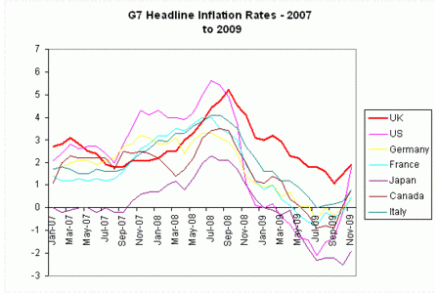
The inflation surge is now upon us. The CPI rate again “surprised” to the upside – Britain is the only major economy in the world to have inflation doing this. But given that the Bank of England’s printing presses have been working overtime to fund a fiscally irresponsible government then little wonder things are different here. To understand just how unusual the UK situation is, consider the below graph: despite suffering the longest recession in G20, we have one of highest rates of inflation in the developed world. The next few months will see this push higher, potentially reaching 4 percent in March and busting the 2 percent target.

The Labour leadership question hasn’t been answered

Rabble-rouser and bruiser-in-chief Charles Clarke has taken a hatchet to the government’s highly political Pre-Budget Report. Writing on his blog, Clarke argues: ‘He (Brown) felt that the main purpose of this pre-election Pre-Budget Report was to recycle his old political dividing lines.   This weakness can only come from fear of discussion of our past failures and fear that it is too dangerous to set out our future plans.   The real danger for Labour is that this weakness will pave the way to political defeat in 2010.’ The Labour leadership crisis has retreated from the limelight recently, but the spectre of internecine war after a whipping at the polls has not.

Playing politics with the public finances

It has started. The Labour attack unit is out today talking about a "Tory VAT rise" - as per Paddy Hennessy’s scoop. Osborne stated his (to me, relatively paltry) position on the deficit: that he’d reduce it faster than Labour but can’t say how much. The Labour attack unit keeps partying like its 1999 with the "Tory cuts" line, now augmented with a "Tory tax rise." Here are the words which the attack unit has crafted for Stephen Timms, chief secretary to the Treasury: "George Osborne refuses to say what services he would cut or what taxes he would increase in order to cut the deficit 'further and faster' than Labour.

The Ed Balls approach to fiscal management

Considering the fiscal crisis we face, this revelation in Andrew Rawnsley's column is particularly dispiriting: "[Gordon Brown] has been egged on by Ed Balls [to make more spending promises], partly because the schools secretary is also obsessed with that old dividing line, partly because he wanted to be able to boast that he had won more money for his department. I am reliably told that the wrangling between the schools secretary and the chancellor went on into the early hours of the morning on the day of the PBR itself. The result was that some of the extra spending beaten out of Mr Darling by Mr Balls did not get into the document because it was already printed.

Has Mandelson given up on Brown?

For any Kremlinologists among us, Peter Oborne's latest column in the Mail sure is a juicy read.  It claims that Mandelson and Brown are "at war again" – only, this time, insiders say the damage to their relationship is "irreparable".  The Business Secretary is said to be "bitterly unhappy" with Labour's class war strategy, and with Brown's reluctance to deal with the fiscal crisis.  And – as Martin highlighted the other day – he wants out. None of this is too surprising.  Indeed, Mandelson has been conspicuous by his absence from the government's PBR media drive, fuelling more than a few Westminster mumblings about his commitment to the Brownite cause.

Why class wars don’t work

Well, it seems like Paul Richards – a former aide to Hazel Blears – wants to corner the market in quietly persuasive demolitions of his own party's strategy.  If you remember, he wrote a perceptive piece on Labour's shortcomings in the aftermath of the Norwich North by-election, which we highlighted here on Coffee House.  And, today, he's at it again, with a very readable article in PR Week on why the class war won't work.  His three reasons why are worth noting down: "First, it is hypocritical. The Labour Party has a disproportionately far higher number of former public schoolboys and schoolgirls in parliament and in the government than a random sample of the public they serve.

The unravelling continues apace

Has Brown got away with his horror Budget?  Reading the Populus poll in this morning's Times, you might be tempted to say he has.  Sure, there's some bad news in there for the government: trust in Dave 'n' George's ability to manage the economy has hit an all-time high, and only 12 percent of respondents think that the measures outlined in the PBR will be sufficient to deal with our country's fiscal woes.  But Labour types will also seize on those numbers which show quite high levels of support for the individual proposals annouced on Wednesday.  78 percent back the bonus tax.  61 percent back the capping of public sector pay increases.  And – surprisingly, to my mind – 51 percent back the national insurance increase.

The PBR Suggests that Labour Thinks It’s All Over but Peter Mandelson Knows It Is

Labour's Pre-Budget Report has been interpreted as a cynical electioneering exercise, a last-ditch attempt to to open up clear blue water between Labour and the Conservatives. Perhaps paradoxically, I thought it was a sign that the Government knows the game is up. Of course the Labour Party has to fight the election - it can't simply not turn up. But it strikes me that using the UK economy quite so blatantly for party political advantage when it was already so fragile, was a strategic error. I am sure Alistair Darling believed he was doing the right thing. He is a man of principle. But it felt very much like a last throw of the dice.  Labour ministers (and, more importantly, their spouses) are beginning to talk about what they will do when they are no longer in office.

Gordon Brown’s one and only legacy

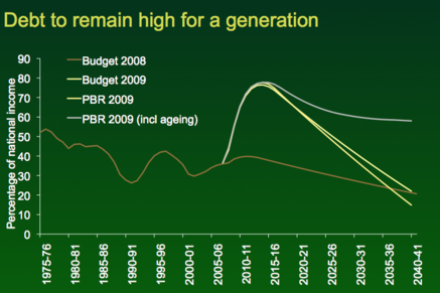
I will sign off tonight with this sickening graph from the earlier IFS presentation – showing the extent to which Gordon Brown’s economic incompetence has transformed the public finances for a generation. Servicing this debt will absorb money that would otherwise be spent creating jobs, lifting people out of poverty, advancing education, promoting prosperity. The leading article in the magazine this week finishes with these words, which came to mind when I saw the above graph: “It will be no surprise if UK public debt has been downgraded by the election; if so, a gilt buyers’ strike will become more than a theoretical possibility. The new government will face a Sisyphian financial task, so formidable as to make almost every other issue of the day look trivial.

At least Gordo and Sarko are still friends…

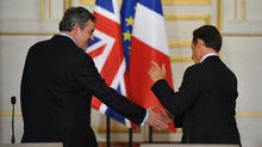
If you're looking for some sort of light relief after yesterday's horror-PBR, then can I recommend the joint article by Gordon Brown and Nicolas Sarkozy in today's Wall Street Journal.  Yep, the two men have put their recent spat behind them, and have cemented their relationship by huddling over a typewriter and bashing out just under 900 words on global financial regulation.  The Entente Cordiale never looked so strong.    Beyond the display of unity, it seems the article's purpose is to convince the City that the EU's French finance commissioner won't blunt our competitive edge.

Behind the expenses curve

And so the expenses scandal rumbles inevitably on.  If you want the latest on all the dubious claims our, erm, honourable representatives made in 2008-09, then I'd recommend Andrew Sparrow's live blog over at the Guardian - and Guido's got a good round-up here.  But, behind all that, there's a u-turn which is almost as embarrassing for the government as all those dodgy, dodgy receipts. Remember when Gordon Brown neglected to mention MP's expenses, or the Kelly reforms, as part of his legislative agenda in the Queen's Speech?  The decision was immediately launched on by Sir Christopher Kelly himself, and set up some juicy attacks for the Tories.

Last orders in the last chance saloon?

It's the set of headlines which Labour must have dreaded after their recent progress in the polls.  The Times: "The axeman dithereth ... but the taxman cometh".  The Guardian: "Darling soaks the rich ... and the rest of us too".  The Mail: "The Buck Passer's Budget".  And so on and so on.  It doesn't look too good inside the papers either.  The FT rails against a  "lack of clarity on public spending plans", while the Independent says that "rarely has a pre-Budget report promised so much and delivered so little".  The Sun's opposition may not be too surprising, but it's there in bucketfuls: "Britain is staring into the abyss. After yesterday's performance that abyss has got deeper.

In his comfort zone

Today we saw just how tricky the game can be for opposition leaders. The government sets the parliamentary agenda and holds the keys to the war-chest. Cameron’s attempts to upset the PM looked diffuse and repetitive. On Afghanistan he offered support. On Kelly he flannelled about some footling detail of parliamentary timing. And on ministerial pay he drew attention to his gravest difficulty, namely that the pre-budget report was coming up next. Brown never looked in difficulty and he cruised easily towards his Six O’Clock sound-bite. ‘The opposition leader has lost the art of communication but not alas the gift of speech.’ A poor day for Dave. Nick Clegg did much better. Gosh he’s an angry beggar isn’t he?