Gordon brown

One thing to remember today

As you can probably imagine, plenty of Labour folk are getting excited about the PBR today.  They regard it as a chance for their party to harden their rise in the polls, and hasten the Tories' descent.  But Danny Finkelstein strikes a necessary note of calm over at Comment Central.  As he puts it, a Budget in which the government has to 'fess up to the horrible state of the public finances is hardly going to do much good for them.   To Danny's analysis I'd add one supporting fact: that rarely, if ever, in recent times, has the government received a significant poll bounce on the back of a Budget.  I blogged about this back in April, and Anthony Wells followed it up with an excellent post here.

Brown’s bonus smokescreen

If today ends up with the government in a row with the City over plans to tax bank bonus pots with bankers threatening to take the government to court, then it will be mission accomplished for the Labour party. The same goes if we end up in a debate over the merits of a Tobin-style tax. For obvious reasons, Labour would rather talk about anything other than the state of the public finances so anything that distracts attention from that central question is, to use the word of the morning, a bonus for Brown. The Tories know this and will try and turn the debate back to the public finances and the fact that Britain was the first major economy into recession and is going to be the last out. It is imperative for them that they succeed.

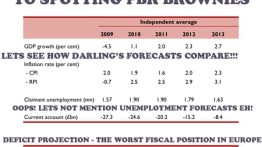
Your guide to the PBR Brownies<br />

How can you tell if you’re being lied to on budget day? Normally its easy: Gordon Brown’s lips move. But, today, there's a handy guide. You can compare Darling’s fiction with the independent average calculated by HM Treasury.

Tackling the deficit

Reform’s report, The Front Line, focused on the how of the public finance question – how to get the deficit down in practice.  We pointed out that since the public sector workforce accounts for around a third of the total government deficit, it should contribute a third of the reduction in the structural deficit.  That would mean reducing the costs of the public sector workforce by £30 billion, equivalent to a reduction of one million of the six million public sector jobs in the UK.  That would take public sector employment back to the levels of 1999 when the recent period of major spending increases began.

Tomorrow could be a turning point for the Tories

The number of polls showing the Tories below forty percent are causing some heartburn for the Tory leadership. When the first poll came out showing the Tory lead down, there was a feeling that this wasn’t all bad, that it would help remind the party that the election isn’t in the bag. But there is now mounting concern at Tory slippage, this is being reinforced by the fact that the party’s own research shows the same trends. Today’s leader in The Times, a paper which is normally editorially supportive of the leadership, was another unhelpful development.

Ever the optimist

It seems absurd to describe our dour and jowly Prime Minister as an eternal optimist, but he is. Rachel Sylvester’s column contains this delicious snippet of gossip: ‘When Mr Darling said that Britain was facing the worst recession for 60 years, Mr Brown telephoned him to tell him the downturn would be over in six months.’ Prudent foresight, there's nothing like it.

Darling contra Brown, Part 573

Ok, so tomorrow's Pre-Budget Report is shaping up to be a horrendously political affair.  But, rest assured, it could have been so much worse.  In what is, by now, a familiar Budget-time story, Alistair Darling is fighting the good fight against some of Brown's most inharmonious fiscal brainwaves.  According to Rachel Sylvester's column today, here are just some of the measures that the Chancellor has resisted: -- A long-term windfall tax on bankers' bonuses (Darling favours a temporary, one-year tax). -- A call to lower the 50p tax threshold from £150,000 to £100,000. -- A reversal of the plan to make it easier for couples to pool their inheritance tax allowances. -- A, ahem, "more optimistic picture of the British economy".

An efficient response 

Both parties want to be seen as the party of public sector efficiency. The Tories want to be able to show that they can do more with less and that cuts therefore need not mean worse services. While Labour wants to contrast their supposedly ‘smart cuts’ with the Tories’ ‘hatchet approach.’   So, this morning we had Gordon Brown delivering a speech outlining how the government would save £12 billion over the next three years; many of the policies he proposed were rather familiar to those of us who have been listening to the Tories on this subject.  The Tories then tried to trump Brown’s speech by announcing the formation of a Public Services Productivity Advisory Board.

This week’s PBR looks set to be Brown’s most political Budget yet

Ok, so all Brown Budgets are political – but signs are that this week's PBR could be his most blatantly partisan yet.  I mean, just look at his speech this morning on improving efficiency in the public sector.  Some of its measures are welcome – for instance, pledging to cut the pay of senior servants, and the general idea of using technology more effectively in government.  But, as other folk have pointed out (see Guido and Iain Dale), the measures are insufficient to the scale of the debt crisis, and many are old news.  All in all, the signs are as we expected: Brown is paying only lip service to cuts. Instead, Brown is going to go heavy on soak-the-rich measures; thereby strengthening what Labour see as two dividing lines.

The politics of distraction

If everyone concentrates on the actual numbers in the PBR then it will be a disaster for Labour. So, instead Labour will try and distract us all with small but eye-catching measures — a new rate of inheritance tax for estates worth more than £5 million, that kind of thing. The aim will be to move the debate from the grim reality of the country’s fiscal situation to Labour’s dividing lines. There will be a lot of pressure on Cameron and Osborne to denounce Labour’s soak the rich measures. But the most important thing for them to do is to get the debate back to the state of the public finances and that is inevitably going to involve side-stepping the arguments that Brown wants to pick.

Let’s Talk About Class

My posh Tory friends get really irritated when I talk about class. Almost as annoyed as my posh Labour friends. The idea that class was somehow excised from the political discourse by New Labour is absurd. We live in a country where the two dominant political parties are essentially representative of their class. And why not? It is completely understandable that a political coalition would coagulate around the interests  of business and big money. It would be a pretty rubbishy ruling class that didn't protect its position.

Brown waits to strike

Things are shaping up nicely for Gordon Brown ahead of the Pre-Budget Report next week. The Tories were 17 points ahead on ICM in October – now it’s 11. Cameron would have a narrow majority on this basis but, given the margin of error, we’re back into hung parliament territory. And this has a self-reinforcing effect on the Tories. A shrinking opinion poll means they tend to get paralysed, avoid arguments, play it safe, wait for Labour to screw up again. As I say in my News of the World column today, the voters who are looking for leadership then don’t really see it. This, of course, softens the Tory vote further. So the stage is set for Labour to get away with murder next week.

The correct decision but a tactical blunder

The Telegraph reports that Alistair Darling will allow married couples to continue to pool their inheritance tax allowances. Downing Street has pressed the Treasury to abolish pooled allowances in order to demarcate between Labour, the party that promotes fairness, and the Tories, the party that entrenches privilege.   For all the recent polls and bravado, the near-bankrupt Labour party is still fighting an intensive rearguard. If it is avoid annihilation, the party has to hold on in Scotland, Wales and urban Northern England. Darling’s pledge illustrates that there is more than one way to fight a defensive battle.

Saving the world | 5 December 2009

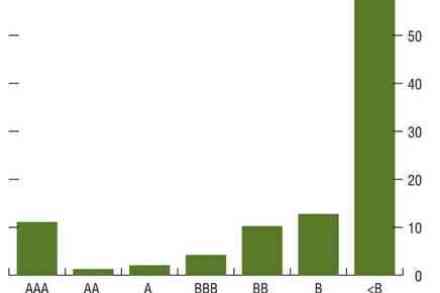
The further revelations about the astonishing costs of the bank bailouts so far indicate just how much taxpayers’ money is now being used to plug the holes in the banking system.  A key cause of the bank crisis is explained by the above IMF graph, charting the decline of some of the trillions of AAA structured credit assets created during the boom.  AAA means “extremely strong capacity to meet financial commitments”, but now over 80% of the US AAA Collateralised Debt Obligations (CDOs) created between 2005 and 2007 are rated BB or lower, somewhere between junk bonds and default (and in some cases almost entirely worthless). In terms of getting things totally wrong this is hard to beat.

Bernanke trashes Brown’s tripartite system

Gordon Brown’s much heralded tripartite regulatory system failed the first time it was faced with a financial crisis, proof that taking away regulatory powers from the Bank of England was a massive mistake. Now, Ben Bernanke — who is trying to secure a second term as Fed Chairman and keep the Fed’s regulatory powers intact — is citing the Brown model as what not to do, telling the Senate banking committee: "[O]ver the past few years the government of Britain removed from the Bank of England most of its supervisory authorities.

Balls: ‘I have resisted moving’

Ed Balls has given an interview to The Times Educational Supplement which contains a comically audacious attempt to rewrite history. When asked about whether he really wants to be in his current job, Balls tells the interviewer, “I have resisted moving”. Now, I suspect this will come as a bit of a shock to Alistair Darling who fought off an effort by Balls to take his job.

Could Brown go for a March 25th election?

The conventional wisdom in Westminster is that the election will be on May 6th. But a few shadow Cabinet members have told me that they think Brown will actually go in March, an idea that they have been pushing for a while. Their argument is that this quarter’s GDP figures will be quite good, boosted by the Christmas rush, and Brown would want to go to the country before, another more disappointing set of numbers came out. Second, Brown will want to avoid people seeing the effects of the new tax arranegements which will come into force in April. Finally, if the election was on May 6th, the first week of the campaign would be lost to the school holidays.

Sarko pulls it off

The news that Nicolas Sarkozy has cancelled a proposed flying visit to London, in order to smooth over the fall out from his attack on the City, has got tongues wagging. Adam Boulton reports: ‘It's claimed Sarkozy asked for this week's meeting to patch things up. So by implication their (his Westminster sources) argument goes - if it isn't happening it’s because Brown is snubbing Sarko and not the other way round.’ This line doesn't convince. According to the Elysee's diary, Sarkozy is otherwise engaged tomorrow, so the finance cordiale will now take place at…wait for it… the European Council meeting in Brussels next week. Why would Brown give away a vital meeting on home soil in favour of one held during the Franco-German Euro-circus?

Risky business | 3 December 2009

With the largest transfer of liabilities in British history – the insurance of the risk of loss on £240 billion of toxic RBS assets by taxpayers – proceeding, there is worryingly little information being given about either what these assets may be or what risks there are to the taxpayer. Rather than the parliamentary enquiry and detailed disclosure Swiss parliamentarians demanded when UBS needed similar assistance, a small press release noting such exotics as “structured credit assets “ has been issued. The spin continues to be that there is nothing to worry about and all this money will come back fine. Bank of England data shows that UK bank exposure to the US increased increased by over half a trillion dollars between 2004 and 2007 to 1.2 trillion.