Gordon brown

A very British diarist

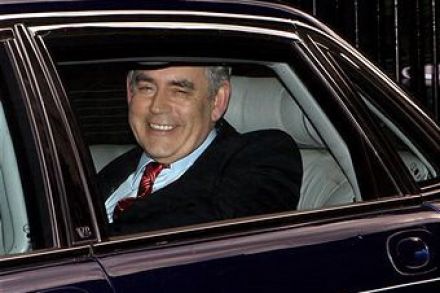
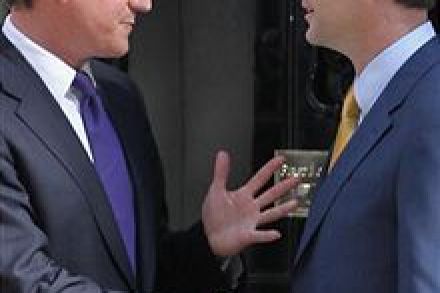
The extracts from Chris Mullin’s diaries that ran in the Mail on Sunday this weekend suggest that the second volume will be as good as the first. It contains things that you just couldn’t make up. Tom Watson, for example, told Mullin that he was pushed into rebellion by the knowledge that Cherie Blair had had the Prime Minster’s section of the nuclear bunker redecorated.   But, perhaps, the most telling  story is what happened when Gordon Brown went to the Chinese embassy to sign the book of condolence for victims of the earthquake there: “While Gordon and his party were inside, word reached them that David Cameron was waiting outside.

Exclusive: Gordon Brown launches his public speaking career

While Tony Blair has been pledging a slice of his massive post-PM earnings to The Royal Legion, a tale reaches me – from an impeccable source – about what Gordon Brown is up to. He once indicated he'd devote his post-PM life to modest good works, but it appears he is also trying to build up a large nest egg of his own: in the world of public speaking, with six-figure fees. He's asked a London speaking agency to tout for speaking engagements for him in the Middle East and Asia. And the price? He's been offered at $100,000 a pop and is promising to speak on areas covered by his new book, The Financial Crisis, which is due out soon. That should have 'em roaring in the aisles.

Is Cameron slowly winning the argument on public service reform?

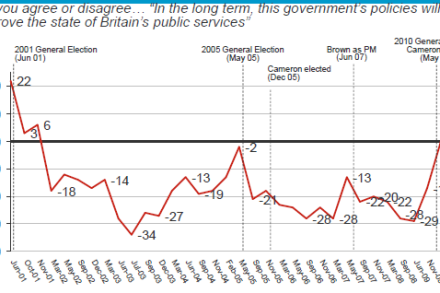
Guido has already highlighted one of the most important graphs from this Ipsos MORI treasure trove, showing that the public have overwhelmingly accepted the need for spending cuts. But this other graph forms a striking companion piece: Sure, the public may be split on whether the coalition will be good for public services. But the main thing to note is that overall optimism is at its highest level since 2001 – and rising. Maybe, contra Brown and Balls, people are realising that you can get more for less.

Ambition should be made of sterner stuff

Few writers can make a silly season story read like official history, so it's worth drifting behind the Times’ paywall to read Rachel Sylvester on Boris and Dave's mutual emnity. It is no secret that BoJo and DC are united in rivalry, but Sylvester adds a second dimension with insider quotations - a mix of arch witticisms and savage partisanship. Here are several of many from today’s column: ‘Most people at Westminster assume that Boris — compared by one of his editors to Marilyn Monroe, “another egomaniacal blonde” — still harbours ambitions to lead his party.

Osborne emerges from the shadows

George Osborne has been quiet these past few weeks, tussling with ministers desperate to preserve some of their budget from his spending review. Today though, Osborne will emerge from the Treasury's recesses to launch a political attack on the ‘deficit denying’ opposition. Come on, Osborne will ask Darling et al, where are these £44bn of cuts you planned?   And answer comes there none, not even an incredible one. Labour’s refusal to countenance a spending review in government means it has very little to offer the spending debate in opposition.

The return of Alan Milburn

Frank Field, John Hutton and now Alan Milburn – the red tinges to the coalition mix are like a Who's Who of reforming Labour politicians. Milburn, we learn today, is to return to government as an adviser to David Cameron on social mobility. It's a role he should be accumstomed to, as he was tasked with writing a report on the issue under Brown. That time, his suggestions were buried by a government which didn't want to face up to the sorry facts. This time, you hope they meet with a more constructive response. But why wasn't a Conservative (or conservative) appointed? That's the question which Iain Dale asks over at his blog – and you can see his point. There are plenty of people on the right who could have stepped into the role, not least someone like Jill Kirby.

Whelan suggests Brown will turn up to Labour conference

A poll in today’s Daily Mail might have the Tories down to 29 percent (in part due to a very large number of undecideds) but it is Charlie Whelan’s interview blaming Peter Mandelson for Labour’s election debacle that is getting all the attention. In a fit of campaign nostalgia, CCHQ has tweeted out a bunch of lines from it. But I suspect it is the last Whelan quote in the piece that has them smacking their lips.  Whelan says, 'Labour has not fallen out of love with Gordon. Quite the reverse. If he tips up at the Conference - which I think he will - he'll go on stage and he'll be cheered to the rafters. This is hardly going to help the new leader of the Labour party, who’ll be announced on the eve of conference.

To Labour’s successors…

Following this morning’s coalition press conference, the Tories’ have released this video: Labour’s Legacy. It’s effective, especially in view of Labour’s continued refusal to acknowledge that Gordon Brown did to Britain what Peter Ridsdale did to Leeds United, albeit on a grander scale.

Strange bedfellows

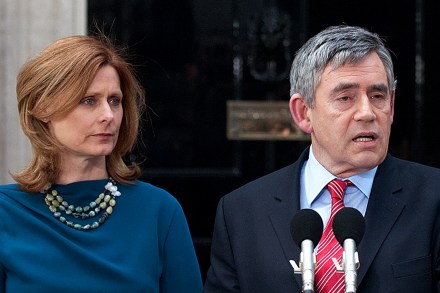
As the row over Naomi Campbell’s testimony at Charles Taylor’s war crimes trial fills up acres of space in the newspapers and hours of airtime for the news channels, I can’t help but remembering the friendship between the model and Sarah Brown. Brown even selected Campbell as her 21st century heroine in a 2009 Harpers Bazaar poll, praising her as a “loyal friend”. Now, it should be stressed that the work Brown and Campbell did together was for a series of worthwhile causes, improving maternal health and helping Haiti post-earthquake. But it struck me as surprising at the time that a savvy former PR woman married to the Prime Minister chose such a controversial friend.

Huhne backs nuclear energy through gritted teeth

You could almost hear the thumbscrews being tightened as Chris Huhne appeared on Today this morning to back nuclear power. The Energy Secretary has an, erm, patchy history when it comes to supporting nuclear – and that fact, coupled with his less than evangelical rhetoric on the matter in government, has got plenty of industry professionals worried. So there he was reassuring us that, actually, the first new nuclear power station is still on course for 2018. And he added, gritting his teeth no doubt, that "providing there is no public money involved, there will be a majority in the House of Commons favour of nuclear power stations.

Alan Johnson, summarised

What became of the likeable lads, that group of New Labour politicians who seemed more decent than the government in which they served? Alistair Darling was one, and he has effectively retired from the frontline of British politics. Alan Johnson was another, and today he gives a frank and wide-ranging interview to Rachel Sylvester. In it, Johnson spends much time cheerleading for David Miliband, and criticising Ed Miliband quite harshly, but there are some points which are worth recording. So here goes: 1) What a drag. As Sylvester puts it, "The [leadership] contest has, in [Johnson's] view, already gone on too long and should not have been extended until September." This is an opinion which many Labour types seem to share.

Brown, the third worst Prime Minister since WW2?

Now here's a poll that you can really get your teeth into. Reported in today's FT, a survey of 100 or so academics has rated Gordon Brown as the third worst Prime Minister since the second world war. It marks him with 3.9 out of 10, ahead of only Sir Anthony Eden and Sir Alec Douglas-Home. At the other end of the scale, Clement Attlee comes out on top with 8.1 our of 10, ahead of second-placed Margaret Thatcher on 6.9. Which, as Tim Montgomerie says at ConservativeHome, is understandable enough – Attlee probably made a more indelible contribution to British life than anyone else on the list. I was struck by the context in which one of the survey's compilers placed Tony Blair's third-placed finish.

5 days that changed the country

Westminster has rewound the tape today, in anticipation of Nick Robinson's documentary on the coalition negotiations tonight. There's speculation about what Nick Clegg did or didn't say back in May; Anthony Seldon has a piece on Gordon Brown's side of things in the Independent; and Robinson himself has a summary article in the Telegraph. Much of what's revealed so far could already be pieced together from the Mandelson memoirs, as well as from Westminister chatter, but some of the new contexts are eyecatching. This, for instance, from Robinson, suggests just how important personality politics was during those days after the election: "Gordon Brown had not prepared a policy offer, nor got the backing of his Cabinet, nor developed a relationship with Nick Clegg.

Guess who’s back | 26 July 2010

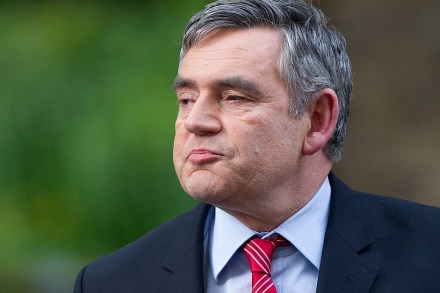
Oh look, Gordon Brown has continured his return to public life with a sizeable interview in today's Independent.  It's a generous portrait which seems designed to dispel any rumours about the former Prime Minister's wellbeing. Apparently, he "looks healthy and fit … seems quite cheerful." And we're treated to descriptions of his face, "like a map of a man's soul." For those who can read any further, there are accounts of his constituency work and his aspirations to "do more on international development". The world shudders. Despite his claims to the contrary, there are ominous signs that Brown is keen to impact upon our national politics.

Clegg’s revolution

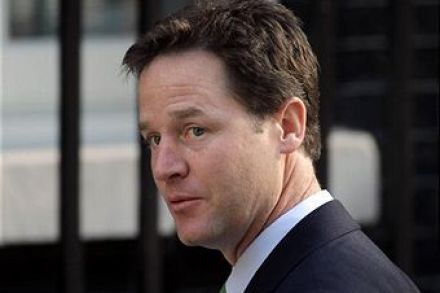
At last, Nick Clegg got his chance to pretend to be PM today and he used it to give a dazzling impression of Gordon Brown.  Opposing him, Jack Straw was off-colour. Hoarse of throat and hunched of stance, he did his best to bring some clarity to Britain’s new mission in Afghan - Operation Leg It. He asked if the exit date of 2014 was ‘absolute or conditional’. Keen to offer value for money Clegg responded to a single question with two answers. He expected ‘no troops in a combat role’ by 2015 – not 2014 – although our departure was dependent on the Afghans’s ability to secure their own country. ‘Conditional then,’ said Straw repeating his question. Clegg repeated his double answer.

All for show?

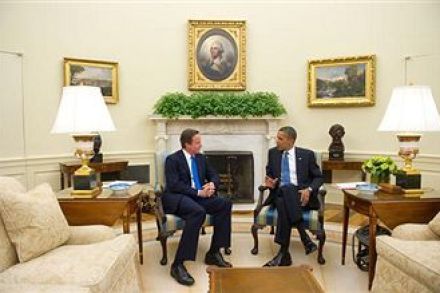
Gordon Brown will be seething, and with some justification: he never got photo-ops like these with Barack Obama. Shots of a cosy chat in the Oval Office are usually reserved for Benjamin Netanyahu, following the latest impasse between Israel and America. The Obama administration has gone to great lengths to repair the damage it did to Anglo-American relations at the start of its term. The President was all sparkle and bonhomie during the joint press conference, and he was careful to name-check ‘The Truly Special Relationship’ twice. Obama may be faking it but he looks comfortable with Cameron. He has always given the impression of being a cold fish, short on empathy, and I suspect he objects to leaders fawning at his throne.

Osborne keeps it simple

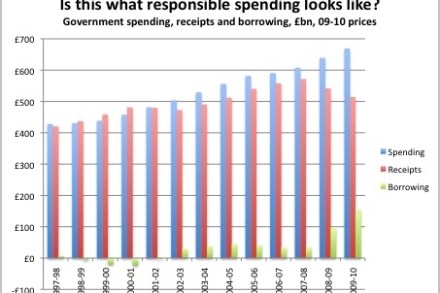
George Osborne has talked of simplifying the tax system for years, and today he launched the OTS, The Office for Tax Simplification. The OTS will be chaired by Michael Jack, s Treasury minister in the Major government, and John Whiting of PWC and Chartered Institute of Taxation. The OTS looks suspiciously like a quango, but some public bodies are necessary and welcome. The tax system is unintelligible, and, needless to say, Gordon Brown complicated it further with morass of stealth taxes, tax credits and new loopholes opened more by chance than design. This has particularly affected small businesses and the OTS will identify salient businesses taxes and recommend their simplification. That can only assist hard-pressed small businesses.

International development’s statist underpinning

Why increase aid to Afghanistan by 40pc when troops are dying from a lack of body armour and helicopters? The pledge to not just protect but vastly increase the aid budget is one which, polls show, leaves the public puzzled.  I was on the Politics Show with Jon Sopel, who was putting to Andrew Mitchell some very sharp questions about all of this. Why build schools in Afghanistan, but cancel them in Britain? Worse, in fact, DFID has a habit of building schools but not finding teachers for them - its ideology states that teaching should be a job for central government, just like it is in Britain. The Afghan government is corrupt and pays a pittance for teachers, who can usually earn more as translators for other foreigners, etc.

Mandelson’s miscalculation

Peter Mandelson’s decision to support Gordon Brown right to the end enabled him to cease being a purely factional figure in the Labour party. The multiple standing ovations he received at the last Labour conference were a recognition of that. As he put it, he was now the prince of stability not darkness. It was easy to see how Mandelson could become one of the elder statesmen of the party. But The Third Man has thrown all this away. Mandelson is once more a highly factional figure. He has admitted that he wouldn’t have stopped his Cabinet colleagues toppling Brown if they could have and that Labour would have done better at the election under a different leader.