Germany

Merkel & Sarkozy have only words

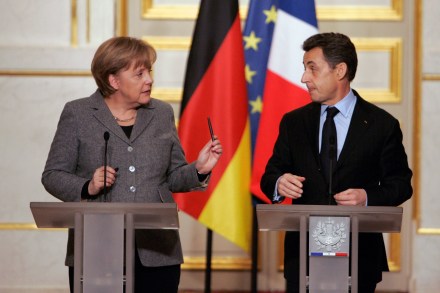
It was something of a mystery. Emergency conference calls about the future of the Eurozone were being made yesterday, but there was no news of those discussions. As it turned out, this was for the best of all possible reasons: there was no news to report. Angela Merkel and Nicolas Sarkozy announced no new measures to alleviate the sovereign debt crisis; rather, they merely declared “solidarity” with Greece and assured the markets that Greece would not be forced from the single currency. Their words seem to have assuaged the markets for the moment, but only the most brazen optimist would bet on the rally being long lived. Tests of confidence

The Euro-crisis heats up

Angela Merkel, Nicolas Sarkozy and George Papandreou are in crisis talks about Greek debt. There are rumours that they are preparing an “orderly default” for Greece. But, officially, Merkel is still pressing ahead with implementing the existing Greek debt deals. This meeting also has a domestic context for Merkel. According to the FT, she is determined to stamp on the growing disquiet within her governing coalition over the Eurozone crisis and is pleading for calm resolve. It remains to be seen if she succeeds.  The danger of contagion within the Eurozone remains and concerns about the exposure of French banks persist, which is doubly worrying for Nicolas Sarkozy given the proximity

Resignation provides a Stark reminder of the divisions within the eurozone

The problems facing the eurozone have been underlined by the departure from the European Central Bank yesterday of its senior German representative, Jürgen Stark. Stark, who is in essence the bank’s chief economist, has quit its six-member executive board. The ECB is saying that he’s leaving for personal reasons but it is widely suspected that he’s really off because he can’t accept the bank’s policy of buying up the debt of embattled eurozone economies.  Stark will almost certainly be replaced by another German. Given the current political dynamics there, it is almost certain that whoever succeeds Stark will take an equally dim view of the ECB purchasing bucket loads of ‘olive

Merkel’s domestic difficulties threaten the Eurozone

As August draws to a close, Europe is bracing itself for a series of September sovereign debt crises. Events in Germany at the moment have the potential to make these crises into events that could break the back of the Eurozone. As Ambrose Evans-Pritchard reports, Chancellor Merkel might not have the votes to push the European Financial Stability Facility through the German parliament. Merkel is currently under attack from all angles in Germany. Helmut Kohl has criticised her foreign policy, while the German president has implied that she should not have let the European Central Bank buy up so many poor quality bonds. It is now possible to see her coalition

Further tension in the Eurozone

The Eurozone’s political crisis is deepening. Further to the news that individual member states were seeking their own bilateral deals with Greece to insure their taxpayers’ money from default, the FT reports that disagreements are emerging over how these deals should be conducted. Holland objects that Finland’s accord with Athens relies on Greece using EU bailout funds as collateral. “The Netherlands is no supporter of this proposal,” Jan Kees de Jager, the Dutch finance minister, said. “It is not compatible with the principle of equal treatment of all euro countries.” Moody’s, the credit rating agency, has said that this affair “confirms that Europe is conflicted over the very decision to provide financial support

This isn’t just any solution; this is an M&S solution

Banks and financial institutions endured a painful day’s trading, following Angela Merkel and Nicolas Sarkozy’s announcement yesterday that the Eurozone should adopt a ‘Tobin tax’, a charge on financial transactions. Once again, M&S chose piecemeal changes over the grand structural scheme desired by markets. The Tobin tax was just one proposal of three. The other two were: to create “genuine economic governance of the Eurozone” under, for the moment, EU President Herbert van Rompuy. The second: to impose a ‘Golden Rule’ on the budgets of Eurozone members. The ‘Golden Rule’ will bind national parliaments to agree to limits on national debt levels and impose statutory requirements on mastering budget deficits. The

Battle of the century

The American historian Walter Russell-Mead has a cynical — but very possibly accurate — take on what the French are trying to persuade the Germans to accept with their plan for Eurobonds: ‘France’s clear short term goal is to commit Germany to underwrite debts from weak EU states.  That not only staves off a crisis that threatens to engulf France; by putting Germany on as a co-signer for Greek, Italian and Spanish loans, France will ensure that Germany’s credit rating will not be better than France’s. The French will accept almost any German rules to limit the ability of countries like Greece to run up new debts.  It is in

Back to the drawing board as Eurobonds look dead in the water

Watch her lips: no Eurobonds. Angela Merkel’s Finance, Minister Wolfgang Schauble has told Der Spiegel: “I rule out Eurobonds for as long as member states conduct their own financial policies and we need different rates of interest in order that there are possible incentives and sanctions to enforce fiscal solidity.” Merkel’s government is making its depositions ahead of tomorrow’s Eurozone summit, rebutting the moves made by other member states over the weekend to introduce Eurobonds, a step towards political integration. Those proposals were backed by Nicolas Sarkozy, with whom Merkel is meeting in private this afternoon. Interestingly, Le Monde reveals that Eurobonds are not even on the agenda of these

What was it like at the time?

At midday on Thursday, 8 June 1933 — Erik Larson is very keen on his times — the newly elected President Franklin D. Roosevelt had a call put through to the history department at the University of Chicago. At midday on Thursday, 8 June 1933 — Erik Larson is very keen on his times — the newly elected President Franklin D. Roosevelt had a call put through to the history department at the University of Chicago. Since taking office in early March Roosevelt had been trying to fill the post of ambassador to Berlin, and with none of the usual suspects prepared to take on the job and Congress on

Is Merkel getting her way?

Below, courtesy of the Telegraph, is a leaked copy of the draft proposals on managing the Greek debt crisis.There are no measures to reduce Greece’s debts to sustainable levels; subsidy is the preferred route. This will presumably hit German taxpayers the hardest, but Merkel has managed to obtain private sector involvement, a clear German objective in these discussions.  However, this course is likely to lead to Greece’s selective default as creditors buy back bonds. The European Central Bank has declared that it is happy to allow this and will continue to accept government bonds in the event of sovereign default. This is a major retreat from its earlier position and commentators are clear that the Eurozone is now flirting

Common Franco-German position on Greek debt

As I wrote earlier this morning, rumours of a ‘common Franco-German position’ on Greek debt were circulating in the early hours. Details are now emerging. Nicolas Sarkozy has dropped plans to impose a 0.0025 per cent levy on Eurozone bank assets, which was opposed by Angela Merkel for being much too cumbersome. In return, it seems that Merkel is prepared to consider the French-led plan of bond rollover. Merkel is also keen that private sector holders of Greek bonds pay their share of this second bailout. According to the FT, she favours a bond-swap deal, whereby bonds that will mature in the next eight years are swapped for new 30 year bonds paying a

Getting a grip of the crisis

“I’m very worried, this building [the Treasury] is very worried and this government is very worried,” said George Osborne of the unfolding crisis in the Eurozone. In an interview with the FT, the chancellor goes on to say that he is in constant contact with his continental counterparts and urges them once again to “get a grip”. Eurozone leaders are meeting today to discuss further loans to Greece. Three options are being considered: first, an extension of the European Financial Stability Facility; second, private sector creditors re-lend money for a longer period and at a lower rate; third, impose a tax on banks to secure revenue for Greece. Despite a

Euro crisis enters a new phase

It was a problem that would be fixed with a snap of the Commissioners’ manicured fingers, but now fresh euro-storms are louring in the near distance. As predicted over the weekend, the markets reacted to the European Banking Authority’s deeply flawed stress tests with fevered concern and a clear note of contempt. The FTSE shed 90 points yesterday, with banks among the day’s biggest losers. The performance in Frankfurt and Paris was equally baleful, as investors fled for safe commodity stocks. As Fraser has noted, Allister Heath argues that the Eurozone crisis is responsible for the booming price of gold. The markets have recovered slightly this morning; but that does

Inadequate stress test inspires anti-EU sentiment across Europe

Yesterday’s European Banking Authority (EBA) stress test was supposed to restore confidence in the euro and Europe’s beleaguered financial institutions; it has had the opposite effect. Investors and market analysts are preparing for ‘Black Monday’ after only 8 banks failed the test and must now raise £2.2 billion between them to stave off ruin. A respected estimate by Goldman Sachs expected at least 15 banks to fail, requiring £29 billion to recapitalise. As the Spectator’s business blog reported yesterday, analysts feared that the EBA’s test would not be sufficiently stringent, and so it came to pass. The findings have served only to undermine confidence in institutions across the continent, many of

Stand up for freedom and freedom will stand up for you (eventually)

It was hard to be a supporter of U.S. President Ronald Reagan in Western Europe. As a student living in West Germany at the time, I remember well the commonly held view of him: B-rate actor who read cue cards, a nuclear-weapons-obsessed warmonger, and not very bright to boot. Never mind that he had also been a popular two-term governor of the most populous state in the U.S. (California), because that did not fit with the bumbling cowboy narrative. When he called the Soviet Union “the evil empire” the chattering classes saw it as simplistic, unsophisticated and cringe-worthy. Not so the people caught behind the Iron Curtain who silently cheered

In for a penny, in for a trillion

The news that the EU seeks a budget of £1 trillion between 2013 and 2020 inspired disbelief rather than ire. President Barroso’s almost childlike insistence that the proposal was ‘relatively small’ was amusing, certainly not alarming. It’s a classic EU trick: pitch for 5 per cent and a string of crazy financial measures (including a ‘Tobin tax’ on financial transactions) in the hope obtaining more modest gains of say 2 per cent. Barroso will also throw the odd concession into the bargain: the announcement of a £5.4bn saving on the Commission’s staffing costs represents a concession. But, Barroso has his work cut out to secure even a 1 per cent

Can Cameronism be Europeanised?

In 1997 New Labour was not just a domestic programme; it was a foreign policy too. Known as the “Neue Mitte” in Germany, Blair’s Third Way soon attracted such converts as the German chancellor, the French prime minister and the Danish leader. In the end, it produced few results for Britain, failing – much as Harold Wilson did in the 1970s – to curry favour for the UK through party political links with other leaders. But for a few years, much as New Labour looked across the Atlantic to the Democratic Party, so Europe’s Social Democrats looked across The Channel. International recognition for his deficit reduction plan notwithstanding, David Cameron

Greece on the precipice

Europe is a doom-monger’s paradise at the moment. Riots in Greece; summary Cabinet reshuffles; meetings between Merkel and Sarkozy to save the single currency — and there’s still the potential for things to get worse, much worse. If the Greek government defaults on its debts, then there’s no knowing where the contagion will spread, only that it it will spread wide: from Spain and Portugal to markets across the world. Share indices have already been trembling at the prospect, although many of them rallied slightly today. One consolation, however scant, is that all this crystallises just what can happen to governments who operate beyond their means. Indeed, this seems to

The Lucifer Effect

Today’s papers are full of comment on the brilliant Panorama exposé of care home abuse. But none have mentioned what jumped out at me: the parallels between this and the Stanford Prison Experiment. The way that the tattooed Wayne treated his mentally ill patients is sickening — but, to me, this is not just a story about human evil. It’s a story about how institutionalisation brings out the evil in people, and that this evil is far closer to the surface than we like to admit. Philip Zimbardo, a psychology professor at Stanford, randomly divided 25 volunteers to play the roles of prisoners and guards in a poorly-regulated, mock prison.

The Euro’s uncertain future

Martin Wolf’s column on the eurozone today does a superb job of summing up its troubles. As Wolf says, “The Eurozone, as designed, has failed.” Keeping its current arrangements is simply not an option for the eurozone. Wolf concludes that: “The eurozone confronts a choice between two intolerable options: either default and partial dissolution or open-ended official support. The existence of this choice proves that an enduring union will at the very least need deeper financial integration and greater fiscal support than was originally envisaged.” The question now is essentially whether Germany and other prosperous eurozone countries are prepared to embark on further integration and a programme of fiscal transfers