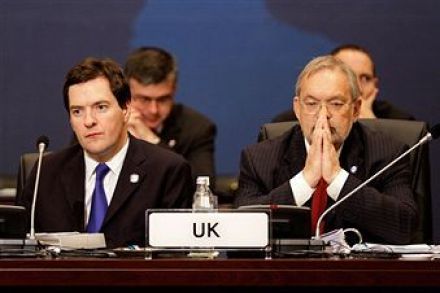
George osborne

The inflation crisis deepens

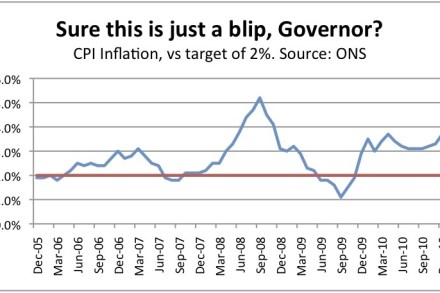
How big does inflation have to get before our politicians admit that it’s a problem? Once again, it has “surprised” on the upside - the CPI index stood at 3.7 percent for December, against a supposed target of 2.0 percent. And the RPI index, which the nation called “inflation” until Gordon Brown asked the media to use CPI instead, is running at 4.8 percent - almost twice its former target of 2.5 percent. That is the painfully high figure to which George Osborne has just added a juicy VAT increase, which is bound to take CPI above 4 percent. Inflation has been above target for three of the last four years - and still Mervyn King says it’s a blip. This is how he justifies the UK’s low interest rates (0.
Leader: King’s ransom

When George Osborne decided to raise VAT, more months ago than he will admit, he did not imagine that he would be compounding the worst inflation in Western Europe. Prices are currently falling in Ireland, flat in Germany and rising only slightly throughout the rest of the Eurozone and America. But in Britain, inflation is back with a vengeance. This week, millions of shopkeepers raised prices by far more than the 2.1 per cent needed to accommodate the new tax. They did so not out of greed, but in preparation for a year of rising heating, staff and transport costs. The shopkeepers realise what Mervyn King, the Governor of the Bank of England, does not: that Britain is once again in an inflationary spiral. The Retail Price Index stands at 4.7 per cent.

The right has little cause for alarm

It is to his credit that nuance is a word inimical to Lord Tebbitt. The unashamedly independent voice of the past has written a cutting piece about the coalition, the Lib Dems and the Oldham East by-election. He says: ‘A Lib Dem win would tilt the Coalition even farther Left and away from Conservative policies.’ Many Tory ministers joke that they thought themselves right wing until meeting their Liberal colleague. This is a radical government that many on the right can cheer.

Clegg: Read my lips…

This comment from Nick Clegg – speaking to the Evening Standard today – deserves pasting into the political scrapbook: “Let me be absolutely clear once and for all. The Liberal Democrats will fight the next election as we did the last – as an independent political party in every constituency in the country.” Which is considerably less equivocal than David Cameron and George Osborne have managed recently. When the Tory pair were pressed on the matter towards the end of last month, they said only that they "expect" the coalition parties to fight independently of each other come election time. Not that the Clegg quotation rules out electoral chicanery altogether.

The VAT argument bubbles along

Today has been one of predictable political sparring over the VAT increase. But, as one Tory MP said to me last night, the crucial question is how long people keep talking about it. If the public come to blame the VAT rise for every price rise they encounter—as Ed Miliband wants them to—then the coalition has a problem. But if the new VAT rise just becomes a fact of life then the coalition will pay a low political price for the rise. Indeed, if the VAT rise ends up helping provide money for an income tax cut later in the parliament then the coalition could actually benefit from it. (Note Osborne's last answer to Evan Davis this morning.) Alan Johnson, the shadow Chancellor, has not had a good day.

Will Osborne be vindicated in 2015?

VAT, VAT, VAT – but what's this? The main headline on today's FT doesn't mention the sales tax at all, and the piece below it only does so in passing. Instead, a declaration that "UK austerity measures [are] expected to pay off," based on a survey of economists conducted by the paper. Although those polled have concerns about inflation and the eurozone, only 13 percent say that George Osborne needs a Plan B for dealing with the public finances. As always, we shouldn't place too much stock in this kind of thing. Some economists will back the coalition, others will back Labour; some will be right, others will be wrong. But, today of all days, the coalition will appreciate a presentational leg-up such as this.

Osborne and Johnson battle over the new tax divide

Now here's a thing: a radio appearance by Alan Johnson that actually clarified some details about Labour's economic policy in the Miliband era. Sure, the shadow chancellor spent most of his time on the Today Programme setting about the coalition's VAT hike, with all the usual arguments about jobs and growth. But there was also confirmation that Labour's deficit reduction plan would split 60-40 between tax rises and spending cuts, and that they would raise national insurance levels rather than VAT. It repositions the argument some way beyond the simple Do/Don't divide that was developing around VAT. Now there are two choices for voters to make. Do they prefer a deficit reduction plan which, for the first time, emphasises tax hikes over spending cuts?

Rising costs: a problem for the public and the coalition in 2011

Ne’er mistake correlation with cause, I know. But, during the Brown premiership, the correlation between petrol prices and poll ratings was still pretty striking. Mike Smithson graphed it early last year, but the basic story was this: the Tories enjoyed their biggest poll lead over Labour when petrol prices were at their highest, and Labour closed the gap to only 1 percent when petrol prices were at their lowest. At the very least, it gives us a hypothesis to work from: prices up, the government suffers; prices down, the government recovers. And it looks as though we’ll be able to test that hypothesis soon enough. Today’s Express reports that – thanks to rising VAT, fuel duty and oil prices – petrol may soon soar to £1.40 a litre.

An 80 percent elected Lords would not be a Lib Dem triumph

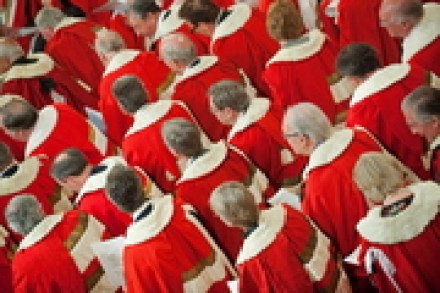
The Lib Dem manifesto committed the party to a fully elected House of Lords. The Tory manifesto talked about a ‘mainly-elected’ second chamber and in 2007 David Cameron voted for ‘the other place’ to be 80 percent elected (interestingly, George Osborne voted for a fully elected Lords). The coalition agreement committed the government to a ‘wholly or mainly elected upper chamber’. So it is hard to see how a Lords that retained a twenty percent appointed element could be portrayed as a major Lib Dem triumph as, according to today’s Guardian, the coalition wants. There has been talk in Westminster that Clegg’s consolation prize if the AV referendum is defeated will be a fully elected Lords, a long-standing Liberal aim.

Minor indiscretions

The Telegraph’s latest Lib Dem revelations are embarrassing for the ministers concerned, but won’t cause the coalition much trouble. Ed Davey is caught being critical of the announcement to take child benefit away from higher-rate taxpayers and expressing concerns about the changes to housing benefit. Michael Moore, the Scottish Secretary, is captured expressing regret about the Lib Dem u-turn on tuition fees and saying he couldn’t work with Tories like Liam Fox "for very long." Steve Webb, the highly numerate pensions minister, was trapped into revealing that he had written to the Chancellor about the child benefit changes because "the details aren’t right." There are, the Telegraph tells us, more of these revelations to come.

A tale of two quads

There could barely be a starker contrast between Danny Alexander's interview with the FT today and the, ahem, Cableleaks. Unlike his fellow Lib Demmer, the Treasury Secretary knew that he was speaking to a journalist – and he keeps well within the lines when discussing the coalition. "My impression," he says, "is that the Liberal Democrats support the coalition. People knew the first couple of years would be extremely tough." Alexander saves his most enthusiastic rhetoric for the quad: the group of four ministers – David Cameron, George Osborne, Nick Clegg and himself – who met regularly during the spending review period to decide where the cuts would fall. As he puts it, "it was a very effective way of making sure the government is joined up".

Dissecting operation Coulson

Tom Baldwin's inaugeration as Labour spin guru occasions Tim Montgomerie to appraise Andy Coulson. For many, Coulson has committed the spin doctor’s cardinal sin and become the story, and not just his more voluble opponents on the left. Tim rejects that analysis, but concedes that Coulson may drift to pastures new in 2011. Coulson’s record is quite impressive. He snared the tabloid press, and, together with George Osborne, ended Gordon Brown’s short honeymoon, exposing the Labour leader’s indecision with well-timed tax cut promises. The Election That Never Was spawned a far more enduring theme: Labour’s internal fissures and the timidity of its senior figures. If Coulson goes, that will be his legacy.

Access all areas | 18 December 2010

It is an exciting day for Liberty Osborne, the Chancellor’s daughter, to join him at work. The windows at HM Treasury are boarded up, workmen line the road replacing the bombproof (but not student-proof) glass. Graffiti defaces the walls, but although several politicians are named and shamed in spray paint (‘Why did Nick Clegg cross the road? Because he’d promised not to’) there is nothing unkind about the author of the cuts: George Osborne himself. When we meet the Chancellor at 10.30 a.m. in 11 Downing St, he does not look the slightest bit like a man under siege. Seven-year-old Liberty bounds out of his study, waving at us cheerfully. The Chancellor is no less upbeat.

Clegg turns his attention from the students to the banks

'Tis the season to bash a banker – or it is if you're a Lib Dem, at least. After the stresses of last week, Nick Clegg lets off steam with an aggressive interview in the FT. "They don't operate in a social vacuum," he says of the City's moneymen, before seething that, "it is wholly untenable to have millions of people making sacrifices in their living standards, only to see the banks getting away scot-free." He even suggests that the government should consider a one-off bonus tax, like that introduced by Labour last year.   Will anything come of it? On the evidence so far, probably not. The coalition – from Vince Cable to George Osborne – has certainly not shied away from tough rhetoric on lending and bankers' bonuses.

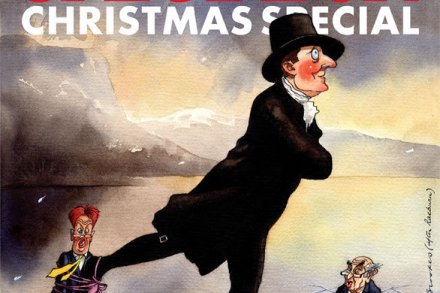
The Spectator’s Christmas interview with George Osborne

The Christmas Special of The Spectator is out today, and George Osborne kindly agreed to an interview. We have printed 1,500 words in the magazine, but James and I thought CoffeeHousers may like a fuller version, where he has more space to speak for himself.  We have gone into way more detail on tax policy here than in the magazine, for example, as Osborne is seldom pressed on this point and his thoughts are very interesting. We have divided it up by subject headings, so CoffeeHousers can skip the chunks they’re not interested in.   Liberty, paternity and Treasury It is an exciting day for Liberty Osborne, the Chancellor’s daughter, to join him at work.

The coming battle over Mainstream Conservatism

It's not just the students who are waging a political struggle. In yesterday's Times (£), Tim Montgomerie fired up a debate over the future of the Conservative Party that will no doubt simmer through the rest of this Parliament. For those who can't delve behind the paywall, the argument was broadly this: that a tension is emerging between liberal Conservatism and a more traditional Conservatism. On the side of the Liberal Conservatives are those who want to extend the union with Nick Clegg and his party; a group which may well include the Tory leadership. On the other side are those who want the Tories to go it alone after the next election, with a more traditionally Tory policy platform.

Can the public purse get some of its money back from PFI contractors?

Asking PFI contractors to voluntarily give back some of the money that they are due from the government might seem like rather a hopeless task. But the PFI-Rebate campaign launched today by Jesse Norman, one of the smartest of the new intake of Tory MPs, has a better chance of success than appears at first blush. Norman is pushing for the contractors to take a 0.5 percent cut which they might well decide is worthwhile to deal with all the negative publicity that further scrutiny of PFI would bring. If these contractors want to take the PFI model global, then they can’t really afford the kind of coverage that a prolonged campaign would bring.

The Guardian’s Wiki-spin

In today's Wikileaks revelations, it is Mervyn King's turn to be pushed through the mill. Did he act politically when pushing for a deficit reduction plan? Was he critical of David Cameron and George Osborne or just pointing out the obvious: that the Tory leaders had not held power before and - shock horror - were keen to get elected? The Guardian's reading of the cables suggests that the government's Batman and Robin (to keep with US diplomatic style) were unprepared for the task ahead. But re-read the key passages and it is clear that Cameron and Osborne were no different from any other opposition leaders - reliant on a small staff, and unprepared for the special pleading they would face as they entered government and tried to cut the deficit.

Osborne airs the Tories’ election message

George Osborne’s autumn statement previewed what I suspect will be the coalition, or at least the Conservatives, re-election message. ‘This government has taken Britain out of the financial danger zone and set our economy on the path to recovery.’   Today’s OBR forecast was a boon for the Chancellor. It suggests that there won’t be a double-dip recession, as his critics suggested there would be. The improved economic numbers allowed him to come to the House and declare that the deficit reduction ‘plan is working’, and that already the coalition has saved the country £19 billion in debt interest. Alan Johnson was his usual self in response.

Osborne saves his glad tidings for another day

Courtesy of Paul Waugh and the Standard, the OBR projects there to be a £6bn budget surplus by 2015-16. There was no fanfare to herald this in George Osborne’s statement, which was a litany of dirge-like thanksgiving for catastrophe averted. The Treasury is now describing the figure as being 'within the margin of error’, which is fluent Sir Humphrey-speak. The Standard’s discovery is another example of the government deliberately hiding good economic news - in what Fraser terms Osborne's Paul Daniels Act. Now why, I wonder, would a self-confessed tactical obsessive, who just happens to be the Chancellor of the Exchequer, be doing that?