George orwell

Reluctant servant of the Raj: Burma Sahib, by Paul Theroux, reviewed

From our UK edition

Eric Blair, to give George Orwell his baptismal name, arrived in Burma (present-day Myanmar) as a 19-year-old trainee police officer at the end of 1922 and left it in mid-1927 just before his 24th birthday. Not much of his time there had a direct impact on his work beyond a solitary novel, Burmese Days (1934), two luminous essays, ‘A Hanging’ (1931) and ‘Shooting an Elephant’ (1936), a poem or two and a scattering of autobiographical fragments, most of which turn up in the second half of The Road to Wigan Pier (1937). None of his letters home survives and only a handful of reminiscences by people who knew him as a servant of the Raj.

In praise of George Gissing, the born exile

George Gissing died just over 120 years ago, marooned in the French Atlantic resort of Saint-Jean-Pied-de-Port and in circumstances that might have been plundered wholesale from one of his notoriously ground-down novels. H.G. Wells, present at the scene, was so affected by his friend’s deathbed ravings that he transferred them word for word into the mouth of Uncle Ponderevo as he lies dying in Tono-Bungay (1909). There are Orwellian shadings: like Gissing, Orwell died at forty-six of lung disease, and was profoundly influenced by his Victorian forebear. It was Anthony Powell who remarked of Orwell’s third novel, Keep the Aspidistra Flying (1936) that “the Gissing had to stop.

gissing

The 2024 regime referendum

The 2024 election will be a referendum on Joe Biden, but it’s also a referendum on a regime. This is how both sides see it. Liberal democracy itself is at stake according to progressives. For Trump supporters, the question at issue is legitimacy of the Deep State. These are different names for the same thing: a leadership caste and its ideology of government. In practice, liberal democracy means a democracy in which liberals never lose power.

regime

Sandra Newman: Julia

From our UK edition

38 min listen

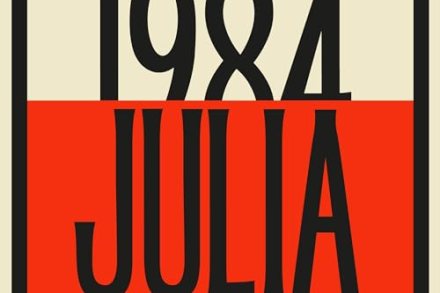
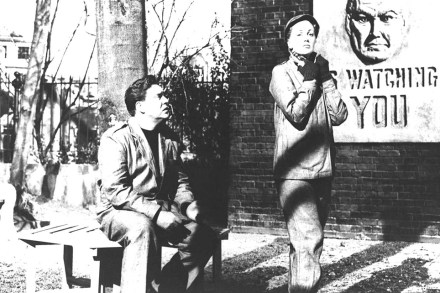
My guest in this week’s Book Club podcast is the novelist Sandra Newman, whose new book Julia retells George Orwell’s Nineteen Eighty-Four from Julia’s point of view. We discuss the spaces Orwell’s classic left for her own novelistic imagination, what we do and don’t know about the world of Big Brother, and whether the misogyny in Orwell’s original belongs to the author or the dystopia he depicts.

Back to the world of Big Brother: Julia, by Sandra Newman, reviewed

From our UK edition

Sandra Newman’s Juliahas a connoisseur’s nose for body odour. When she gets close to another person or animal, she almost always notices their smell – manly, dusty, dungy, a hint of talcum powder. When she suppresses emotion, she sweats. She sprains her wrist and tears rise ‘of themselves like sweat’. In a pivotal scene, she unblocks a gruesomely overflowing toilet. This abundance of bodily functions feels like a reminder of George Orwell’s original Julia in Nineteen Eighty-Four, whose physical abandon makes her an object of desire and symbol of rebellion. This fantasy is punctured in Julia. Bodies are sensuous but they are also skin-crawlingly horrible. Mutilated wrecks, with teeth and nails removed in the Ministry of Love, creep around London on all fours.

Russia’s long history of smears, sabotage and barefaced lies

From our UK edition

Russian politicians often refer to something called the Dulles Plan. This document purports to capture the future CIA chief Allen Dulles explaining, in 1948, the US strategy to destroy the moral foundations of the USSR and bring about ‘the death of the most intractable people on Earth... the definitive, irreversible dying out of its self-consciousness’. If this sounds like a fictional villain’s expository monologue then that’s because it is. The text was taken from an antagonist’s speech in a 1971 novel, Eternal Call, which itself recalled a much earlier Russian forgery, the anti-Semitic Protocols of the Elders of Zion.

George Orwell’s unacknowledged debt to his wife Eileen

From our UK edition

Anna Funder, the author of Stasiland, is a premier-league writer who can roll fiction, reportage, criticism and memoir into glinting prose, her sentences like handheld treasures you keep turning over, admiring their graceful contours and crafted precision. Lately she’s published little. In fact Wifedom is a book wrenched from the swirl of domestic duties that drown out women’s voices – the lifeline, in this case, being a chance find at a moment of ‘peak overload’ when she stumbles on a rare edition of George Orwell’s collected non-fiction. Eileen’s fingerprints are all over Animal Farm, a book that displays a psychological acuity Orwell lacked Diving into his essay ‘Why I Write’, she looks for self-recognition and pauses over a sentence.

In praise of the suburban semi

From our UK edition

In 1939 George Orwell took aim at burgeoning British suburbia and its population of lower middle class lackeys in his novel Coming Up for Air, memorably describing the new homes being built on the fringes of cities as ‘semi-detached torture chambers where the poor little five-to-ten pound a-weekers quake and shiver'. More than eight decades on and the Office for National Statistics reports that one in three of us lives in a semi-detached home, an architectural style with a far longer and more interesting history than Orwell may have been aware of. They are also – officially - the hottest property type on the market. Analysis of more than 100,000 house sales over the past year by sales firm Property Solvers found that semis took an average of 150 days to sell.

Why is George Orwell so difficult to pin down?

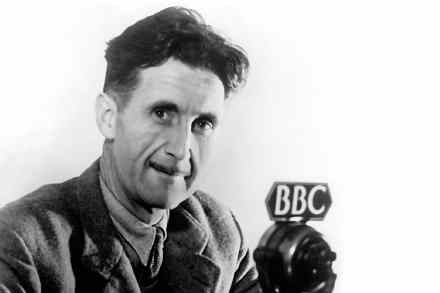
Outside Broadcasting House, the BBC’s main center in London, is an imposing, eight-foot-high statue of a man. He leans over slightly, as if to accost passersby, and holds a cigarette. A sign behind him declares, “If liberty means anything at all, it means the right to tell people what they do not want to hear.” The man is the author and critic George Orwell and the statue was intended as a permanent commemoration of his writings and values, as well as his short-lived stint at the BBC during World War Two.

orwell

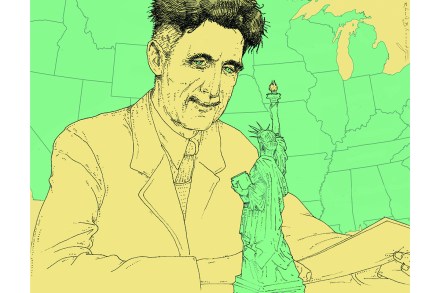
How America influenced George Orwell

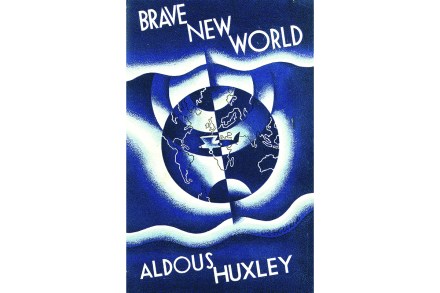
Some of the most tantalizing pieces of George Orwell’s journalism are the reviews written on the hoof, filed against deadlines, sent straight to the typewriter while World War Two raged above his head. One of them is a round-up of four reprinted dystopian novels supplied to the weekly magazine Time and Tide in July 1940, shortly after the fall of France. (Today, it’s rarely reissued and barely available outside the stout bindings of volume XII of Orwell: The Complete Works.) The four books are Jack London’s The Iron Heel (1908), H.G. Wells’s When the Sleeper Wakes (1910), Aldous Huxley’s Brave New World (1932) and Ernest Bramah’s The Secret of the League (1907).

orwell

When America makes Orwell look like an amateur

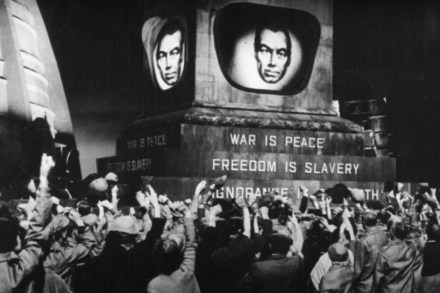
Under today's gathering dark clouds, a reread of Nineteen Eighty-Four shows how the otherwise prescient George Orwell was wrong to think people were going to have to be tortured into submission. Half of America (still psychologically locked down, vexed and vaxed) wouldn't have it any other way. The world of Nineteen Eighty-Four is grim in a way 2022 would understand. The people of Orwell's future want to be controlled. They have come to prefer it. Freedom from choice makes them feel safe. People accept being monitored, and their media being censored. They think of it all with a sense of the inevitable — the only way to stay safe if they think of it at all. The all-seeing telescreens in their homes and the snitches and spies embedded in their lives are for the better, really.

Why George Orwell’s ‘perfect pub’ deserves to be saved

From our UK edition

Eleven days after turning 45, I sent my first ever letter of complaint to the council. A real coming of (middle) age. The topic of my complaint? My local pub. I followed the British protocol for complaining – I made it clear I’m ‘dismayed’ and ‘appalled’ and hope people can ‘see sense’ – about an issue that has instilled such rage in me that a stiff drink is required. You see, my local, the Compton Arms in Islington, north London, is under threat of closure. This is no ordinary pub. Tucked away from the busy stretch of Upper Street, on a picture-perfect back road, is an establishment that has been serving the public since the 16th century, open near continuously since the 1800s.

How science fiction novels read the future

The pandemic is not quite over, but we are getting used to its inconveniences. What disaster will be next? An antibiotic-resistant strain of the bubonic plague? Climate collapse? Coronal mass ejection? Will the next catastrophe be natural — perhaps a massive volcanic eruption, the likes of which we have not seen for more than two centuries, since Tambora in 1815? Or will it be a manmade calamity — nuclear war or a cyberattack? And might we inadvertently descend into a new form of AI-enabled totalitarianism in our efforts to ward off such calamities? To all these potential disasters it is impossible to attach more than made-up probabilities. So what can we do about them? The best answer would be that we should strive to imagine them.

science fiction

The unfamiliar Orwell: the writer as passionate gardener

From our UK edition

This is a book about George Orwell’s recognition that desire and joy can be forces of opposition to the authoritarian state and its intrusions. To explore the theme, Rebecca Solnit has produced a sequence of loosely linked essays around the roses and fruit bushes the author of Animal Farm planted in 1936 in the garden of his modest Hertfordshire house. A Californian with more than 20 books behind her, Solnit opens this latest with a pilgrimage to Wallington, where Orwell’s Albertine roses have endured. The blooms instigate a reconsideration of the man ‘most famous for his prescient scrutiny of totalitarianism’, which in turn invites the author ‘to dig deeper’ and question ‘who he was and who we were and where pleasure and beauty...

The doctor is mad

I have been writing a lot about the politically inspired perversion of language. The name “Orwell” crops up in any such discussion, as does the word “Newspeak,” that twisted mode of language that Orwell outlined in the appendix to Nineteen Eighty-Four. The goal of Newspeak, Orwell said, was to replace standard English with a sharply diminished patois whose linguistic poverty was its prime political advantage. By reducing the suppleness of language, the elites who controlled society hoped also to reduce dissent — not only the activity of dissent, but also the thoughts and emotions that guided it. This has been a perennial dream of budding totalitarians, from the French Revolution to the varieties of communist tyranny.

medical

Can a criminal really be ‘prolific’?

From our UK edition

The BBC made a documentary about a man sent to prison for being the ‘most prolific rapist in British legal history’, in the words of Ian Rushton, the deputy chief crown prosecutor for North West England. To my ears, it sounds weird to call a rapist ‘prolific’. It sounds no better to refer to ‘one of the country’s most prolific serial killers’ as the Sun did last weekend. The difficulty is that the word still carries connotations of its Latin origin prolificus, ‘capable of producing offspring’. The Latin word was in use in Britain from the 14th century, and the English form developed only in the 17th century.

Modern English

The English language as written today is often nearly incomprehensible on first reading, and as spoken almost unintelligible and unpleasant to the point where the civilized listener disengages himself in frustration and disgust from the speaker and his speech. The problem in the first instance is the readiness of people who know better to embrace demotic usage in semi-formal literary venues, such as respectable journalism; the second, the bizarre combination of pretension and illiteracy and its results, the jargon and barbarisms ubiquitous in the 21st century.

English

Beyond 1984: why I’m listening to George Orwell

From our UK edition

One of the great things about touring in the age of audio books, is that you can use your time driving between gigs, with nothing more to concentrate on than other half-tons of steel and rubber hurtling down 'Smart' motorways at suddenly varying speeds, to really binge on reading. I’d long been meaning to expand my knowledge of George Orwell. I’m pretty familiar with his better, or at least better known, essays and I have of course regularly scaled his Two Last Peaks, Animal Farm, and 1984. I've read Animal Farm so often that it has become a sort of catechism, and if it had a tune I could probably sing it right through.

How two literary magazines boosted morale during the Blitz

From our UK edition

William Loxley’s lively account of ‘Bloomsbury, the Blitz and Horizon magazine’ begins with W.H. Auden and Christopher Isherwood emigrating to the United States in January 1939 and ends with George Orwell dying in University College Hospital in January 1950. Between these two events Loxley explores the often interconnected professional and personal lives of a number of British writers, publishers and editors — principally Orwell, Leonard and Virginia Woolf, Cyril Connolly, Stephen Spender, John Lehmann and Dylan Thomas — during the second world war and its immediate aftermath.

How the International Brigades were ‘thrown into the heart of the fire’

From our UK edition

During the Spanish civil war of 1936 to 1939, 35,000 men and women from around the world volunteered to fight against the forces of General Franco and his supporters from Fascist Italy and Nazi Germany. When the volunteers were withdrawn in September 1938 after two years of bitter fighting, more than a fifth of them had been killed and very few emerged unscathed. Conflicts are by definition binary affairs, so it’s inevitable that bitterly contrasting views of the role of the International Brigades have existed ever since the civil war itself. For the volunteers and their supporters, their sacrifices were a ‘heroic example of democracy’s solidarity and universality’.